



If you run a law firm, you already know how competitive online search has become.
Keywords like "personal injury lawyer near me" can cost more than $100 per click in paid search. Every firm, from solo practitioners to regional powerhouses, is competing for the same handful of spots on page one. And with AI tools like ChatGPT, Perplexity, and Google's AI Overviews now answering legal questions directly, the definition of "showing up" has expanded considerably.
The firms winning online are investing in both SEO and Answer Engine Optimization (AEO): the practice of structuring your authority so you appear not just in traditional search results, but in the AI-generated answers that are rapidly becoming the first place people research legal help.
This guide covers both. We'll walk through what makes legal SEO uniquely difficult, what it takes to rank competitively, and how the link-building and authority signals that move Google rankings are the same ones that get law firms cited by AI.
Why Legal SEO Is a Different Game
Legal SEO sits in a category Google calls YMYL: "Your Money or Your Life." These are websites where the quality of information can have real consequences for people's finances, safety, or legal standing. Google holds YMYL content to a significantly higher standard than most categories.
What that means practically: publishing keyword-optimized content is not enough. Your site needs to demonstrate genuine expertise, visible authority, and external validation. Google calls this framework E-E-A-T, covering Experience, Expertise, Authoritativeness, and Trustworthiness.
Attorney bios need to be credible and detailed. Content needs to reflect real legal knowledge. And your backlink profile needs to come from authoritative sources, not generic directories or link farms.
The AEO connection is direct: AI systems like ChatGPT and Perplexity are trained on web content and learn to associate sources with authority in specific domains. A law firm that earns citations from bar associations, legal publications, and news outlets becomes part of the training signal that makes AI more likely to recommend it by name. YMYL credibility and AI citability are built the same way.
The Competitive Landscape: What Law Firms Are Up Against
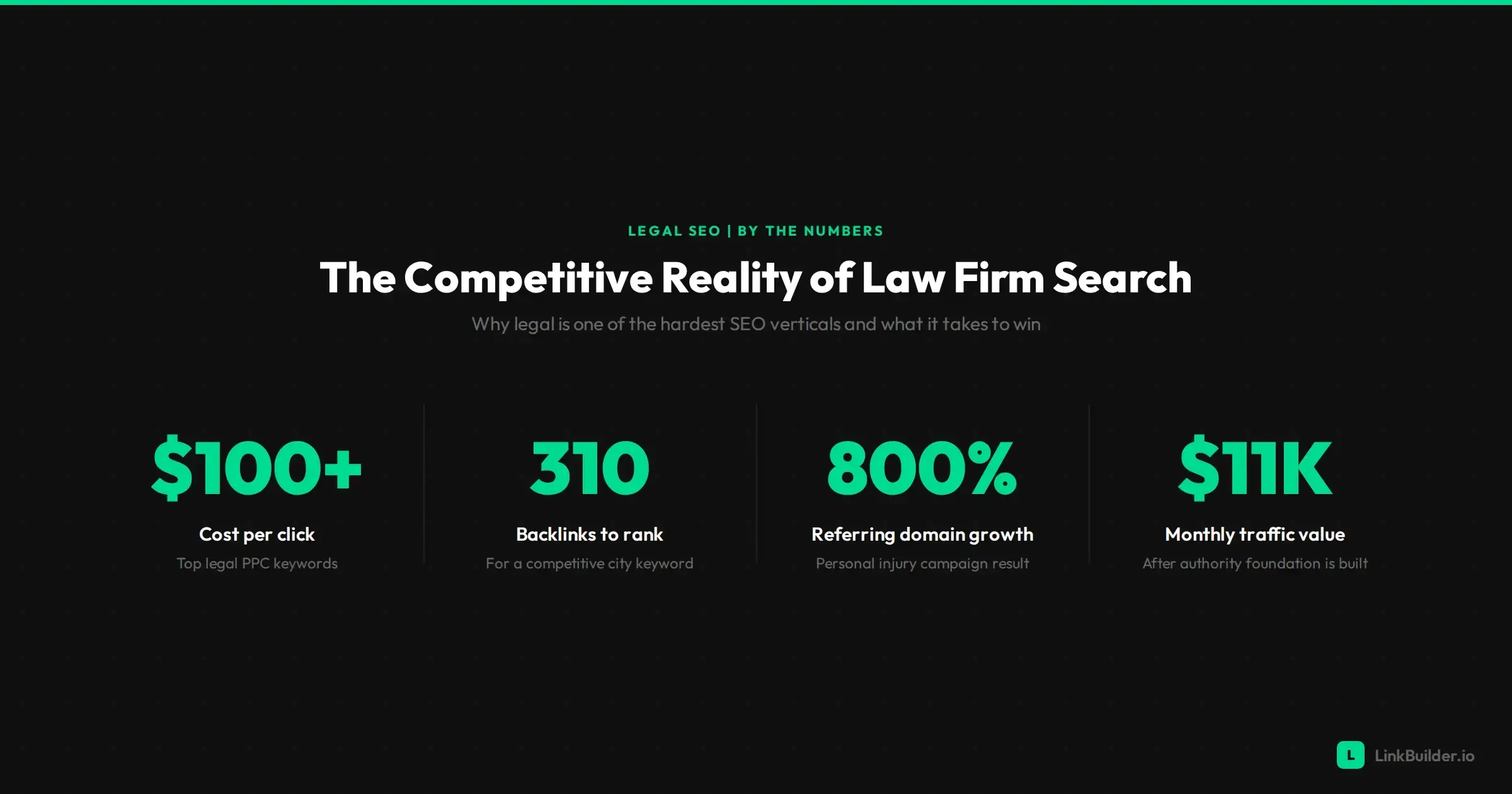
The number of active lawyers in the U.S. has grown roughly 15% over the last decade. More lawyers means more websites competing for the same high-value keywords. Legal terms rank among the most expensive in any industry, which is precisely why organic rankings carry enormous business value.
To illustrate the gap: one personal injury firm we worked with discovered that ranking competitively for their primary city keyword required an estimated 310 backlinks. At the start of the campaign, they had fewer than 50 referring domains. Closing that authority gap was the entire first phase of the strategy.
Within months of consistent link building, their organic traffic grew from around 500 visitors per month to over 7,700. The equivalent traffic value in paid search: more than $11,000 per month. That's the ROI equation legal SEO can produce when the authority foundation is built correctly.
Another personal injury firm came to us spending heavily on TV advertising with modest results. After a focused SEO campaign, they were ranking for over 2,000 relevant legal keywords and generating consistent monthly traffic value without the overhead of paid media.
The authority gap in legal SEO is measurable and closeable. But you have to know what you're building toward and build it systematically.
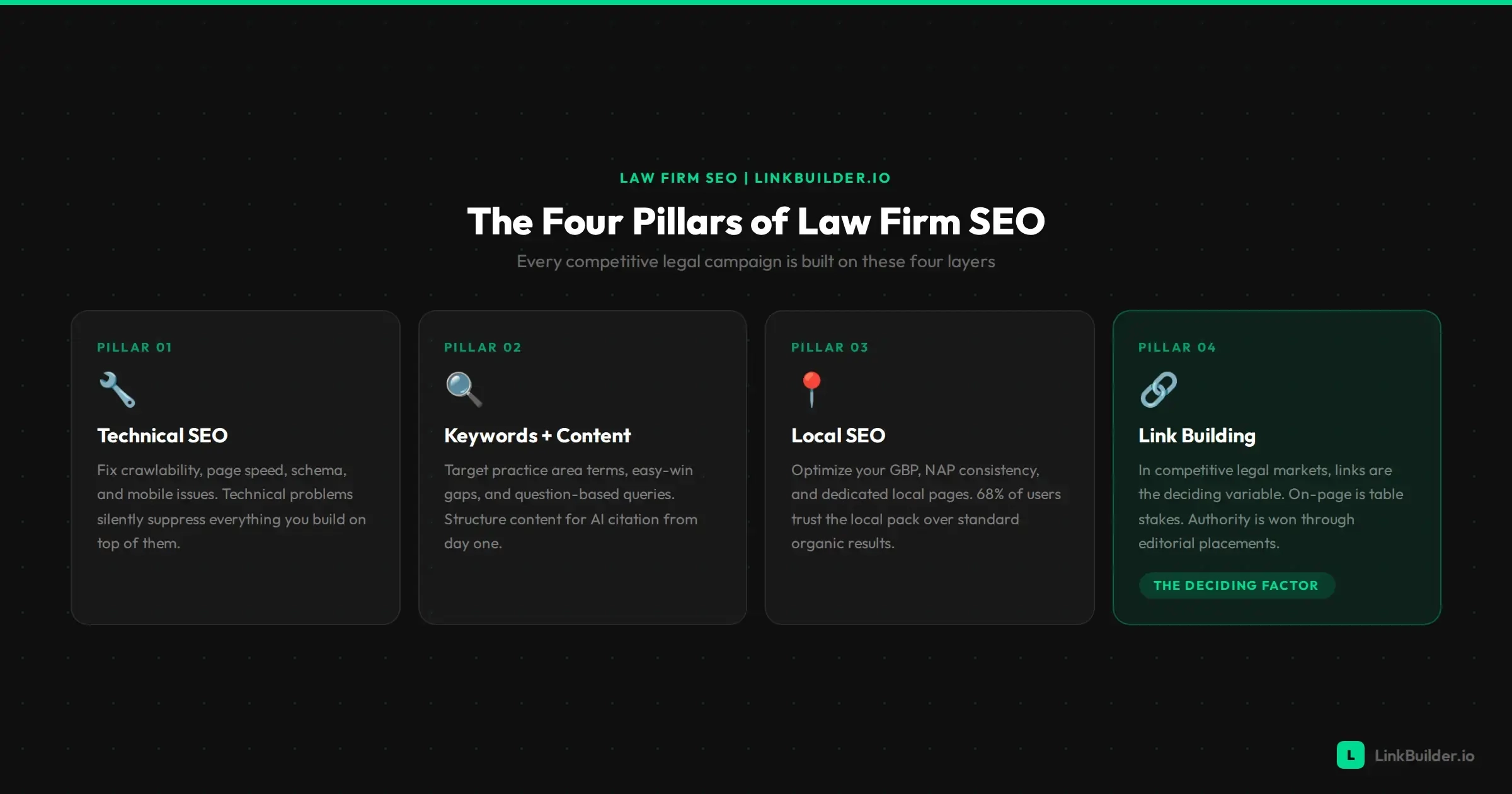
The Four Pillars of Law Firm SEO
1. Technical SEO: The Foundation
Before any other strategy will work, your site needs to be technically sound. Technical issues are often the hidden reason a firm isn't gaining traction despite investing in content and promotion.
Common problems we find on law firm sites:
Slow load times caused by uncompressed images or excessive JavaScript (most legal searches now happen on mobile)
Crawlability errors that prevent key practice area pages from being indexed at all
Broken internal links that waste the link equity built through months of outreach work
Missing or misconfigured schema markup, which matters for both local search and AI content parsing
Technical issues left unresolved undermine everything else you do. They also suppress your ability to be cited by AI systems, which rely on clean, crawlable page structure to extract and index content correctly.
2. Keyword Research and Content Strategy
Legal keyword research requires understanding how clients actually search, which is usually more specific and more urgent than firms expect.
Target easy-win keywords first: terms your site already ranks for in positions 4 to 30. A focused push can move these to page one quickly while longer-term authority building continues.
Run a competitor keyword gap analysis. One Texas law firm uncovered 2,852 unique keywords they weren't targeting through this exercise, many tied directly to their core practice areas.
Go deep on location-modified keywords. "Employment lawyer in Sacramento" or "DUI attorney Chicago" represent the highest-intent local searches. Getting into Google's local pack for these terms generates direct calls and consultations.
Build content around long-tail legal questions. Queries like "can I sue my employer for wrongful termination in California" represent active searchers looking for help. Content that answers these questions builds topical authority, earns natural links, and is exactly the type of structured answer AI systems cite.
AEO note: AI tools prioritize content that directly and concisely answers specific questions. Legal FAQ content and practice area pages structured around clear questions and answers are well-positioned to appear in AI-generated responses. Adding FAQ schema to these pages signals to both Google and AI platforms that your content is formatted for direct answers.
3. Local SEO
For most law firms, local search is central to the strategy. The majority of legal queries include a geographic modifier, whether typed or inferred from the user's location.
Google Business Profile optimization: a fully completed listing with practice areas, photos, updated hours, and actively managed reviews. Studies suggest 68% of users trust the local pack results over standard organic listings.
NAP consistency across all directories and platforms. Inconsistent name, address, or phone number data across Avvo, Martindale, FindLaw, and other legal directories erodes local ranking trust.
Dedicated local landing pages for each practice area and location. "Motorcycle accident attorney in Phoenix" should be its own page, not a passing mention in a generic practice area overview.
A steady review acquisition process. Reviews are a ranking signal for local search and a trust signal for both Google and the AI systems that surface local recommendations.
4. Link Building: Where Rankings Are Actually Won
We cover this in depth in the next section because it deserves more than a brief summary. In competitive legal markets, link building is not one component of the strategy. It is the deciding factor.
Link Building for Lawyers: Where Rankings Are Actually Won
Backlinks remain one of Google's most heavily weighted ranking signals. In legal, where domain authority is everything and the competitors you're up against have been building it for years, links are frequently the only variable separating page one from page two.
The goal is never volume. It's authority and relevance. A link from a local news station covering a story your attorney commented on, a bar association publication, a respected legal directory, or a major regional newspaper carries genuine ranking power. A hundred links from generic directories carry almost none.
Why link quality matters more in YMYL
In legal, healthcare, and finance, Google is closely attentive to who is vouching for you externally. A link from the LA Times signals something fundamentally different from a link from a directory that exists only to sell placements.
We've seen this in practice. For a California employment law firm, we secured a backlink from the LA Times through targeted media outreach. That single link, combined with a sustained campaign across authoritative legal and news sources, contributed to over 5,600 keyword rankings, 120 top-3 positions, and $7,400 in monthly traffic value.
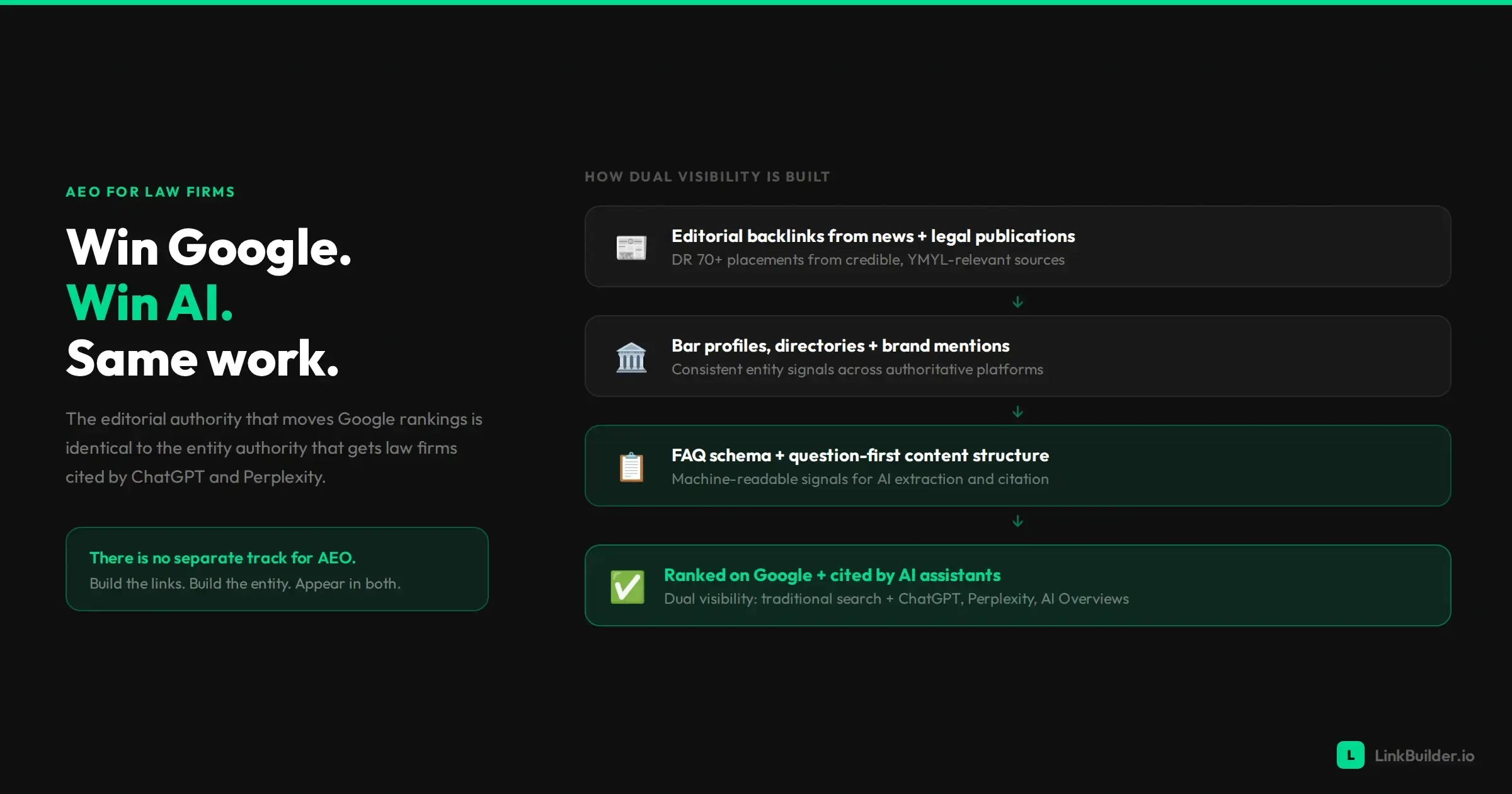
The AEO connection: AI systems like ChatGPT and Perplexity learn which sources are authoritative by analyzing citation patterns across the web. A law firm consistently linked from credible legal publications, news outlets, and professional organizations builds the entity authority that makes AI assistants more likely to reference it by name. The backlinks that win Google rankings and the citations that win AI recommendations are built through exactly the same work.
Where law firms earn their best links
Digital PR and media outreach: Getting attorneys quoted in relevant news coverage generates high-authority editorial links that are nearly impossible to replicate through standard outreach. These also directly build AI citation authority.
Legal directory placements: Avvo, Martindale-Hubbell, FindLaw, and Justia are foundational. Their value extends beyond domain authority; they're among the sources AI systems treat as credible when surfacing law firm recommendations.
Bar association and legal organization profiles: Many state and local bar associations link to member profiles. These carry YMYL-relevant authority that generic sites cannot replicate.
Guest content on legal and industry publications: Contributing to publications like Above the Law, Law360, or vertical-specific legal outlets builds topical authority and earns contextual links.
Original data and case-driven content: Law firms that publish original research on outcomes, settlement averages, or legal trends earn natural citations from journalists and researchers. This is also exactly the type of content AI systems pull from when generating answers.
The bar association constraint
Most link acquisition tactics that work in other industries run into friction in legal. State bar advertising rules vary, and promotional tactics require careful review before deployment.
This is part of why working with a specialist link building team pays off in this vertical. The right links need to be editorially placed, topically relevant, and built through genuine publisher relationships, not through schemes that could attract a Google penalty and a bar complaint simultaneously.
See how we approach link building for law firms, or get in touch for a free proposal.
AEO for Law Firms: Getting Recommended by AI Assistants
Traditional SEO gets you into Google's ranked results. But in 2026, that's only part of the visibility picture.
AI tools like ChatGPT, Perplexity, and Google's AI Overviews are fielding millions of legal questions daily. These systems don't just rank pages; they generate answers and cite sources. When someone asks an AI assistant "who is the best personal injury lawyer in Dallas," your firm either appears or it doesn't.
Answer Engine Optimization (AEO) is the practice of structuring your authority so AI systems recognize your firm as a credible, citable source. For law firms, this has four components:
Structured, question-first content
AI systems are trained to pull concise, authoritative answers to specific questions. Content that directly addresses "What should I do after a car accident?" or "How long do I have to file a personal injury claim in Texas?" is well-positioned to be cited. The format matters: clear question headings, direct answers in the opening paragraph, and supporting detail below.
Schema markup
FAQ schema, LegalService schema, and Attorney schema give AI systems explicit, machine-readable signals about what your firm does, where you practice, and what questions your content answers. Adding structured data to practice area pages and key blog posts is one of the highest-leverage AEO moves available to law firms right now.
Entity authority
AI models build a representation of your firm as an entity: who you are, what you specialize in, where you practice, and how credible you are based on who references you. Consistent mentions across authoritative sources including news coverage, legal directories, local publications, and professional organizations build that entity profile over time.
This is the same work as link building. There is no separate track for AEO. The firms that invest in earning authoritative, editorially placed links are the same ones building the entity authority that AI systems draw on when generating recommendations.
Original, experience-based content
AI tools are weighted toward content that demonstrates genuine expertise and real-world experience. Case results, attorney commentary on legal developments, and practice-area explainers written from actual case experience are all stronger citation signals than generic educational content. Thin, templated pages do not get cited.
One motorcycle accident law firm we worked with saw their content pulled into AI-generated answers about their practice area as a direct result of building authoritative links and structuring content around direct answers. That dual visibility, traditional rankings plus AI citations, is what a well-executed legal SEO strategy looks like in 2026.
What a Winning Legal SEO Campaign Looks Like
Month 1: Technical audit and quick wins
Every campaign starts with a full site audit. We identify technical issues, crawlability errors, broken links, and on-page opportunities. We also identify easy-win keywords already within striking distance of page one. Fixing technical issues and capturing quick wins builds early momentum and establishes a clean baseline for link building.
Months 2 to 4: Content and link building
This is where the core work happens. We build out practice area content targeting priority keywords, develop blog content targeting informational and long-tail queries, and begin a sustained link building campaign focused on authoritative, editorially placed links from legal and media publications.
Months 4 and beyond: Scaling and AEO optimization
Once the foundation is solid, we scale what's working. That includes expanding into new keyword clusters, pursuing higher-authority link placements, and optimizing content for AI citation using structured data and direct-answer formatting.
One employment law firm saw their traffic grow over 1,000% through this kind of systematic approach: technical fixes combined with consistent content creation and link building. Rankings climbed month over month, including one keyword that moved from position 51 to position 9 after we optimized the page and built supporting backlinks.
Common Mistakes Law Firms Make with SEO
Thin practice area pages. A single paragraph describing your services is not enough for competitive legal keywords. Each practice area needs a dedicated, comprehensive page that demonstrates real expertise.
Skipping the technical audit. Sites that have never been audited almost always have fixable problems actively suppressing performance.
Prioritizing link volume over quality. A hundred low-quality links will actively hurt a legal site. One well-placed editorial link from a regional news outlet is worth more than dozens of directory spam.
Stopping too soon. Legal SEO compounds over time. Firms that maintain consistent content and link building over 6 to 12 months see results accelerate. The firms that stop at 90 days rarely see the full payoff.
Ignoring AI visibility. If your content strategy doesn't account for AI Overviews and AI assistants, you're leaving a growing share of visibility untouched. AEO is not a replacement for traditional SEO. It's built on the same foundation.
Ready to Build a Legal SEO Strategy That Drives Real Clients?
We've worked with law firms across personal injury, employment law, criminal defense, family law, and more. We understand the YMYL requirements, the link quality bar, and what it takes to move rankings in competitive legal markets.
Frequently Asked Questions
How long does law firm SEO take to work?
Most firms see measurable results within 3 to 6 months, with more significant traffic growth at the 6 to 12 month mark. The timeline depends on your site's starting point, the competitiveness of your market, and how consistently the campaign runs.
How important are backlinks for legal SEO?
In competitive legal markets, they're often the single most important variable. On-page optimization is table stakes: every serious firm has it. The firms ranking at the top do so because they've built more authoritative, more relevant external links over time. Closing that gap is what most legal SEO campaigns are designed to do.
What is AEO and does my law firm need it?
AEO (Answer Engine Optimization) is the practice of optimizing your content and authority to appear in AI-generated answers from tools like ChatGPT, Perplexity, and Google's AI Overviews. As these platforms become more widely used for legal research and referrals, the firms with structured, authoritative content and strong entity authority will have a meaningful visibility advantage. We build AEO into every legal campaign we run.
Is SEO worth it for a smaller law firm?
Yes, and often more so than for larger firms. Smaller firms competing in specific practice areas or geographic markets can dominate those niches with focused keyword targeting and targeted link building. The cost-per-lead through organic search is typically far lower than paid advertising, where legal keywords can exceed $100 per click.
How do I know if my link building is working?
Track three things: referring domain growth over time, keyword ranking movement for your target terms, and organic traffic value. Tools like Ahrefs show all three clearly. For AI visibility, track how often your firm appears in AI-generated answers for your core practice area queries over time.