



Everyone in SEO knows that backlinks matter. But here's what's changed: the bar for what counts as a good link just got a lot higher.
In the traditional ranking world, a backlink from a decent site with reasonable domain authority was good enough to move the needle. Volume mattered. Velocity mattered. You could build a few dozen mid-quality links and watch rankings climb.
That logic doesn't hold in an AEO world.
Answer engines like ChatGPT, Google AI Overviews, and Perplexity don't just look at whether you rank. They're evaluating whether your site is trustworthy enough to cite. And that evaluation is heavily tied to the quality of sites linking to you. Ahrefs research into AI's impact on SEO confirms that domain-level authority signals, built through quality links, are among the strongest predictors of AI citation rates.
The good news: you don't need to start over. You need to level up. Here's what the data shows, what's changed, and how your link building strategy needs to adapt.
The AEO Citation Pipeline (And Where Links Fit In)
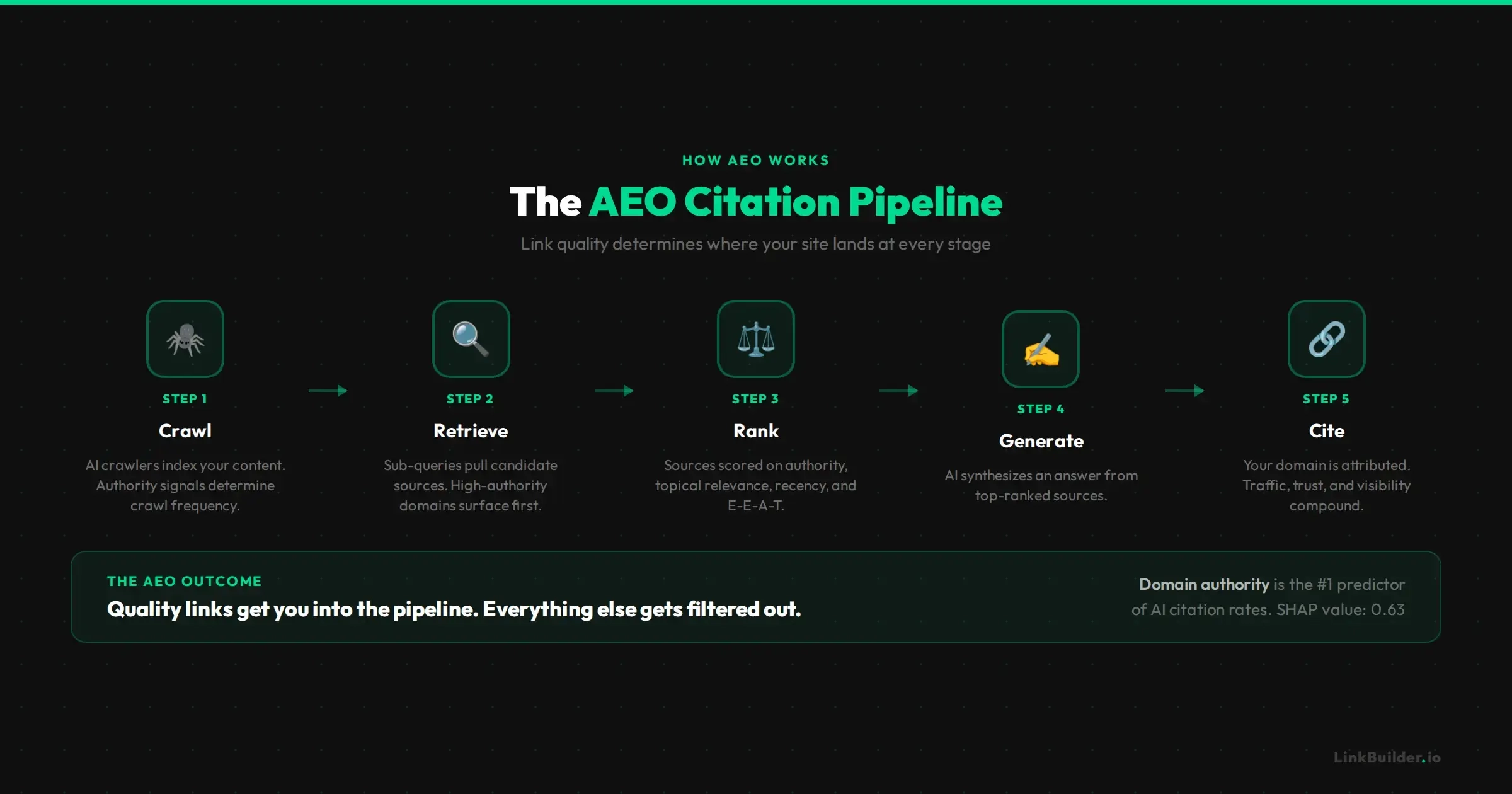
To understand why link quality matters so much for AEO, you need to understand how AI engines actually choose what to cite.
It works like this:
Crawl: AI platforms run their own crawlers or rely on Google's index. Your content has to be crawlable and indexable before any of this matters.
Retrieval: When a user asks a question, the engine runs sub-queries against its index to pull candidate sources.
Ranking: It scores those sources on authority, relevance, recency, and content structure.
Generation and Citation: It synthesizes an answer and, where applicable, attributes sources.
That ranking step is where your link profile becomes decisive. SE Ranking's analysis of 2.3 million pages found that domain traffic is the strongest single predictor of AI citations, with a SHAP value of 0.63 — meaning it outweighs almost every other on-page signal. And domain traffic is a downstream effect of high-quality backlinks from authoritative sources.
High-traffic sites earn 3x more AI citations than low-traffic ones, full stop.
Meanwhile, research shows that the majority of sources cited in Google AI Overviews already rank in the top 10 organic results. You can't separate AEO performance from SEO authority. They're the same game, and link quality is the common thread.
Why Volume-Based Link Building Now Works Against You
Here's a real problem we see with a lot of incoming clients: they've built a lot of links. Hundreds, sometimes thousands. But their AI visibility is near zero.
The culprit is almost always link quality.
A bloated backlink profile full of low-DR placements, thin guest posts on irrelevant sites, or spammy niche edits doesn't just fail to help with AEO. It can actively hurt you. Here's why:
It dilutes your topical authority signals
AI engines evaluate your domain's expertise in part by looking at which sites link to you and why. If you're a B2B SaaS company with 400 backlinks, and 300 of them come from general lifestyle blogs, coupon sites, and irrelevant directories, that pattern signals shallow topical coverage to an LLM's entity-relationship model. It doesn't look like a trusted authority. It looks like a site that bought links.
It doesn't help you pass E-E-A-T signals upstream
Google's E-E-A-T framework is baked into how both the traditional algorithm and AI Overviews evaluate sources. High-quality linking domains pass experience, expertise, and authority signals to your site. A link from a recognized industry publication with real editorial standards does something a link from a low-effort PBN or link farm simply can't: it associates your brand with legitimate expertise. Google's spam policies make clear that manipulative link patterns are penalized precisely because they distort these trust signals. E-E-A-T factors appear in 96% of AI Overview citations. If you want to be cited, your link profile needs to show that credible sources vouch for you.
It suppresses crawl priority
AI crawlers behave similarly to Googlebot in one important way: they prioritize crawling authoritative, well-linked content. A link profile that looks spammy can reduce how often AI bots visit and re-index your content, meaning fresher updates don't get picked up. AEO favors freshness too — AI-surfaced URLs are 25.7% fresher than traditional search results on average. If your best pages aren't getting re-crawled, you're losing that edge. This is one reason we look at link building in 2026 with an AI-first lens on every campaign.
What High-Quality Links Actually Look Like for AEO
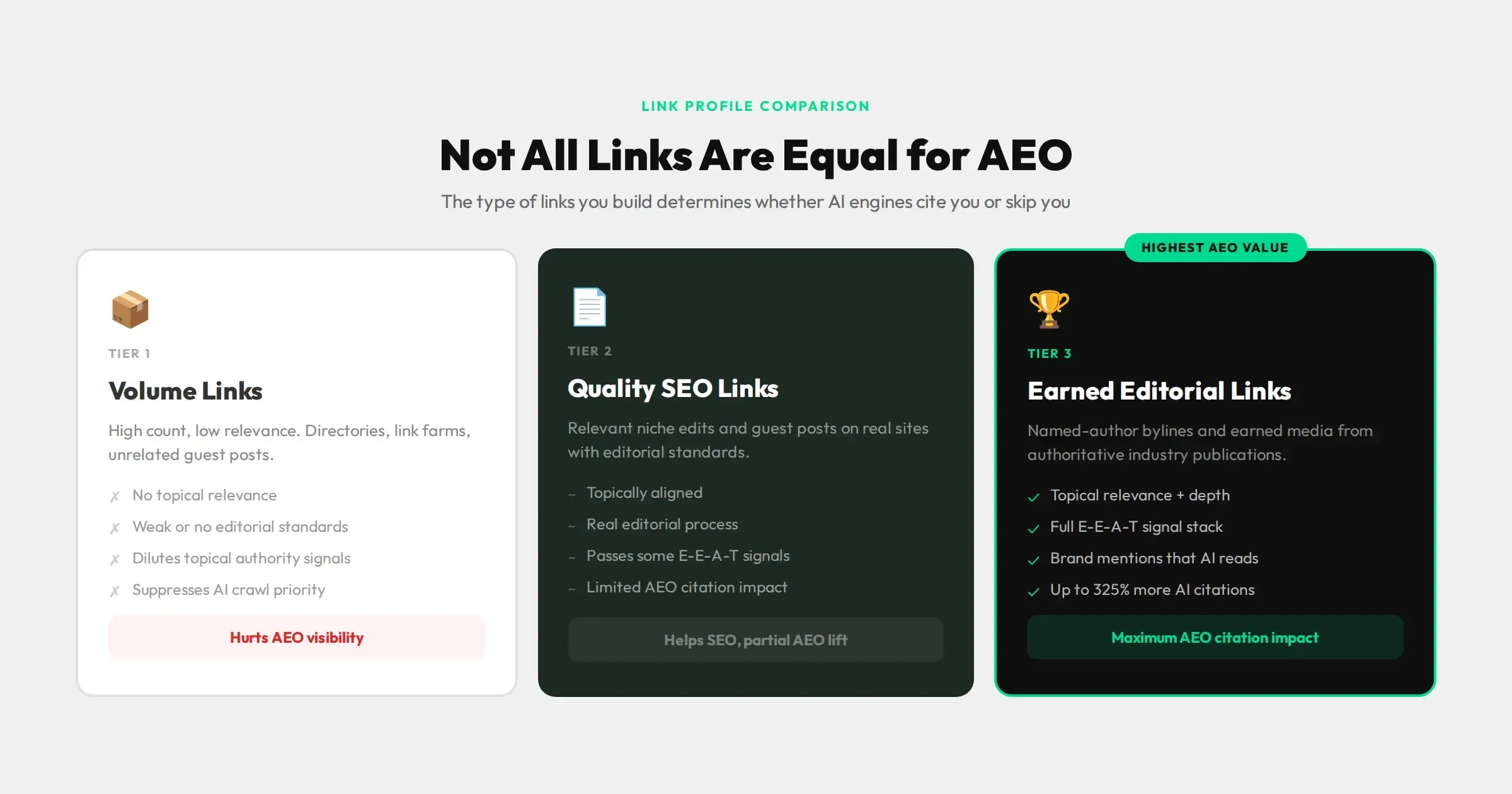
Not all DR 60+ links are equal. AEO has its own hierarchy of link value, and it doesn't map perfectly to traditional SEO metrics. Here's what we look for:
Editorial placement on topically relevant sites
A link from a high-DR site that has nothing to do with your industry is worth less than a link from a mid-DR site that's a genuine authority in your niche. LLMs use entity recognition and topic modeling to evaluate the semantic relationship between who links to you and what you're about. Topical relevance isn't just an SEO nice-to-have anymore. It's a core AEO signal, and one of the main reasons we focus on relevant backlinks over raw domain metrics.
Real editorial standards at the linking domain
Does the site have real authors with bylines? Do they publish original research? Do they cover a specific beat with depth? These signals matter because AI platforms, like Google, evaluate the editorial quality of linking domains as a proxy for how much to trust the association.
Author credibility and named attribution
Guest posts and contributed articles that link back to you aren't all created equal. A bylined piece from a named expert with an established digital footprint carries significantly more E-E-A-T weight than an anonymous placement. It's the same logic that makes editorial links the new brand mentions for AI search. The author's credibility travels with the link.
Earned media and brand mentions
Earned media distribution can increase AI citations by up to 325% (Stacker, December 2025). And 90% of AI citations driving brand visibility come from earned and owned media, not paid placements (Edelman). That means PR-style link acquisition — pitching to journalists, contributing expert quotes, earning coverage in recognized publications — isn't just a brand play. It's one of the highest-ROI moves you can make for AEO visibility. Platforms like Qwoted and Featured (which relaunched HARO in 2025) connect you directly with journalists seeking expert sources, making this kind of outreach more accessible than ever.
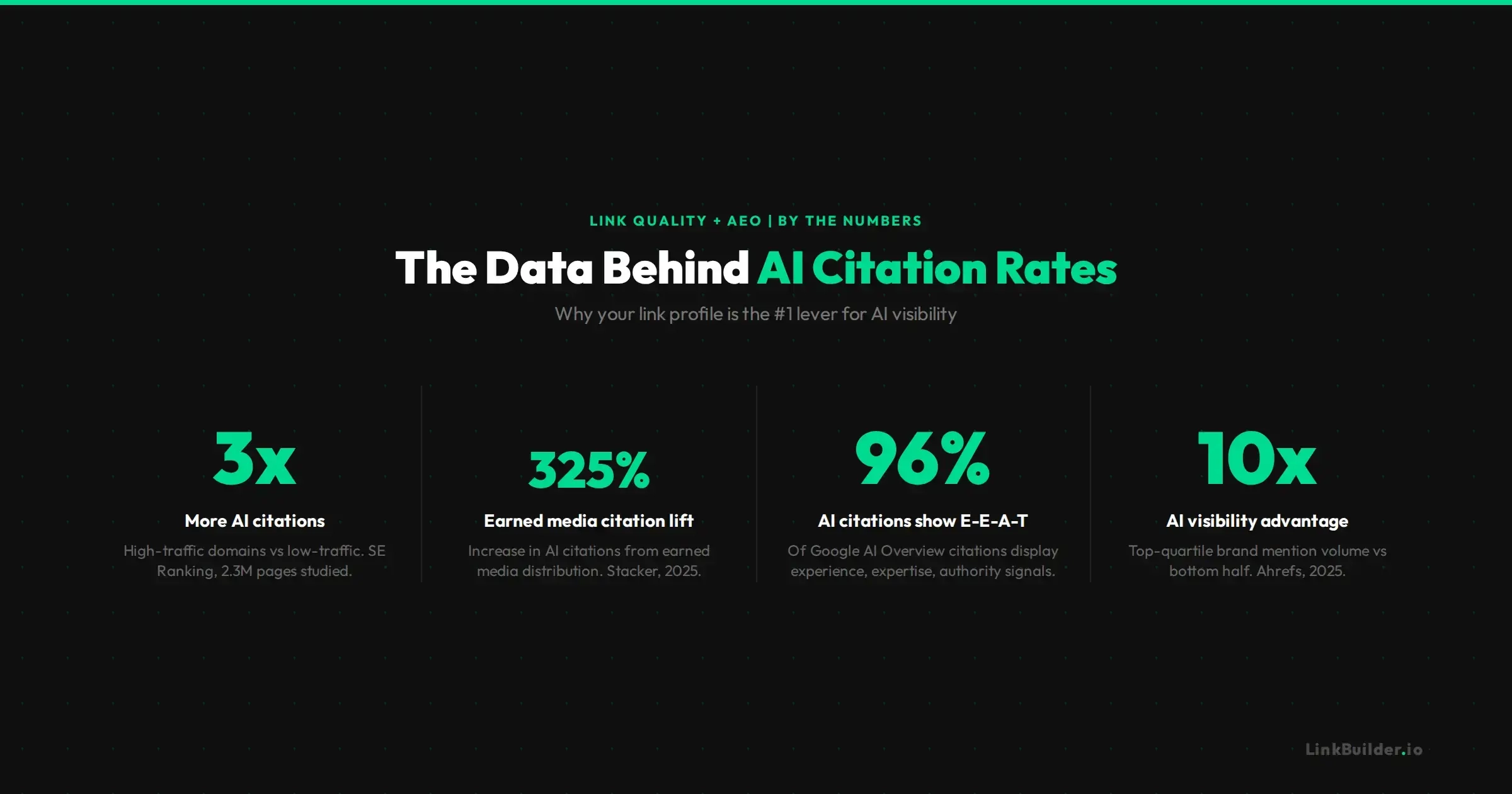
Brands in the top 25% for web mentions get 10x more AI visibility than those in the bottom half. The relationship between high-authority backlinks and AI citation rates is that direct.
Auditing Your Link Profile Through an AEO Lens
If you're not sure where you stand, this is the framework we use to evaluate a link profile's AEO readiness:
Topical concentration: What percentage of your referring domains are genuinely relevant to your core topics? A healthy profile skews heavily toward niche-relevant sources.
Editorial quality distribution: Pull your top 50 referring domains by DR. Open each one. Does it have real editorial standards, real authors, and original content? Or does it look like a content farm?
E-E-A-T indicators: Check for author bylines, citations, and institutional credibility in your top linking domains. These are the domains passing the most value for AEO.
Link velocity vs. link quality: If you've built a lot of links fast, look at the DR distribution. A spike of low-DR placements is a red flag for both Google and AI citation systems.
Brand mention tracking: Are you showing up in industry roundups, expert quotes, or earned press? This is the fastest-growing category of AEO-relevant link equity.
Our link quality framework goes deeper on each of these signals if you want a more structured evaluation. The goal isn't to have the most links. It's to have the right ones — a concentrated signal of topical authority from sources that AI engines already recognize as credible.
Practical Steps to Improve Link Quality for AEO
Here's how to shift your link building program to prioritize AEO-ready links:
1. Tighten your target site criteria
Add topical relevance as a mandatory qualifier, not just a nice-to-have. A site needs to cover your industry with depth before it's worth pursuing for a link. Relevance scores higher than raw DA in an AEO context. This principle informs how we work, where every campaign starts with a relevance-first target site audit before a single email goes out.
2. Invest in editorial placements with named authors
Guest posts on authoritative, niche-relevant publications with real bylines carry double duty: they're valuable for traditional search rankings and they pass the E-E-A-T signals AI engines look for. Don't just target the highest-DR domains. Target the ones where expert content lives. Niche edits and link insertions into existing authoritative editorial content can be especially efficient here. You're slotting into an already-trusted context.
3. Build an earned media layer
If you're not actively pitching journalists and responding to media inquiries, you're leaving AI citations on the table. Earned media is the highest-quality link type for AEO. It combines domain authority, editorial credibility, brand mentions, and topical relevance in a single placement.
4. Audit and disavow low-quality links
If your link profile is heavy with irrelevant or low-quality domains, a targeted disavow can help clean up the signal. This isn't something most sites need to do routinely — Google's algorithms are good at ignoring low-quality links. But if you've been doing volume-first link building, it's worth reviewing. Google's disavow tool guidance in Search Console is the right starting point.
5. Align content with link targets
The pages that earn the best links are the ones worth linking to: original research, in-depth guides, expert commentary, unique data. If your link building strategy isn't paired with a strong content strategy, you're making it harder to earn the editorial placements that move the AEO needle. We cover the content side of this in our guide to AI search optimization.
How LinkBuilder.io Approaches Link Quality
We've always been focused on quality over volume. But with GEO and AEO now real visibility channels for our clients, our targeting criteria have only gotten sharper. Every site we pursue needs to clear the editorial credibility bar, the topical relevance bar, and the E-E-A-T bar.
That means saying no to a lot of sites that would have been fine two years ago. It means prioritizing earned media placements alongside traditional outreach. And it means thinking about every link in terms of what signal it sends to an AI engine evaluating whether your client deserves to be cited.
If you're building links that don't clear that bar, you're not just wasting budget. You're potentially diluting the authority signals you need for AEO visibility.
Want to see what a quality-first link profile looks like for your vertical? Get in touch with our team and we'll put together an audit and a strategy built around both search rankings and AI citations.
The Bottom Line
AEO doesn't make link building less important. It makes it more demanding.
The sites getting cited by ChatGPT, Google AI Overviews, and Perplexity aren't just well-optimized. They're trusted: by other credible sites, by real editorial voices, by institutions and publications that AI engines already recognize. Your link profile is the strongest signal you have that you belong in that group.
Build accordingly. Fewer, better links. Topically concentrated. Editorially credible. That's what link quality for AEO actually means.