

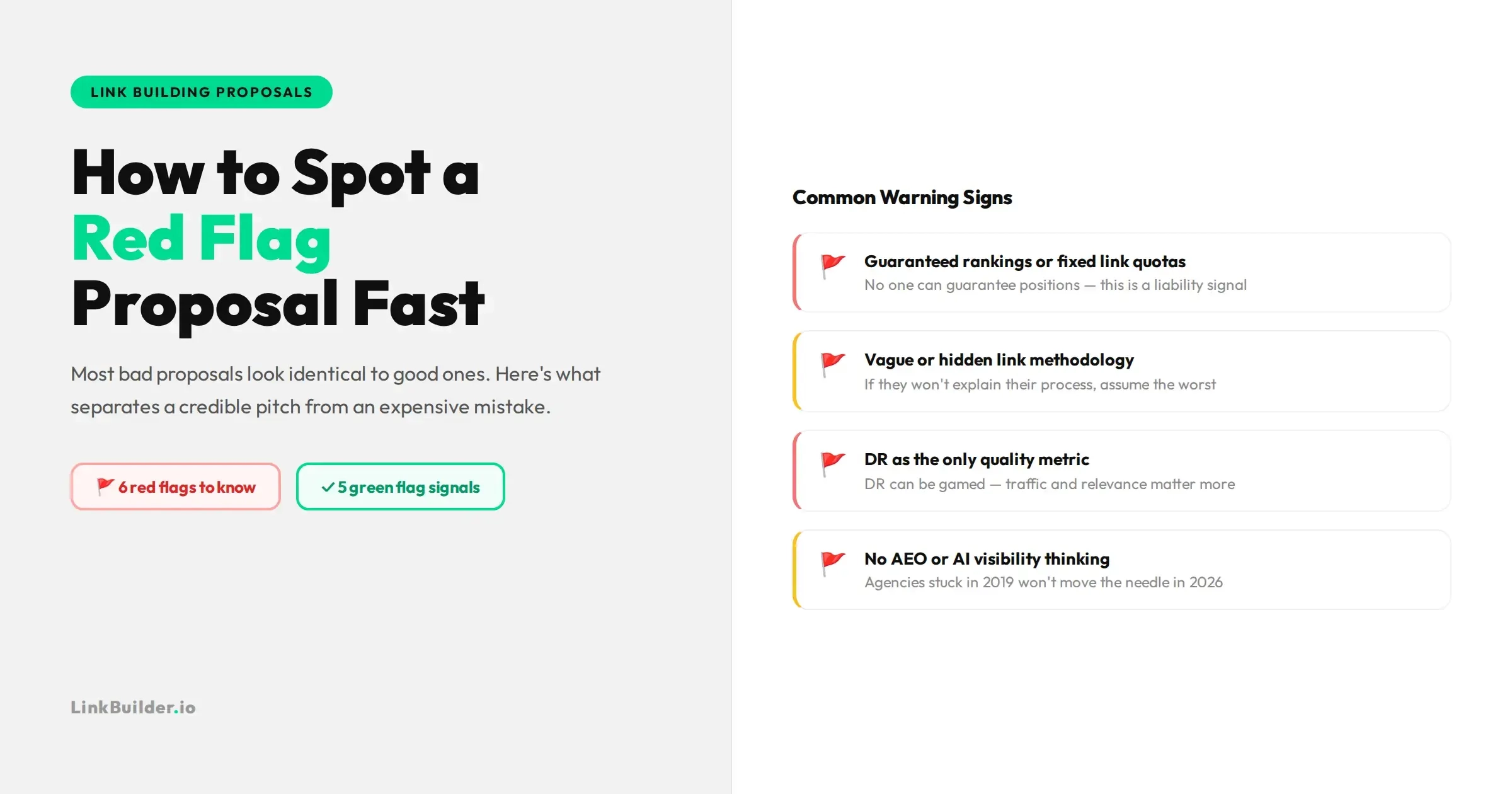
Red Flags in Link Building Proposals (And What Good Ones Look Like)

Erika
Head of Link Operations
Most link building proposals look confident. Bold metrics, a clean slide deck, promises of high-DR placements within 30 days. The pitch sounds right. The contract goes out. Then three months later you’re staring at a link report full of sites you’ve never heard of, wondering where it all went wrong.
The problem isn’t that bad agencies are rare. It’s that their proposals are designed to look exactly like good ones.
Whether you’re evaluating a new agency, reviewing a freelancer’s pitch, or stress-testing your current partner, knowing what separates a credible link building proposal from a problematic one is one of the highest-leverage skills you can develop. It saves budget, it saves time, and in a world where AI engines are increasingly using your link profile as a citation signal for search answers, it saves your organic visibility too.
Here’s what to look for, what to push back on, and what a proposal from a serious agency actually contains.

Red Flag 1: Guaranteed Rankings or Fixed Link Volume
This is the most common one, and the most dangerous. Any proposal that leads with guaranteed first-page rankings, or commits to a fixed number of links per month regardless of quality, is telling you something: they’re prioritizing your signature over your results.
Nobody can guarantee rankings. Google’s algorithm involves hundreds of variables outside anyone’s control. Agencies promising specific keyword positions are either planning to use short-term tactics that manufacture a temporary spike, or they’re not being straight with you.
The same applies to link volume promises. “20 DR 50+ links per month” without any qualifier about niche relevance, editorial standards, or placement quality is selling you a number, not a strategy. Link quality matters far more than volume, especially now that AI citation systems increasingly reward topical authority over raw link counts.
As Ahrefs found in their analysis of link building services, the agencies consistently producing results are the ones that prioritise placement relevance above all other metrics.
What you should see instead: realistic projections tied to competitive analysis, honest timelines (most campaigns take three to six months to show measurable ranking movement), and language about quality criteria rather than quotas.
Red Flag 2: Vague or Hidden Methodology
If you ask a prospective agency how they actually get links, you should get a specific answer. Not a slide deck full of icons. A real answer: what types of sites they target, how they qualify them, what the outreach process looks like, and who creates the content placed on those sites.
Agencies that dodge this question, pivot to results slides, or say something like “we have exclusive relationships with publishers” without explaining what that means are almost certainly operating from a paid placement inventory, a private blog network, or both.
PBNs and low-quality link farms look fine on paper until Google catches up. Google’s spam policies are explicit about manipulative link schemes, and the agencies using them are betting that the penalties land on your domain, not theirs. They’re often right.
A credible agency walks you through their process in detail: how they find sites, how they evaluate topical relevance, what editorial standards they require of publishers, and what happens if a link doesn’t go live. That level of transparency is the baseline, not a bonus feature.
Red Flag 3: DR as the Only Quality Metric
Domain Rating is a useful proxy metric. It’s not a quality standard.
A proposal that uses DR as its primary signal of link value, without mentioning organic traffic, topical relevance, or editorial standards, is revealing how the agency thinks. DR can be gamed. Sites with inflated DR and minimal real traffic are common in the link seller market.
A DR 60 placement on a content farm that accepts any guest post from anyone is worth nothing, and may actively harm your backlink profile.
When reviewing a proposal, look for whether they mention organic traffic of the linking domain, the site’s niche relevance to your content, editorial quality signals (real authors, original content, a real audience), and how they’ll monitor placement quality over time.
The AEO dimension makes this even more important. AI citation engines evaluate links semantically, not metrically. A link from a high-traffic, topically relevant site with named authors carries far more weight for AI visibility than a cluster of high-DR placements from unrelated domains.
An agency only talking about DR is optimizing for a metric that matters less by the month.
Red Flag 4: Suspiciously Low Pricing
Link building is expensive because doing it properly is difficult. There’s competitor analysis, target site prospecting, content creation, outreach, relationship management, and placement tracking. When an agency prices this at a fraction of what the work actually costs, one of two things is happening: they’re cutting corners, or they’re using infrastructure built for link selling, not link building.
As a rough benchmark, quality editorial link building through a reputable agency typically starts at $1,000 to $2,000 per link for genuine placements on real, vetted sites.
Packages promising ten or twenty high-authority links for a few hundred dollars are sourcing those links from somewhere, and that somewhere is almost always a PBN, link farm, or bulk content network with no real editorial standards.
uSERP’s 2025 State of Backlinks Report found that most serious SEO programs spend between $5,000 and $10,000 per month on link building — context that’s worth keeping in mind when a proposal comes in at a tenth of that.
This doesn’t mean you should overpay. It means price is a signal. If the proposal is dramatically cheaper than market rate, the right question isn’t “what a deal” but “how are they delivering this at that price?”
Red Flag 5: No Case Studies or Verifiable Results
Any agency worth working with has results they can point to. Not aggregate vanity metrics on their homepage, but specific client examples: what the site looked like before, what links were built, what changed in rankings and traffic, and over what timeline.
If a proposal doesn’t include at least one concrete case study relevant to your industry, ask for one. If they can’t provide it, that’s a flag. If the case studies they do provide are vague — “one of our clients increased traffic by 300%” with no site name, no vertical, no strategy — they’re not real evidence of anything.
It’s also worth checking third-party platforms like Clutch and G2. Real agencies have real reviews from real clients. If the only social proof in the proposal is testimonials on their own site with no way to verify them, apply appropriate skepticism.
You can also review our own client case studies to see what transparent, verifiable results actually look like across industries.
Red Flag 6: No Mention of AEO or AI Visibility
This one is newer, but it’s becoming a reliable signal of whether an agency is current or still operating on 2019-era assumptions.
Links don’t just influence Google rankings anymore. They determine whether your site gets cited by ChatGPT, Google AI Overviews, Perplexity, and other AI search platforms that are increasingly shaping how buyers discover and evaluate vendors.
A proposal with no mention of AI search optimization is a proposal built for a search landscape that’s already changing.
The agencies operating at the front of this shift understand that link building in 2026 requires a different emphasis: topical authority over raw volume, editorial credibility over domain metrics, earned media and brand mentions alongside traditional outreach.
If a proposal doesn’t reflect any of this thinking, it’s worth asking whether the team is keeping pace with how search actually works now.
What a Good Link Building Proposal Actually Contains

After reviewing red flags, it helps to know what the positive version looks like. Here’s what we include in every proposal we send, and what you should expect from any serious agency.
1) A competitive gap analysis
Before recommending any strategy, a credible agency should show you where you sit relative to the sites already ranking for your target keywords. That means analysing your backlink profile, your competitors’ profiles, and identifying the specific types of links and topical clusters driving their rankings. The strategy should follow from the data.
2) Specific target page and anchor text strategy
The proposal should name the pages on your site that will receive links, and explain why. It should also address anchor text distribution: what percentage of links will use exact match, partial match, branded, and naked URL anchors. Over-optimized anchor profiles are a penalty risk. A serious agency plans around this.
3) Publisher qualification criteria
You should be able to see exactly how the agency decides which sites to target. Minimum traffic thresholds, relevance requirements, editorial standards, what they check beyond DR. This is what a quality-first approach actually looks like in practice.
4) Transparent reporting on every placement
Every link delivered should come with the URL it was placed on, anchor text used, DR and organic traffic of the linking domain, and the target page on your site. Monthly reporting should show trends over time. You should be able to verify every link yourself.
5) Realistic timelines with honest caveats
A good proposal tells you what to expect and when, without overpromising. It acknowledges that link building is one input into rankings, that other factors (technical SEO, content quality, competition) also matter, and that results compound over months, not days.
How We Approach Proposals

Every proposal we send starts with your competitive situation, not a price list. We look at what’s ranking, why it’s ranking, and what types of high-authority links your target pages need to compete. Then we build a campaign around that, with full transparency on every placement, every publisher, and every quality metric we use.
We also build AEO into every campaign by default: prioritising editorial links and earned media placements that carry E-E-A-T signals, not just domain metrics. Because the same link profile that improves your Google rankings should also be improving your visibility in AI-generated answers.
If you’re reviewing proposals right now and something feels off, get in touch. We’re happy to give you an honest read on what you’re looking at.
The Short Version
A link building proposal is the first real test of how an agency thinks. Do they lead with guarantees and volume, or strategy and quality? Do they explain their methodology, or hide it? Do they show you verifiable results, or polished slides?
The answers tell you almost everything you need to know before you sign anything.
The standard has risen. Link building in 2026 isn’t just about rankings. It’s about building the kind of trusted, topically authoritative profile that AI engines use to decide whether your site is worth citing. The agencies that understand this show you that in their proposals. The ones that don’t are still optimizing for a search landscape that’s already moved on.
Erika
Head of Link Operations