

Every SaaS company you compete with has a content team, a link budget, and a shared doc full of outreach templates. That’s what makes software the hardest category on the web to build links in. The tactics aren’t a secret. Execution is what separates the brands that own a category from the ones renting space on page two.
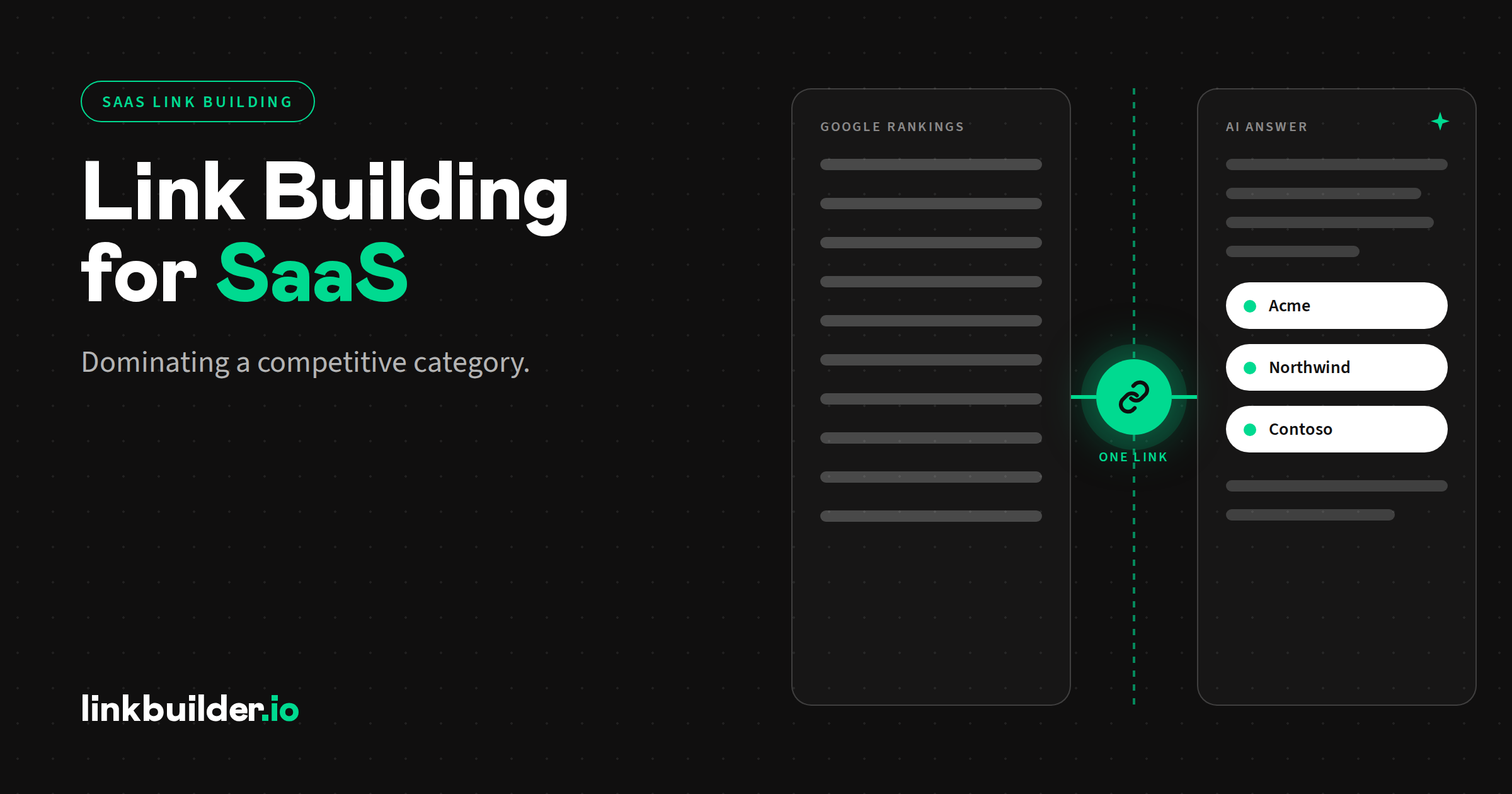
And the goalposts moved. A few years ago, SaaS link building had one job: push your pages up a list of ten blue links. Now the same buyer who used to type “best CRM for small teams” into Google is asking ChatGPT, or watching Google’s AI Mode assemble an answer from a dozen sources before a single ranking is visible. Links still decide who wins the classic results. They also feed the signals that decide whether your brand gets named in the answer at all.
This guide covers how we build links for SaaS clients in crowded categories: which pages to push, which link types move the needle in software, why product pages are so hard to earn links to, and how to run a campaign that produces rankings and AI citations at the same time. We’ve included numbers from two of our own SaaS campaigns so you can see what working looks like.
Why SaaS is the toughest category for link building
Three things stack against you in software.
First, the SERPs that matter most are owned by aggregators. Search almost any “best [category] software” query and the top results are review marketplaces, publisher listicles, and the one or two incumbents with a decade of link equity behind them. Your product page isn’t competing against another product page. It’s competing against a domain with 90,000 referring domains.
Second, your money pages are commercial, and editors know it. When we built links for a design software client, site owners repeatedly told us they’d rather link to a blog post than to the photo editor tool page, because linking to a product felt like running an ad. That resistance is normal in SaaS, and it’s the main reason most in-house teams end up with hundreds of links pointing at the blog and almost none pointing at the pages that generate signups.
Third, AI answers are now part of the category. Google’s guide to optimizing for its generative AI features describes how AI Overviews and AI Mode use “query fan-out,” firing off multiple related searches to build one response, then grounding that response in pages retrieved by Google’s core ranking systems. For a buyer asking “which project management tool integrates with Slack and has time tracking,” the answer is assembled from a wider set of pages than the classic top ten, and the brands mentioned inside it are the ones with authority spread across the web.
So you’re fighting on two fronts at once. The good news is that the same links, chosen well, work on both.
What a backlink does for a SaaS brand now
Links haven’t stopped mattering for Google. Google’s generative AI guide says plainly that AI features are rooted in its core ranking and quality systems, and that standard SEO best practices are still the way in. If links move your rankings, they move your eligibility to be cited.
What’s changed is what else a good link carries with it.
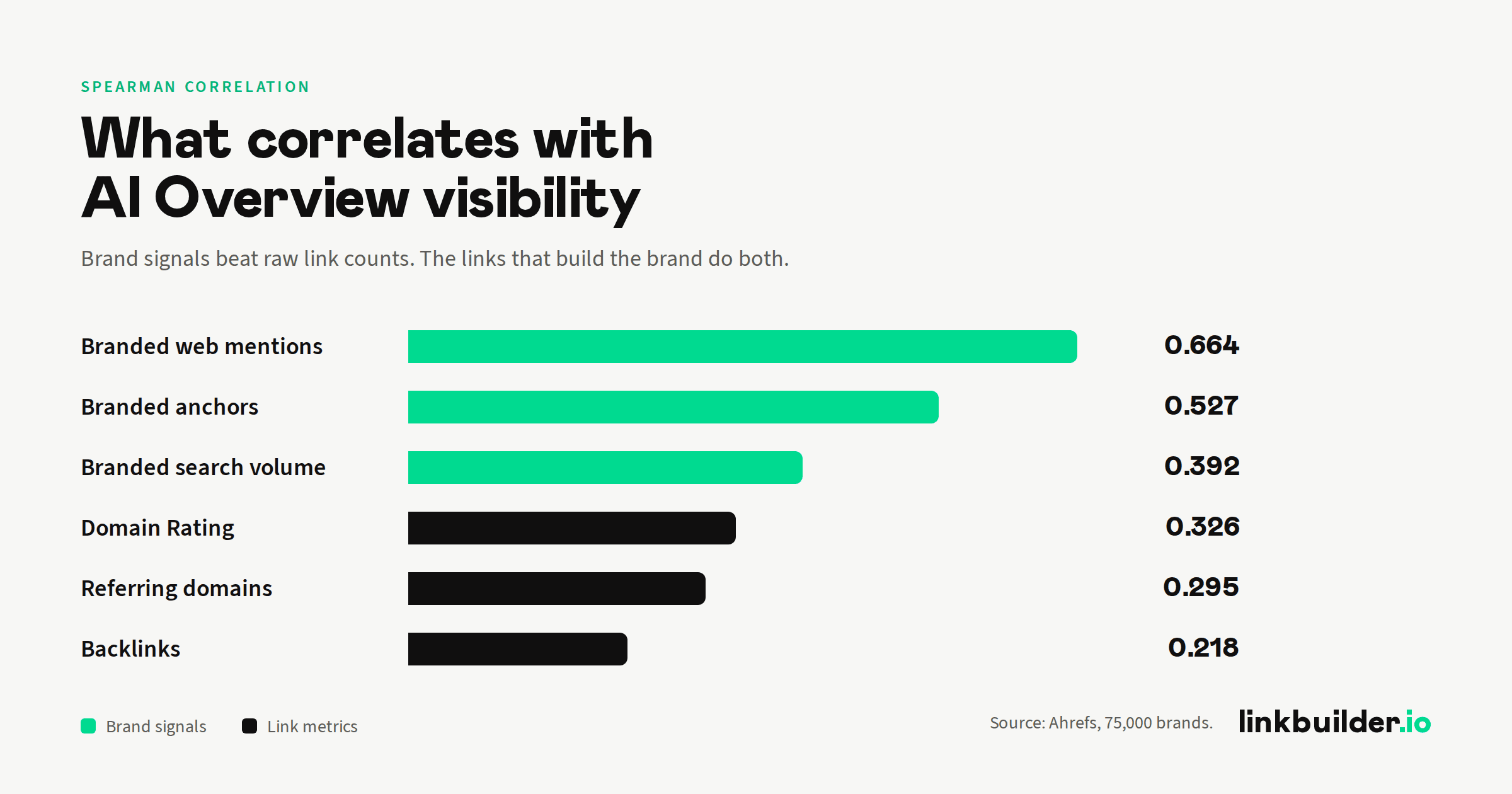
In 2025, Ahrefs analyzed 75,000 brands to see which factors correlated with a brand being mentioned in AI Overviews. Branded web mentions came out on top at 0.664 on the Spearman scale. Branded anchor text was next at 0.527. Raw backlink count sat at 0.218, with Domain Rating at 0.326 and referring domains at 0.295. Brands in the top quartile for web mentions averaged 169 AI Overview mentions. The next quartile down averaged 14.
Read that carefully, because a lot of people read it wrong. It doesn’t say links stopped working. It says the mention is doing more of the work than the hyperlink. A placement on a relevant site that names your brand, explains what it does, and links with a branded anchor delivers three of the top-correlated signals in one hit. A “click here” link on a page that never says your brand name delivers one.
We covered how this changes link quality assessment in our guide to what makes a backlink trustworthy. The short version for SaaS: relevance and context now outweigh DR, and the page needs to say who you are and what category you’re in, not just link to you.
One caution. The same Google guide warns against chasing “inauthentic mentions,” and Google’s spam policies still list paid links, excessive exchanges, and keyword-optimized anchors in guest posts as link spam. The mention has to be real editorial coverage or it’s a liability on both fronts.
Choose the pages that decide the category
Most SaaS link campaigns fail before outreach starts, because nobody decided which pages were worth the effort.
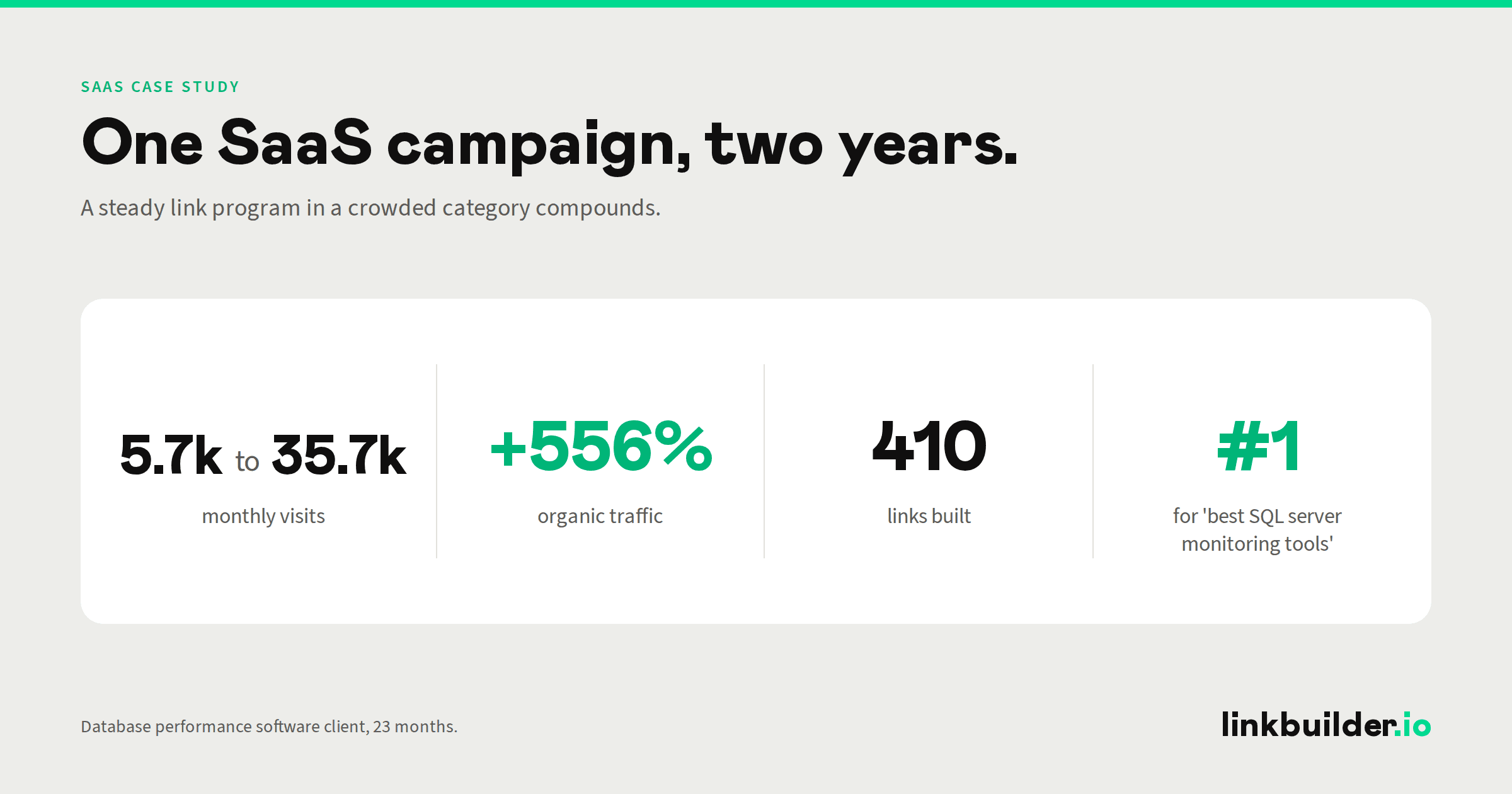
Our client in the database performance space is a good example of doing this right. Before building a single link, we worked with their team to find pages that were underperforming but tied to revenue: the monitoring and comparison pages targeting terms like “SQL server monitoring tools,” where the cost per click runs well over $70. Over roughly two years and 410 links, those pages moved from page two to position one for “best SQL server monitoring tools,” “SQL server monitoring tools comparison,” and “SQL database monitoring.” Organic traffic grew 556%, from 5,700 to 35,700 monthly visits, and the monthly traffic value tripled from around $10,000 to over $30,000. The full campaign breakdown is here.
Here’s the selection logic we use.
Revenue proximity. Comparison pages, alternatives pages, integration pages, and category landing pages sit closest to a signup. They’re also the pages AI answers draw on for “X vs Y” and “best tool for Z” questions.
Ranking gap. A page sitting between positions six and fifteen for a valuable keyword needs links more urgently than one at position one or position 60. The middle is where links change outcomes.
Link gap. Run a competitor backlink analysis on the three sites outranking you for the target term. If they have 40 referring domains to the equivalent page and you have four, you’ve found the job.
Linkability. Some pages can’t earn editorial links no matter how good the pitch is. If a page has no realistic path, build links to the supporting content around it and pass equity internally.
Pick five to ten pages. Not fifty.
The link types that move a SaaS category
There’s no shortage of link building tactics. In software, a handful do most of the work.
“Best tools” listicles and comparison roundups
This is the single most valuable placement type in SaaS, and it isn’t close. A listicle titled “12 Best Time Tracking Tools for Agencies” is where buyers shortlist, where Google ranks the category, and where AI fan-out queries land when someone asks for options. Getting added to an existing, ranking listicle gives you a relevant link, a branded mention, a category association, and referral traffic from people who are already comparing.
For our design software client, roundup placements were a core tactic. Across the campaign we built 1,840 links from sites like Printful (DR 87), CloudTalk (DR 79), and Nuclino (DR 73), and the client moved into the top three for “online photo editor” (keyword difficulty 96) and “photo editor” (KD 93). Organic traffic went from 315,000 to 961,000 monthly visits, a 204% increase. You can read how we approached that campaign in full.
Find the listicles by searching your category terms plus “best,” “top,” and “alternatives,” then filter to pages that already rank in the top 20 and have been updated in the last year. Pitch the editor with a specific reason the list is incomplete without you. Generic asks get deleted.
Editorial guest contributions on sites your buyers read
Guest posting still works in SaaS when the site is one your customers read and the article is a real contribution. It doesn’t work when the site is a “write for us” farm that publishes anything with a payment attached.
Google’s site reputation policy, updated in August 2026, targets third-party content published on a host site mainly to borrow that site’s ranking signals. The factors Google says it reviews include whether the content is formatted like the host’s other content, whether authorship is clear, and whether the same piece appears elsewhere. Translation for your outreach: original article, named author, editor involvement, one publication. Do that and guest posts remain one of the most reliable ways to earn links from high-authority tech and business publications.
Integration partner and ecosystem links
If your product integrates with Slack, HubSpot, Shopify, or Salesforce, you have a list of companies with a built-in reason to mention you: their integration directory, their partner page, and often a co-marketing post. These links are relevant by definition, they come with a branded mention, and most SaaS teams never ask for them.
Data studies and original research
The linkable asset advice from years ago still holds, with one update. A data study earns links from people who cite your number. It also gets your brand name written next to your topic dozens of times across the web, which is exactly the branded mention signal Ahrefs found dominating AI visibility. One well-built report on your category (churn benchmarks, pricing trends, adoption data pulled from your own product) can outperform 50 generic guest posts. Our guide to linkable content walks through choosing a topic that will get picked up.
Digital PR and earned media
For brands that need to go from “unknown” to “named in the answer,” coverage in trade and business publications does something a link alone can’t: it builds the web mention count AI models draw on. We run this as Digital PR for SaaS clients who need brand authority as much as they need link equity.
What we skip: reciprocal link schemes, PBNs, footer and widget links, and anything else on Google’s link spam list. In a competitive category, a penalty sets you back further than any competitor could.
Getting links to product and service pages
This deserves its own section because it’s where SaaS teams get stuck.
With the design software client, editors pushed back on linking to tool pages. The fix wasn’t to give up on those pages. It was to change what we were asking for.
We repositioned each tool page as a resource rather than a product. A background remover isn’t a “feature.” It’s a free tool that solves a specific problem for a creator writing a how-to post. We offered to collaborate on content where the tool was a natural part of the workflow, so the link was earned by the article instead of tacked onto it. And we looked for existing articles where a link to the tool already made sense and asked for an addition rather than a new post.
That combination is why a campaign that could have produced 1,840 blog links produced links to the pages that drive signups instead.
Anchor text and brand association in AI answers
Anchor text used to be a rankings lever. In SaaS it’s now a category lever.
Ahrefs found branded anchors correlating with AI Overview visibility at 0.527, second only to raw web mentions. Meanwhile, Google’s link spam examples specifically call out optimized anchor text in articles, guest posts, and press releases. So the old move, exact-match “project management software” anchors in every placement, is both riskier and less useful than it was.
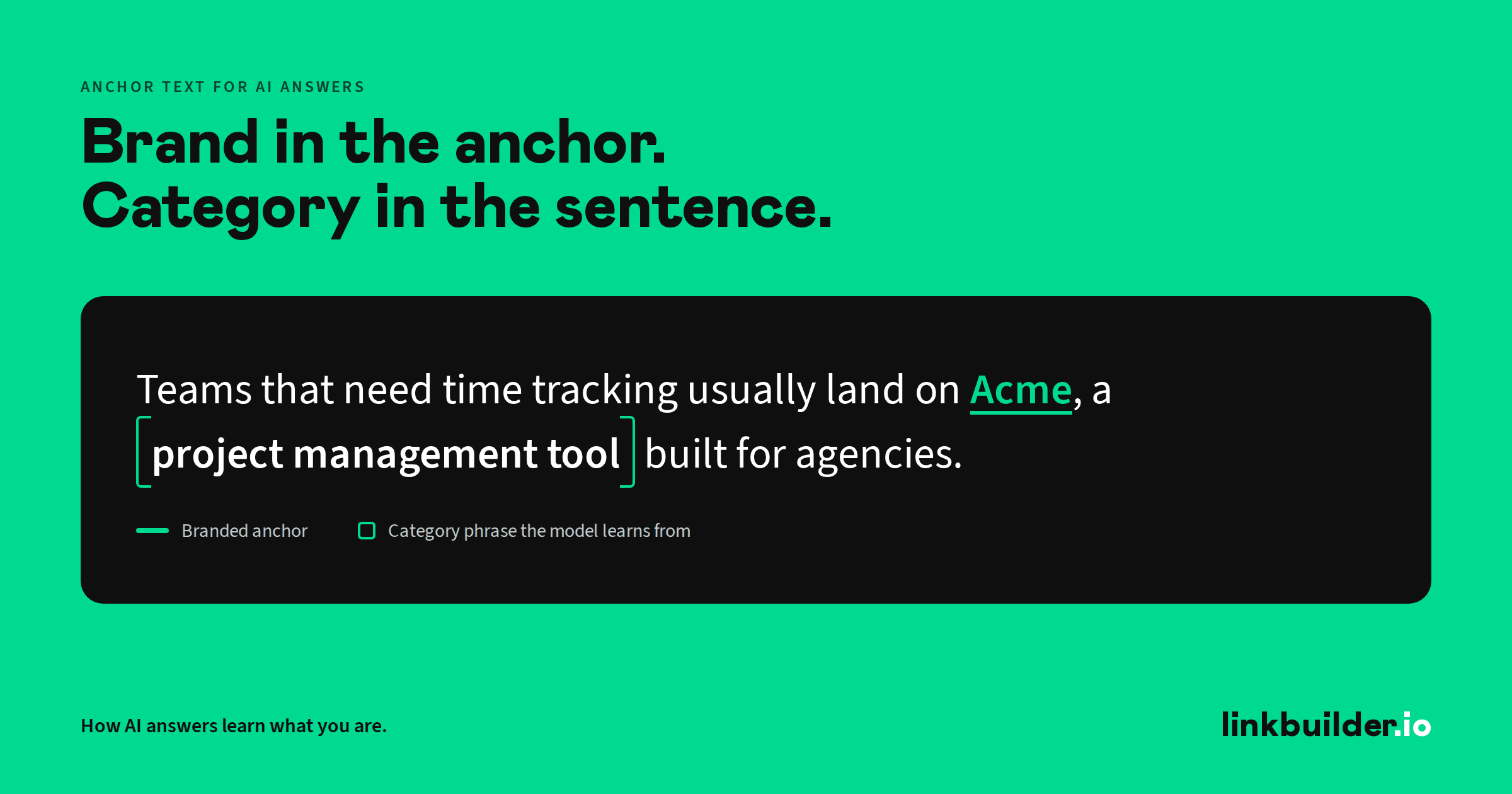
What works: the brand name as the anchor, with the category in the surrounding sentence. “Teams that need time tracking usually land on Acme, a project management tool built for agencies.” The link carries your brand. The sentence teaches the model what you are. Repeat that pattern across enough relevant sites and the association sticks, in Google and in the answer engines. Our generative engine optimization guide goes deeper on building that association on purpose.
A 90-day plan for a SaaS link building campaign
Here’s the sequence we run for new SaaS clients.
Weeks 1 to 2: Page selection and gap analysis. Pick five to ten target pages using the criteria above. Pull competitor link profiles for each. Set a baseline for rankings, referring domains, and, if you can measure it, brand mentions in AI answers.
Weeks 3 to 6: Prospecting and listicle audit. Build a prospect list by buyer relevance, not DR alone. Identify every ranking listicle in your category you’re missing from. Set a DR floor and a traffic floor for the campaign so quality doesn’t drift once volume picks up.
Weeks 7 to 12: Placement and measurement. Run outreach across listicles, editorial contributions, and partner pages in parallel. Track rankings weekly and referring domains monthly. Google points to the Generative AI performance report in Search Console for measuring visibility in AI features; use it alongside a brand monitoring tool to see whether mentions are climbing.
At 90 days you should see movement on the mid-ranking pages first. Position one for the hardest terms takes longer. Both campaigns above ran for about 23 months. Set expectations accordingly and keep the campaign consistent, because in this category, stopping means the competitor behind you catches up.
How we run SaaS link building at LinkBuilder.io
We’ve built links for CRM platforms, marketing automation tools, developer tooling, cloud security, design software, and a long list of B2B SaaS companies in between. Every campaign starts with the page and competitor analysis above, runs against a DR floor we agree on up front, and reports every link built each month.
If you want to see how we’ve handled categories like yours, our case studies are public, numbers included. Details on packages are on our link building services page. And if you’re ready to talk through your target pages, get in touch and we’ll put a plan together.
The takeaway
SaaS is a hard category because everyone in it is competent. Winning comes down to choosing the right pages, earning the placements that buyers and answer engines both rely on, and getting your brand named correctly in context, over and over, on sites that matter. Links built this way move rankings and build the mention footprint AI answers draw from. That’s the whole strategy. It just has to be executed better than the ten other companies running it.

Erika
Head of Link Operations