


White Label Link Building: A Complete Guide for Agency Resellers

Erika
Head of Link Operations
Link building is one of the most impactful parts of SEO. It's also one of the hardest to deliver consistently.
Building backlinks at scale takes publisher relationships, outreach infrastructure, and a team that knows how to earn placements on authoritative sites. Most agencies don't have all three. And the bar just moved again, because clients no longer only ask where they rank. They ask whether they show up when someone puts a question to ChatGPT.
That's where white label link building comes in. It gives your agency the ability to offer high-quality link building under your own brand without building an internal outreach team from scratch. A specialist provider handles prospecting, outreach, and placement. You deliver the results and keep the client relationship.
This guide covers what white label link building is, how the reseller economics actually work, what to look for in a provider now that AI answers are part of the deal, and the questions to ask before you sign anything.
What Is White Label Link Building?
White label link building is a service model where a specialist provider builds backlinks on behalf of your agency. You deliver those links to your clients under your own brand. The end client never sees the provider's name. They only see yours.
For agencies, the economics are straightforward. You place an order with a white label partner, approve the placements, and hand a branded report to your client. You buy at a wholesale rate, sell at your own pricing, and keep the margin. No hiring. No training. No building an outreach team from scratch.
It's a common practice because link building is essential to SEO campaigns but requires specialized skills that most digital marketing agencies don't have in house.
You might reach for a white label partner when:
A client asks you to build links and you don't have the capability.
You spot that a client's rankings are stalling because of a weak backlink profile.
Your in-house team is at capacity and turnaround is slipping.
You want to test link building as a service line without committing to headcount.
A client starts asking why competitors appear in AI Overviews and they don't.
That last one is newer, and it's changing what agencies need from a fulfillment partner.
Why Link Building Now Carries Two Jobs
A backlink used to do one thing: pass authority and help a page rank. It still does that. But the same placement now does a second job, and agencies that understand this can sell link building far more effectively.
When a publisher covers your client, two assets get created. There's the link, which feeds rankings. And there's the brand mention, the client's name sitting inside real editorial context on a source that AI systems already trust.
That second asset carries more weight than most agencies realize. Ahrefs analyzed 75,000 brands to see which signals predict visibility in Google's AI Overviews. Branded web mentions came out strongest at 0.664. Backlinks correlated at 0.218. Brands sitting in the bottom half for web mentions barely register in AI answers at all.
For your agency, that means a well-run link building campaign is now the easiest way to answer the AI visibility question your clients are starting to ask. You're not selling links. You're selling presence on the sources that both Google and the answer engines rely on. Our guide to generative engine optimization covers the on-page half of that picture.
It also means your provider matters more. A partner placing links on sites nobody reads gives you neither job done.
The Reseller Economics
The margin question is usually the first one agency owners ask, so here's the shape of it.
You pay your provider a wholesale rate per link or per campaign. You bill your client at your retail rate. The difference is your margin, and because there's no fixed staffing cost behind it, that margin holds whether you're running two clients or twenty.
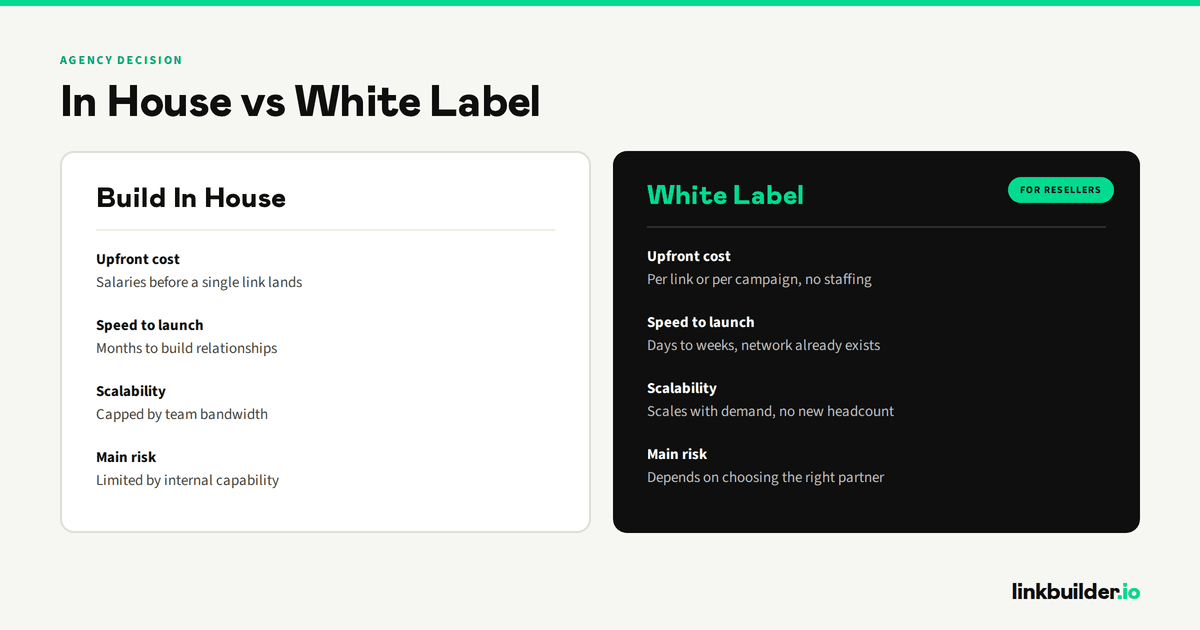
In-house link building | White label link building | |
|---|---|---|
Upfront cost | Salaries for outreach specialists, writers, and managers before a single link goes live | None. You pay per link or per campaign |
Scalability | Capped by team bandwidth | Scales with demand, no new headcount |
Speed to launch | Months to build relationships and infrastructure | Days to weeks, the network already exists |
Control | Full control of strategy and execution | You approve placements, the provider executes |
Expertise | Limited to what your team already knows | A specialist team with publisher networks across niches |
Main risk | Quality depends entirely on internal capability | Quality depends on choosing the right partner |
A few things worth knowing before you price your offer:
Mark up on value, not cost. Your client is buying rankings and visibility, not a line item. Agencies that price transparently per link tend to get squeezed. Agencies that sell link building as part of a growth retainer keep healthier margins.
Build in your management time. Approving placements, briefing target pages, and presenting results to the client takes real hours. Price for them.
Watch the volume thresholds. Most providers, us included, offer partner discounts at higher tiers. At LinkBuilder that's 10% on our Growth package ($9,999 per month) and above, taken either as commission if the client pays directly or as a discount if you do. You can see all our tiers on our pricing page.
Ask about link guarantees before you promise anything. If you commit to a client that links stay live for a year, you need a provider who backs that.
When White Label Link Building Makes Sense
It isn't for everyone. It's the right call for agencies in these situations:
You're managing three or more link building clients at once. At that volume, in-house teams stretch thin. Turnaround slows, quality dips, and your team burns out.
You're entering a niche where you have no publisher relationships. Building connections in a new vertical takes months. A partner already has them.
You want to offer link building without a dedicated team. Hiring, training, and retaining outreach specialists is expensive and slow.
You're growing faster than your fulfillment capacity. If you're winning clients but struggling to deliver, outsourcing lets you scale without sacrificing quality.
You need consistent output month over month. In-house teams have hard capacity limits. A provider absorbs volume spikes without missing deadlines.
If you're weighing this against handling everything internally, our guide to outsourcing link building works through the trade-offs in more detail.
Quality Control Is the Whole Game
Quality control is the biggest risk when you put your brand on someone else's work. The links a provider builds directly determine whether your client's campaign works or backfires.
Good links lift authority and rankings. Bad ones get ignored by Google if you're lucky, or trigger a penalty if you're not. Either way your agency wears it, because as far as the client knows, you built them.
Link building scams are still common. Watch for:
Providers using PBNs. Private blog networks exist purely to pass link equity and are a direct violation of Google's guidelines.
Link farms. Sites that look normal but exist only to host paid links.
Directory, comment, and forum links sold as a package. These rarely harm a site, but they deliver close to zero ranking impact and are rarely worth paying for.
Fake guest post services. Guest posts placed on PBNs and link farms rather than real publications.
Unproven providers. Anyone claiming big results with no case studies, no live examples, and no verifiable reviews.
The pattern across all five is the same. Real editorial placement takes time and relationships. Anything promising volume at a price that seems impossible is selling something else.
How to Choose a White Label Provider
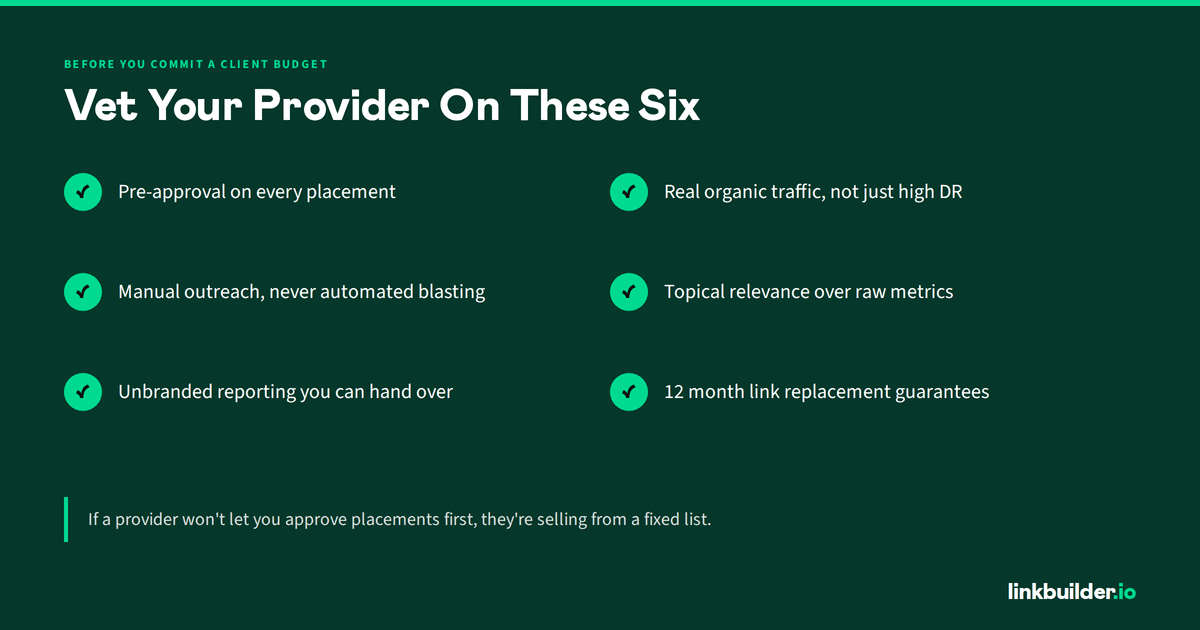
Not all white label services are equal. Here's what to check before you commit a client's budget:
Pre-approval on every placement. You should review and approve each target site before outreach begins. A provider who won't offer this is almost certainly selling from a fixed list.
Real organic traffic, not just high DR. A DR 70 site with no organic visitors is worthless to your client. Look for vetting on actual readership and editorial standards.
Manual outreach, not automated blasting. Links earned through genuine relationships hold up. Links from automated outreach create risk you inherit.
Topical relevance over raw metrics. A DR 50 link from a site in your client's niche beats a DR 80 link from an unrelated directory. Relevance drives rankings, and it drives the topical co-occurrence that helps AI systems associate your client with their category.
A considered anchor text strategy. Over-optimization is one of the fastest routes to a penalty. Your provider should map anchor text distribution against your client's existing profile rather than repeating the target keyword.
Transparent, unbranded reporting. Every link should arrive with a live URL, target page, anchor text, DR, and traffic data, in a format you can hand to a client without editing.
Link guarantees. Ask about replacement policy. Strong providers offer 12-month guarantees and replace links that drop inside that window.
Clear communication boundaries. Confirm how the provider handles contact, invoicing, and reporting so nothing branded ever reaches your client by accident.
That last point gets overlooked and causes the most damage. Before signing, ask directly: who communicates with the end client, what appears on invoices, and what happens if a client Googles a delivered placement and traces it back? A serious white label partner will have answers ready.
What We Check Before Placing a Link
Every link we place has to move the needle for your client. Our due diligence covers:
Organic traffic. A clear sign Google trusts a site. We look for a minimum of 1,000 organic visitors per month.
Outbound to inbound link ratio. Too many outbound links signals a link farm. We look for a healthy balance.
Content quality. We manually review each site to confirm it publishes original, edited content.
Domain rating. We place on sites that match or beat the authority in your chosen plan. DR is Ahrefs' 0 to 100 measure of backlink profile strength, and higher DR sites pass more weight.
Niche relevance. Links from publications related to your client's business have more impact than unrelated ones. We always place niche-relevant links.
We only use white hat link building methods, built on manual outreach and real relationships. No PBNs, no farms, no shortcuts you'd have to explain later.
Types of Links a White Label Partner Should Offer
A strong partner offers more than one placement type. The most common:
Guest posts. Original articles on relevant third-party sites with a contextual in-content link. These are the backbone of most campaigns. Our guest post guide covers how they're earned.
Editorial placements. Links inside existing articles on authoritative sites. Editorial links read naturally and carry strong signals because they sit in established content.
Digital PR links. Coverage earned through newsworthy angles, original data, or expert commentary. These come from high-authority news and media sites and are the hardest for competitors to replicate, which is also what makes digital PR so effective for AI visibility.
Expert source placements. Your client gets quoted as a source in articles journalists are already writing. The platform landscape here shifted hard: the original HARO was shut down in December 2024, and while the brand has since been revived under new ownership, journalist sourcing is now spread across several competing platforms. The tactic still works. But a provider whose pitch deck still says "our HARO service" may not have kept up.
Niche edits. Links added to existing indexed content on relevant sites. On legitimate sites with real traffic, these can deliver quickly because the page already has authority.
The best campaigns combine several types to build a natural, diversified profile. If a provider only offers one, treat it as a red flag.
Our 6-Step Process
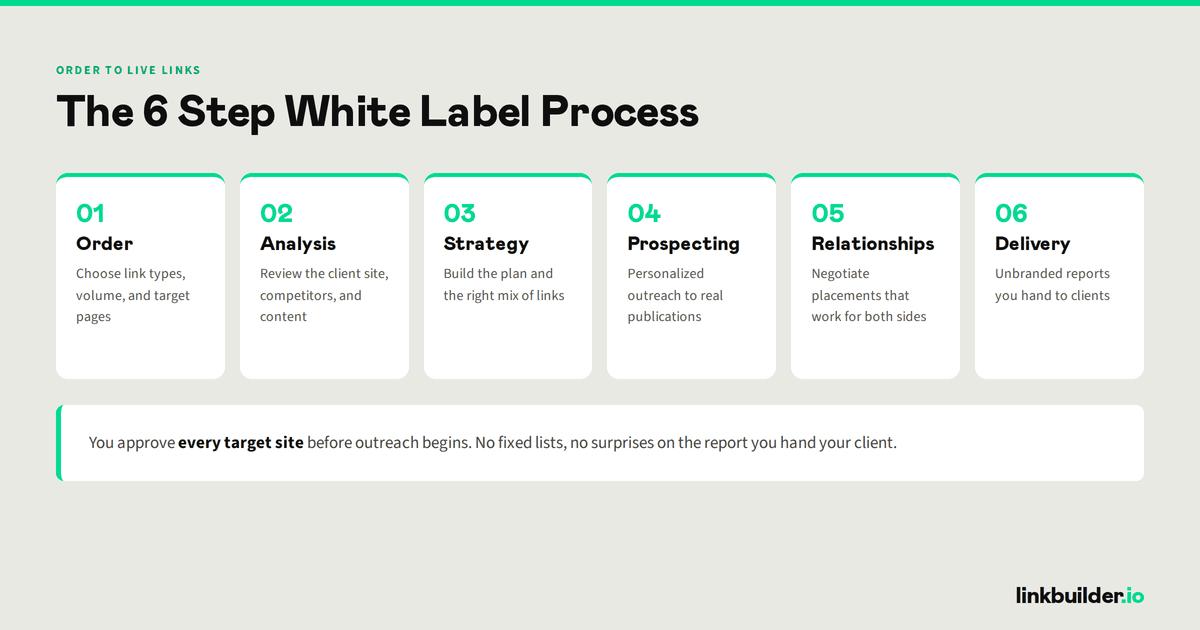
1. Order
You choose the link types and volume, and tell us which pages to build to. If you're not sure, we'll help you identify the best candidates.
2. Analysis
We review your client's site, their competitors, and their existing content to find the strongest opportunities.
3. Strategy
We build a plan for the fastest route to quality links. The exact mix depends on the client and their targets, and often includes guest posts, editorial links, and linkable assets.
4. Prospecting
We build a list of opportunities and reach out. Every message is personalized to the site and makes a real case for why the client is worth covering. That's what gets responses from publications that matter.
5. Relationship building
We leverage existing publisher relationships and build new ones, then negotiate placements that work for both sides.
6. Delivery and reporting
As links go live we track them with a backlink monitoring tool and deliver unbranded reports you can pass straight to your client.
What to Report to Your Clients
Most agency link reports stop at referring domains and DR. Those still matter, but they no longer tell the whole story. Consider adding:
Target page movement. Rankings for the specific pages you built to, not sitewide averages.
Referring domain growth over time. The trend line is more persuasive to clients than a monthly count.
Branded search volume. Coverage that prompts people to search your client's name is doing real work.
Total web mentions, linked and unlinked. This is the signal that correlates most strongly with AI visibility, and almost nobody reports it.
Presence in AI answers. Run a fixed set of category prompts monthly and log whether your client appears. It's a simple habit that makes for a striking slide six months in.
Adding those last two costs you very little and differentiates your reporting from every other agency your client has worked with.
Frequently Asked Questions
What is white label link building?
White label link building is when an agency outsources link building to a specialist provider and delivers the results to clients under its own brand. The provider handles prospecting, outreach, and placement, while the end client only ever sees the agency's name and reporting.
How much does white label link building cost?
Pricing is usually per link or as a monthly retainer, and varies with the authority and relevance of the target sites. Managed monthly programs typically start in the low thousands and scale with link volume. Be cautious with anything priced far below market, as it usually indicates PBNs, link farms, or sites with no real traffic.
Is white label link building safe for my agency?
It's as safe as the provider you choose. Legitimate editorial placement built on manual outreach carries no more risk than links you'd build yourself. The risk comes from providers using PBNs, link farms, or automated outreach, which can trigger penalties your client will hold you responsible for. Pre-approval on every placement is the single best protection.
Will my client find out I'm outsourcing?
Not with a properly run white label service. Reporting is unbranded, the provider never contacts your client, and placements carry no provider branding. Confirm the communication and invoicing process before you start.
Does link building still work now that AI answers exist?
Yes, and arguably it matters more. Backlinks remain a core input to rankings, and the rankings feed Google's AI Overviews. The brand mentions that come alongside those links correlate even more strongly with AI visibility than the links themselves. Link building is one of the few tactics that builds both at once.
How long before clients see results?
Expect meaningful ranking movement in three to six months, depending on competition and the client's starting authority. Set that expectation early. Agencies that promise results in weeks tend to lose the account in month three.
Build Links Your Clients Will Be Glad You Sold Them
Our white label service is built for agencies that want to offer serious link building without the overhead of an in-house team. High-quality placements on real sites with real traffic, unbranded reporting you can hand straight to a client, and a strategy tailored to each account.
You don't need link building expertise to use it. We'll help identify target pages, plan anchor text, and analyze competitors, and the program flexes to fit however you like to work.
Have a look at our case studies to see the work in action, or book a call and we'll map out what a white label program would look like for your client roster.