


Digital PR Plus: How Earned Links and Brand Mentions Work Together

Erika
Head of Link Operations
Every digital PR placement gives you two assets, not one.
There's the link, which feeds your rankings. And there's the mention, the moment your brand name sits inside real editorial context on a source people and machines already trust. Most teams count the first and ignore the second.
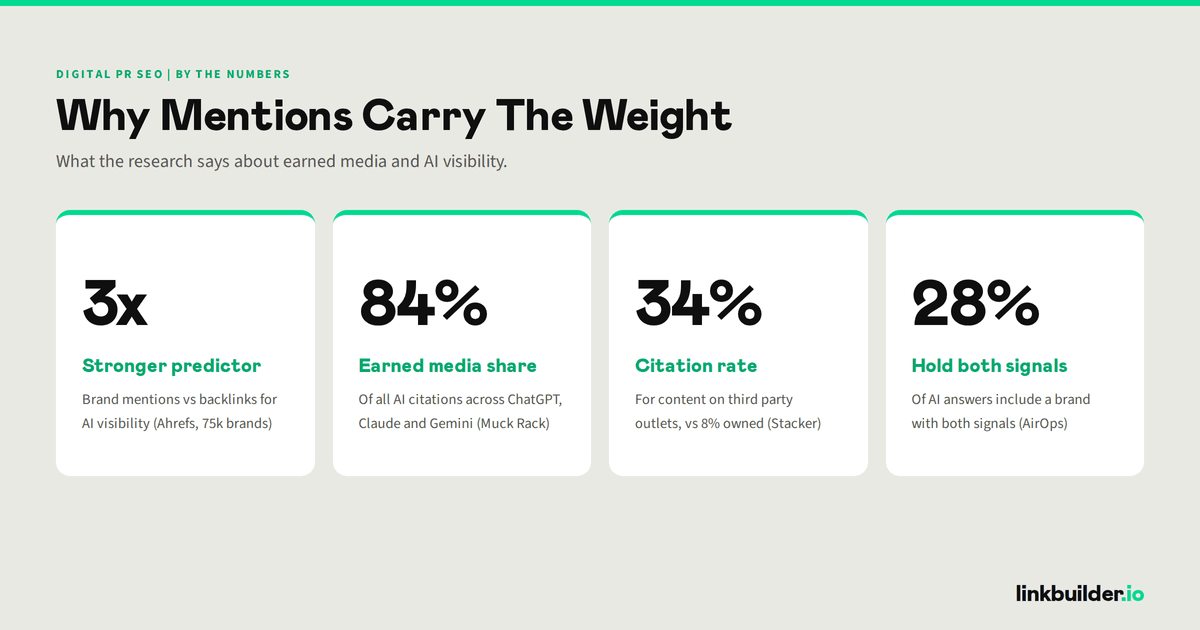
That's a problem, because the research says the second one is doing more work than you think. Ahrefs looked at 75,000 brands and found that branded web mentions correlate with visibility in Google's AI Overviews at 0.664. Backlinks came in at 0.218. Roughly three times the predictive power, from the signal most reporting dashboards don't even track.
This is what digital PR SEO looks like now. Not link acquisition with a press release attached, but a coordinated play where the link and the mention compound each other.
Here's how that works, and how to run campaigns that earn both.
What Is Digital PR SEO?
Digital PR SEO is the practice of earning editorial media coverage that improves your search rankings and your visibility inside AI answers at the same time.
It differs from standard digital PR in what it optimizes for. Traditional PR chases reach and sentiment. Digital PR SEO chases reach, sentiment, and the technical signals search engines and large language models use to decide who's credible.
Three things separate it from ordinary link building:
The placement is editorial. A journalist or editor chose to include you, which is a different quality signal than a paid or negotiated link.
The context is rich. Your brand appears next to your category terms, your competitors, and the problem you solve. That co-occurrence is what teaches a model what you are.
The outlet carries independent authority. The publication's own trust profile transfers to the claim it's making about you.
You're not buying a link. You're buying a sentence about your brand in a place that matters.
The Two Assets Every Placement Creates
Split a single piece of coverage into its parts and you can see why measuring only one half undercounts the campaign.
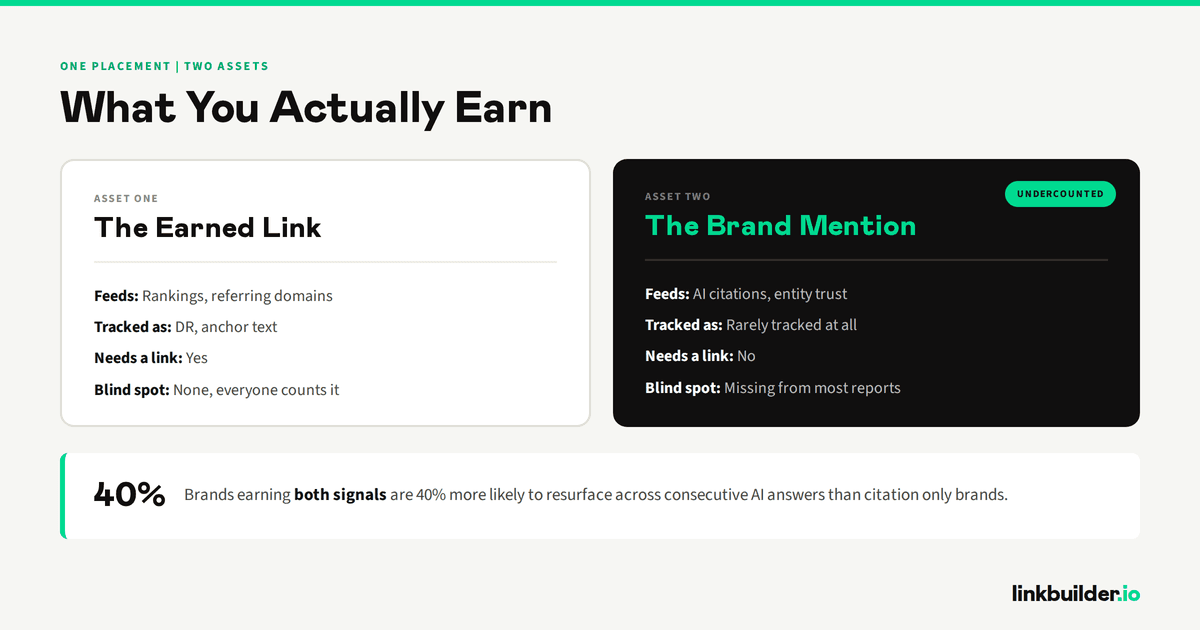
The earned link | The brand mention | |
|---|---|---|
What it is | A contextual dofollow link back to your site | Your brand name inside the article body |
What it feeds | Rankings, referring domains, domain authority | Entity recognition, AI citations, branded search |
How it's usually measured | Referring domains, DR, anchor text | Rarely measured at all |
Whether it needs a link | Yes | No |
That last row is where most teams get tripped up. A mention works without a link attached.
AirOps found something that makes this concrete: nofollow links correlate with AI visibility at 0.509, and dofollow links at 0.504. Statistically, they're the same. If your outreach team is walking away from a placement in a genuinely authoritative outlet because the link is nofollow, you're leaving the more valuable asset on the table to protect the less valuable one.
That doesn't mean links stopped mattering. It means they stopped being the only thing that matters.
Why Mentions and Links Together Beat Either One Alone
This is the part that reframes how you should think about campaign design.
AirOps tracked how brands move in and out of AI answers across repeated runs of the same query. Only about 30% of brands stay visible from one answer to the next. Models rebuild the response from scratch every time, so single snapshots tell you almost nothing.
But brands that earned both a mention and a citation were 40% more likely to resurface across consecutive runs than brands that only got cited.
And here's the opening: only around 28% of AI answers include a brand carrying both signals. Dual visibility is the strongest position available and most of your competitors don't hold it.
The mechanism isn't complicated. A citation tells the model where to find the information. A mention tells it that independent sources treat your brand as a real entity in this category. One is navigation. The other is trust. Models that are reconstructing an answer from scratch lean on trust to decide who makes the cut.
Chase one, you get volatility. Chase both, you get staying power.
How AI Engines Read a Digital PR Placement
If you want to understand why editorial coverage punches above its weight in AI search, look at what these systems are actually reading.
Muck Rack's ongoing analysis of AI citations, drawn from more than 25 million links across ChatGPT, Claude, and Gemini, found earned media accounts for roughly 84% of everything these models cite. Journalism alone makes up about 27%. Paid and advertorial content sits near zero, around 0.3%.
Across three editions of that study going back to mid-2025, the earned media share has stayed in the low-to-high eighties. That's not a model quirk. That's structural.
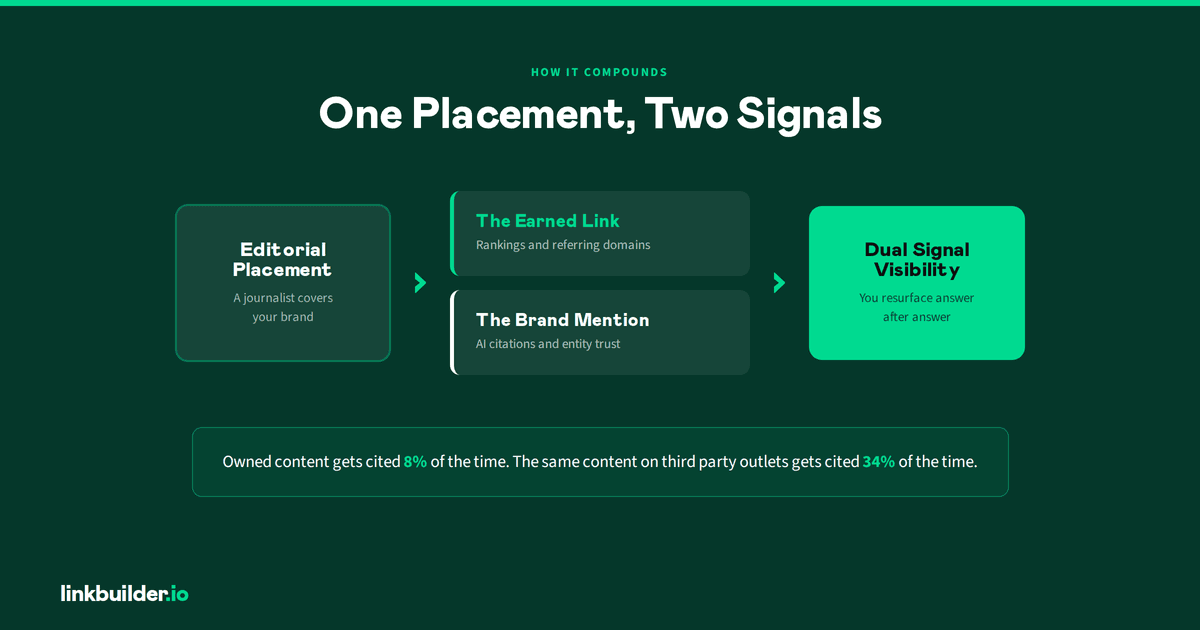
Stacker and Scrunch went a step further and isolated the variable. They took the same articles and measured citation rates in two conditions: living only on the brand's own site, versus distributed across third-party news outlets. Owned-only content got cited about 8% of the time. The identical content, placed on third-party publishers, hit 34%. Their larger follow-up study across 87 stories and eight AI platforms put the median lift at 239%.
Same words. Different address. Four times the citation rate.
Two more findings worth sitting with:
About 60% of AI Overview citations come from URLs that aren't ranking in the top 20 organic results. Your ranking isn't a prerequisite for being cited.
Around 85% of brand mentions in early commercial discovery come from external domains, not your own. Brands with a strong off-site footprint are roughly 6.5 times more likely to surface in AI search than those relying on owned content.
You can't publish your way into this. The signal only exists off your domain. That's the whole argument for treating digital PR as an SEO channel rather than a brand-awareness line item, and why press links belong in your search strategy rather than beside it.
What This Changes About Running Campaigns
The strategy shifts in four specific ways.
Pitch for context, not just placement
A link in a listicle where your brand appears once is worth less than a story where your brand is discussed, described, and positioned. When you're briefing a campaign, ask what the article will actually say about you, not just whether it links.
The goal is co-occurrence: your brand name appearing near your category terms, your use cases, and the problem you solve. That's the raw material models use to build an understanding of what you are.
Target the outlets AI already cites
Muck Rack turned up an uncomfortable gap. The journalists PR teams pitch most often overlap with the journalists AI models actually cite by roughly 2%.
Most PR target lists were built for human reach. If AI visibility is part of the goal, the list needs rebuilding around which publications your target engines already pull from. Run your category prompts through ChatGPT, Perplexity, and Google AI Mode, note which outlets come back, and pitch those.
Favor repetition over the one-off hit
One placement in a major outlet feels like a win. It rarely moves visibility on its own.
Because models rebuild answers each time, and because visibility fluctuates run to run, what you want is a consistent presence across many trusted domains. Breadth of recognition matters more than any single trophy placement. This is why ongoing campaigns outperform one-time pushes, and why news site coverage works best as a program rather than a project.
Make the page you're pointing at worth citing
Earned coverage sends signals toward a destination. If that destination is a stale, poorly structured page, you've spent budget carrying trust to a dead end.
AirOps found that pages going more than three months without an update are over three times more likely to lose AI citations. More than 70% of AI-cited pages have been updated in the past year. On commercial queries the window tightens further.
Before a campaign runs, make sure the target page uses a single H1 with a clean heading hierarchy, leads with a direct answer under each heading, includes lists and a table where they help, and reflects current pricing and claims. Our guide to generative engine optimization covers the on-page side in full.
How to Measure Digital PR SEO Properly
Referring domains and DR are still worth tracking. They're just an incomplete picture. Add these:
Unlinked brand mentions. Track total web mentions over time, not just linked ones. Unlinked mentions are a real signal, and they're also a reclamation opportunity.
Branded search volume. Ahrefs found branded search correlates with AI Overview visibility at 0.392, ahead of backlinks. Coverage that drives people to search your name is doing SEO work.
Branded anchor share. Branded anchors correlated at 0.527, second only to mentions. Check that your anchor text profile isn't over-weighted toward exact-match commercial terms.
AI answer share of voice. Run a fixed set of category prompts on a schedule and log how often you appear, whether you're mentioned, cited, or both.
Dual-signal rate. The percentage of AI answers where you get the mention and the citation. Given only about 28% of answers include a dual-signal brand, this is the metric with the most room to move.
Track these before a campaign starts so you have a baseline. Digital PR results compound, which means the interesting curve is a six-month one, not a two-week one.
Where Digital PR Plus Fits
We built Digital PR Plus for brands that need top-tier coverage rather than volume.
Each campaign secures 10 or more premium earned media placements on leading global outlets, with verified domain metrics and contextual dofollow links inside real editorial content. Placements are structured so the brand mention reads naturally alongside your category terms, which is what makes coverage usable by AI Overviews as well as by Google. Reporting is white-label, so agencies can pass it straight to clients. Campaigns run at $5,000.
If you need consistent monthly velocity instead of a single high-impact push, our standard Digital PR service runs on monthly tiers starting at 12 or more guaranteed placements. The two work well together: Plus establishes the tier-one anchor coverage, monthly campaigns sustain the breadth that keeps you resurfacing.
Both produce editorial links rather than directory or negotiated placements, which is the distinction that matters for link trust in both search and AI systems.
Frequently Asked Questions
Is digital PR SEO different from link building?
Yes, though they overlap. Link building optimizes for the link itself. Digital PR SEO optimizes for the link and the surrounding editorial context, because that context drives brand mentions, entity recognition, and AI citations. A digital PR campaign produces links as one output among several.
Do unlinked brand mentions actually help SEO?
They help visibility, which is the outcome you're after. Unlinked mentions don't pass link equity, but they correlate strongly with appearing in AI Overviews and generative answers, and they lift branded search volume, which feeds back into rankings. Nofollow and dofollow links correlate with AI visibility at almost identical rates, which tells you the mention is doing much of the work regardless of link type.
How long does digital PR take to affect rankings and AI visibility?
Placements go live within weeks. Ranking movement typically shows over two to four months as links are crawled and authority settles. AI visibility can move faster in some cases, since newly published content can start generating citations within days, but consistent presence across answers takes a sustained program rather than a single campaign.
How much does digital PR cost?
It varies by tier and outlet quality. Campaign-based tier-one coverage tends to start around $5,000, and monthly retainer programs generally range from roughly $2,750 to $10,000 depending on placement volume. Cheaper offers usually mean syndicated press release distribution, which produces very different results from genuine editorial placement.
Should I do digital PR if I'm not ranking yet?
Often yes. Around 60% of AI Overview citations come from pages outside the top 20 organic results, so AI visibility isn't gated behind existing rankings the way traditional SERP visibility is. Digital PR is one of the few tactics that can build authority and visibility at the same time.
Earn Both Signals
The teams winning in AI search aren't the ones with the biggest link counts. They're the ones whose brand gets discussed, in context, on sources the models already trust, with a link back to a page worth citing.
That's what a well-run digital PR campaign delivers. Both signals, from the same placement.
We can show you which outlets your category's AI answers are already pulling from, and what it would take to get you into them. Book a call and let's map it out.