

How to Set Realistic Link Building Timelines (by Vertical)

Erika
Head of Link Operations
Ask ten SEOs how long link building takes. You’ll get answers like “six months,” “three to twelve,” or the standard “it depends.” All technically correct. None of them helpful when you’re trying to budget a campaign or set client expectations.
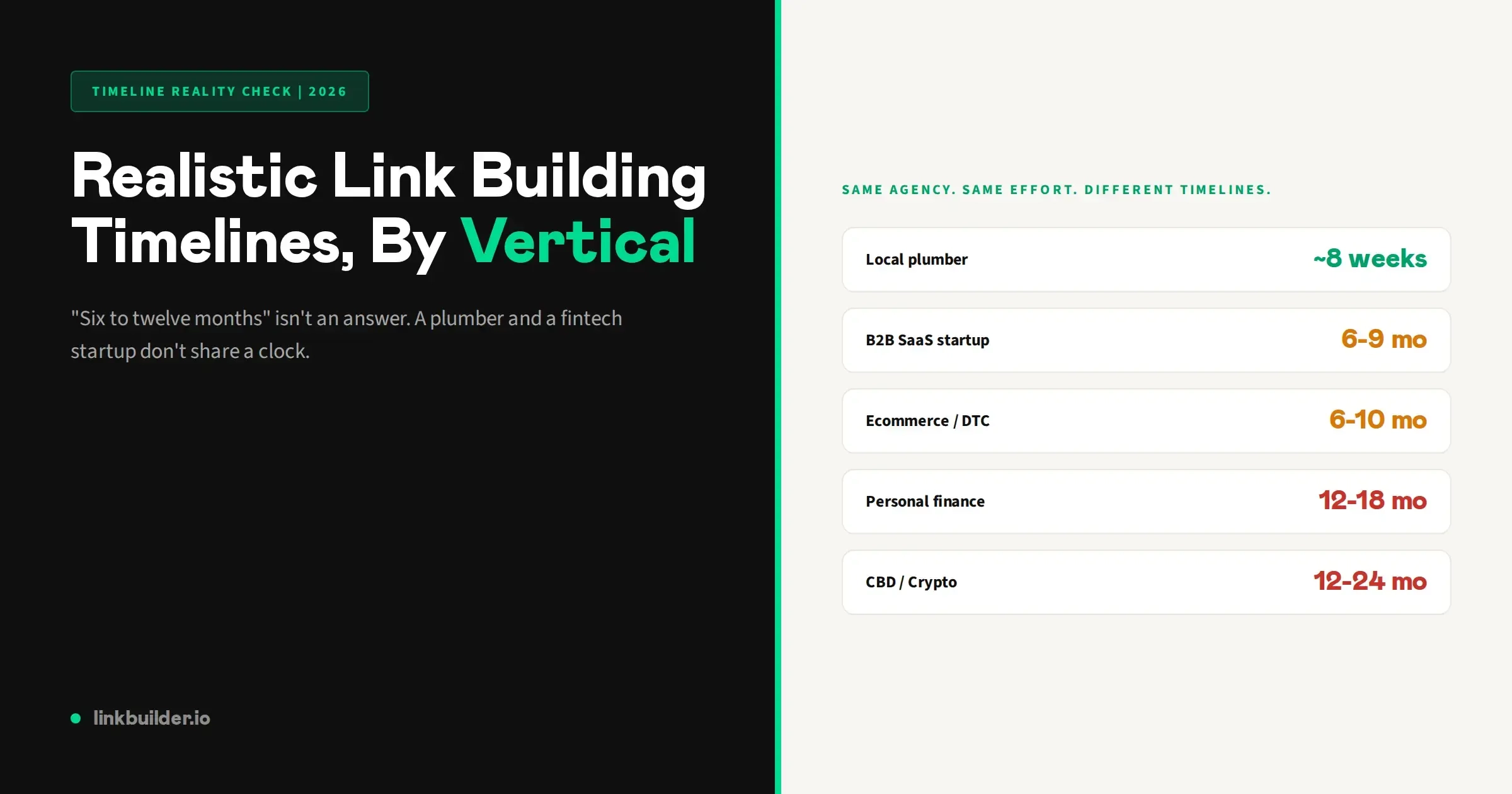
Your timeline depends almost entirely on your vertical. A local plumber and a fintech startup don’t operate on the same clock. Same agency, same budget, same number of links can produce results in four months for a SaaS productivity tool and take eighteen months in personal finance. BuzzStream’s 2025 industry data puts the median for B2B around six to nine months, but the variance across categories is huge.
Below: realistic timelines for six common verticals, with the specific factors that compress or stretch each one.
Four Factors That Drive Every Timeline

We covered how long link building takes in general terms in a separate guide. This post focuses on what changes when you swap verticals. Four variables explain almost all of it.
-
Competition density. How many sites are actively building links for the same keywords? In personal finance, you’re not just trying to rank. You’re trying to outpace dozens of well-funded competitors building links continuously.
-
Trust threshold. Google applies E-E-A-T weighting differently across categories. YMYL topics (health, finance, legal) demand more authority signals before any ranking will move.
-
Content velocity. News, finance, and B2B publish constantly. Industrial manufacturing doesn’t. High-velocity verticals create more linkable opportunities, plus more competition for the same publishers.
-
Editorial friction. CBD, gambling, crypto. Many publishers refuse placements outright. Others charge premiums. This stretches everything.
Your link velocity also has to mirror or modestly exceed your competitors’ pace. Too slow and you fall behind. Too fast and Google flags it.
Local Services: 2 to 4 Months
Local service businesses have it easiest. Dentists, plumbers, lawyers, contractors, real estate agents. The competition is geographically bounded, the keyword universe is small, and most local competitors have weak link profiles you can leapfrog with modest investment.
First ranking movement at six to ten weeks. Real traffic gains by month three or four. Stable competitive position by month six. You usually don’t need more than 8-15 quality local placements to start outranking competitors, and citations from regional press and industry-specific directories punch well above their weight. The bar is lower because most local competitors aren’t actively building links at all. They’re just sitting on a Google Business Profile and hoping.
Caveat: major metros change the math. Personal injury lawyers in Manhattan or cosmetic surgeons in LA are competing at national-level intensity, even if the keyword has “NYC” in it. Same for any local service category where the average customer transaction runs into the thousands. Once the LTV is high enough, dedicated SEO competitors show up, and the local timeline starts looking more like B2B SaaS. Add four to eight months in those cases.
B2B SaaS: 6 to 9 Months
SaaS sits in the awkward middle. Real publishers exist. Journalists actively seek expert commentary. The audience is reading. But the content you actually need links pointing to (comparison pages, integration pages, pricing pages) almost never earns links naturally, which means most of your authority has to flow in through blog content and propagate internally. Our deeper guide on link building for SaaS covers the strategy mechanics. The timeline picture:
The benchmark
First ranking movement around month four to six. Meaningful traffic and lead lift around month seven to nine. Twelve months before you’ve stabilized in a competitive category.
What helps
Original research and benchmark reports compound brutally well in SaaS. A single “State of [your industry]” study can pull links for two or three years if it’s promoted right. Newer SaaS categories (vertical SaaS, recently launched product types) move significantly faster than mature horizontal ones because the SERP isn’t yet saturated with authority sites.
What kills the timeline
Mature horizontal categories like CRM, project management, and accounting are punishing. Incumbents have been compounding link equity for a decade. New domains face an additional 9-12 month trust delay before links really start moving rankings, regardless of how well the content is built.
Ecommerce and DTC: 6 to 10 Months
Ecommerce timelines split based on what page type you’re trying to rank. Category and collection pages move on backlink signals plus content depth. Product pages almost never earn editorial links and rely on internal authority distribution from category pages and blog content. Most ecommerce SEO failures we see start here, with operators expecting product page rankings to lift on the same timeline as the rest of the site.
Plan for first movement around month five to seven, real traffic gains by month eight to ten, and stable category page rankings around twelve months. Product page rankings lag the rest by another three to six months. That gap surprises a lot of operators who expect link building to lift everything in parallel.
DTC brands with a clear founder story or distinctive product positioning land lifestyle press faster than generic ecommerce sites. We’ve seen DTC clients earn TechCrunch and Forbes coverage in their first two months simply because the founder had something interesting to say about category trends. Once a piece of coverage like that lands, it tends to attract three or four follow-on mentions in adjacent press. The flip side: in established categories where Amazon, Walmart, and the category leader hoover up most coverage, even great link building takes longer to break through. Thin-margin categories also limit how much volume you can sustain monthly, which extends timelines further.
YMYL Verticals (Finance, Health, Legal): 12 to 18 Months
Your Money or Your Life is the slowest category in SEO, and it’s not close. Google’s quality rater guidelines explicitly call out YMYL pages as needing the highest level of trust signals. Backlinks alone won’t move YMYL rankings without supporting infrastructure: credentialed authors, citation density, expert review markup, the right kind of authority signals.
Realistic numbers: first ranking movement at eight to twelve months. Meaningful traffic at twelve to fifteen. Stable competitive position somewhere between eighteen and twenty-four months.
Where the time actually goes

Tier-one digital PR campaigns (Forbes, WSJ, MarketWatch for finance; major medical publications for health) compound much faster than guest posts in YMYL. Original research featuring credentialed researchers earns disproportionate authority signals that other tactics simply can’t match.
New domains in YMYL face an additional six to twelve month trust delay on top of the normal timeline. Personal finance and insurance have some of the highest competition density in SEO, with affiliate sites running continuous campaigns. Healthcare layers on additional content vetting that slows production. Legal verticals demand credential signals that take time to build out. None of this is fixable with budget alone. The timeline is structural, not a function of how hard you push.
Restricted Verticals (CBD, Gambling, Crypto): 12 to 24 Months, Sometimes More
Restricted categories are their own animal. The publisher universe for any given category is 60-80% smaller than non-restricted equivalents. Costs run 30-50% higher per qualified placement. Outreach response rates are flatly lower across the board, even with strong content.
Plan for first movement around month nine to fourteen. Meaningful traffic by month fourteen to eighteen. Brand new sites in these categories often push past two years before anything resembling competitive rankings.
One useful angle: industry-specific publications that do accept the category often have small audiences but very high topical relevance, which Google weights heavily. Original research and expert commentary can also earn coverage in mainstream business and lifestyle press if the angle is framed around broader trends rather than the product itself. That’s where the unlock usually is.
Enterprise: There Isn’t One Timeline
Enterprise sites don’t have a timeline in the same sense. Different sections of the site are at different stages simultaneously, and the question is never “when do we see results” but “which property and which keyword cluster.” Enterprise link building is a continuous program, not a campaign with an end date.
Specific clusters can move within four to eight months given coordinated content and link investment. Whole-site authority growth tracks over twelve to twenty-four month windows. New property launches inherit some authority from the parent domain but still need six to twelve months of dedicated work to compete in their specific niche.
The bottleneck at this scale is rarely budget or strategy. It’s internal coordination. Multiple teams building links to overlapping pages can trigger Google’s spam signals, and brand and PR teams operating without SEO alignment leave a lot of authority on the table. We’ve seen enterprise programs lose six full months because the SEO team and the brand team were independently pitching the same publications. Editors blocked both. The fix wasn’t more outreach; it was a shared spreadsheet and a Friday standup.
Setting Expectations With Stakeholders

How you communicate timeline matters as much as the timeline itself. Stakeholders who expect results in three months and get them in eight will always consider the campaign a failure, even when eight is the right number for the vertical.
Frame timelines in milestones, not endpoints. “First ranking movement” is not the same as “meaningful traffic,” which is not the same as “stable competitive position.” Setting all three up front gives stakeholders early signals of progress instead of one distant goalpost.
Report on leading indicators that show the campaign is working before rankings move. Referring domain growth, average DR of placements, topical relevance scores, and AI citation tracking all shift before traffic does. Our guide on link building reporting walks through the full framework, but the principle for timeline communication is simple. Make progress visible before the headline metric moves.
And budget for the actual timeline, not the wishful one. A six-month budget on an eighteen-month vertical is the most expensive way to learn this lesson. We’ve watched clients churn agencies every six months for three years before realizing the problem wasn’t the agencies. It was the math.
How We Set Timelines at LinkBuilder.io
Before any new engagement, we look at your vertical’s competitive landscape, your starting backlink profile, and the keywords you’re chasing. We tell you what’s realistic for your specific situation, not what’s convenient to sell. We’ve turned down engagements where a client’s budget couldn’t sustain the timeline their vertical actually requires. Setting unrealistic expectations is worse than not taking the work.
Working across verticals like SaaS (Udemy, SoFi), travel (TripAdvisor), and ecommerce has taught us something most agencies won’t admit out loud: the same playbook does not work everywhere, and pretending it does is how clients end up frustrated at month four. The agency you want is the one that tells you upfront when your category needs eighteen months, not the one that promises results in six.
Want a second opinion on what’s achievable in your vertical? Book a strategy call. We’ll walk through the specific factors in your category and give you a timeline you can actually hold to.
The Bottom Line
Pick a vertical-specific timeline and commit to it. Local services move in months. Restricted YMYL categories move in years. Both can succeed. Only the campaigns with matched expectations make it to the finish.
The campaigns that fail aren’t the ones that take too long. They’re the ones cancelled at month four because someone expected three.
Erika
Head of Link Operations