

What Your Link Building Budget Actually Buys: A Realistic Guide to Backlink Quality at Every Tier

Erika
Head of Link Operations
Here’s a conversation we have a lot. A client signs up for a link building package, sees the first month’s placements, and asks why their backlinks aren’t appearing on TechCrunch.
It’s a fair question, and it points to a bigger issue. Different price points buy different things, and most agencies aren’t clear about what those differences actually are. The result is mismatched expectations: budget links pitched as premium, premium campaigns sold as silver bullets, and clients in the middle trying to figure out which is which.
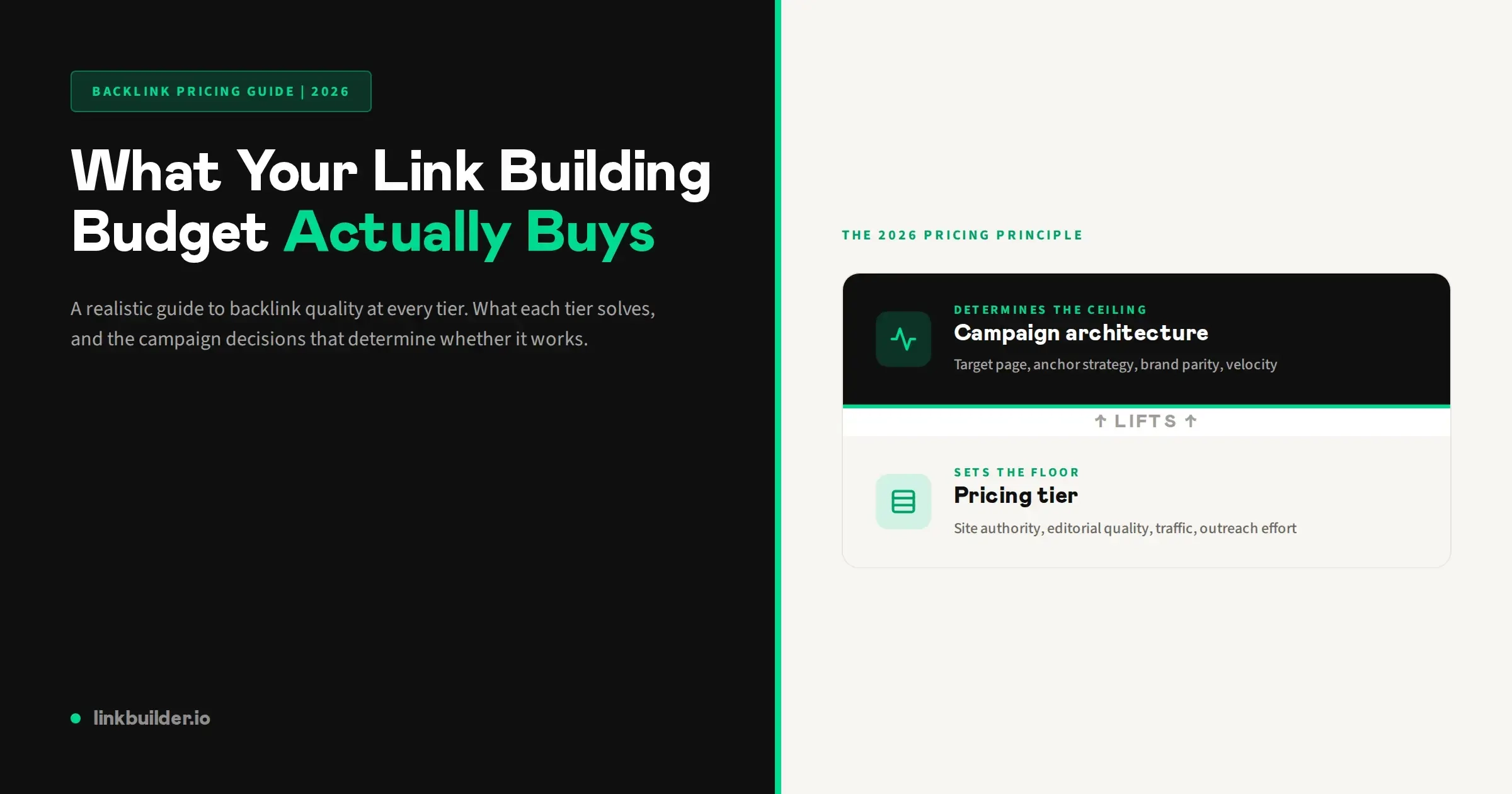
Backlinks still drive rankings. Backlinko’s analysis of 11.8 million Google search results found the #1 result has 3.8x more backlinks than positions 2-10. But “a backlink” is a category, not a product. A $150 placement and a $1,500 placement solve different problems. Tier sets the ceiling on what’s possible. Campaign architecture (target page selection, anchor strategy, content depth, velocity, brand parity) determines whether that ceiling gets hit.
This post breaks down what each tier actually delivers, what real outreach looks like behind the scenes, and how to think about budget alongside the campaign-level decisions that determine ROI.
Why Backlink Pricing Varies So Wildly

The same backlink, by name, can cost $150 or $1,500 depending on who’s selling it. The spread isn’t arbitrary. We’ve broken down the full economics in our guide on link building pricing. The factors that move the needle most:
-
Domain authority and traffic. A DR 70 site with 100,000 monthly visits costs more to place on than a DR 35 site with a few thousand. Editors at higher-authority sites field more pitches and accept fewer of them.
-
Topical relevance. A B2B SaaS placement on a real B2B SaaS publication costs more than a generic business or marketing blog. Smaller qualified pool, harder outreach, more valuable link.
-
Editorial quality. Sites with strict editorial review reject most pitches. The ones that get through require well-researched, human-written content with multiple revision rounds. Trustworthy backlinks come from sites that take editorial seriously, and that work has a real cost.
-
Real traffic and engagement. A site that actually has readers (not just a domain rating) commands a premium. Sites with real audiences send referral traffic, get cited in AI Overviews, and signal trust to search algorithms in ways empty DR can’t.
-
Outreach effort. Pitching a tier-one publication can take weeks. Pitching a content-mill blog takes 30 seconds. BuzzStream’s 2025 pricing data puts the average link insertion at $141 and the average guest post at $365, but the spread is wide for good reason.
-
Campaign architecture and portfolio fit. The least-discussed factor and often the most important. A $1,500 placement pointed at the wrong target page, with the wrong anchor, on a brand the publication’s audience doesn’t recognize, can underperform a $300 link placed correctly. Tier is one input. The architecture around the link decides whether the link works.
When you’re comparing quotes from two agencies, the price difference usually traces back to one or more of these factors. The cheaper option isn’t a deal. It’s a different product, often serving a different purpose.
What Each Price Tier Actually Delivers (and Which Problem It Solves)

Here’s what to realistically expect at each common price point in 2026, what the placement sites tend to look like, and what kind of SEO problem each tier is built to solve.
Sub-$200 per link: Foundational diversification
This is the tier where most early-stage sites start, and it’s also where the link-building landscape varies most dramatically in quality. Done well, sub-$200 placements give a new site the backlink diversification it needs to look established to search engines. Done poorly, they put your site on a list with a thousand other sites pointing to the same low-quality sources.
At the legitimate end of this tier, you’re paying for placements on smaller sites with lower DR but genuine content, lighter editorial review, and faster turnaround. The sites won’t move the needle for established brands competing on commercial keywords, but they do useful work for sites in early-stage authority building, niche diversification, or filling out a thin backlink portfolio.
At the bottom of this tier, especially below about $100, you start seeing the patterns we’ve written about in how to buy backlinks safely: AI-generated content, ad-stuffed templates, and sites that exist primarily to sell placements. Those are the ones to avoid. The fix isn’t to skip the tier. It’s to vet the sites.
Best fit for: brand-new domains needing backlink diversification, niche sites supplementing premium work with topical breadth, and clients who legitimately need volume at low cost and have the judgment to vet site-by-site.
$200-$500 per link: The mid-market workhorse
This is the tier where most ongoing link building programs sit, including our standard backlink offering at LinkBuilder.io (which sits alongside custom campaign work for established brands). Our review of the wider guest posting services landscape covers what’s available at this price point.
Expect placements on real blogs, written by humans, with editorial standards. DR typically 40-60 with modest but real traffic. A SaaS placement will land on a marketing, business, or tech blog with at least adjacent content. Acceptance rates are good, turnaround is reasonable, and the volume math works for sustainable monthly programs.
What this tier doesn’t reliably deliver: placements on publications your CMO reads. SaaStr, TechCrunch, Forbes, and tier-one industry outlets sit in a different price tier. There’s also a brand-parity factor at play here. DR-70+ outlets typically won’t outbound-link to sites with weak brand signals, regardless of pitch quality. If your brand presence and content depth haven’t yet caught up to where you want your links, mid-market placements are often the right move while you build the underlying authority that premium outlets require.
Best fit for: ongoing programs at most established sites, B2B and ecommerce brands building authority over 6-12 months, and sites that need consistent monthly volume more than they need any single marquee placement.
$500-$1,500 per link: Premium guest posts
This is the premium guest post tier. Placements on sites with strong editorial reputations, real verifiable traffic, and tight topical alignment to your industry.
Expect DR 50-75, named authors with real bylines, on sites that don’t accept just any pitch. Outreach often takes weeks. Editors push back on angles, request multiple revisions, and reject content that doesn’t meet their standards.
This is where placements start to do double-duty. They pass real link equity, send referral traffic, and increasingly get cited in AI tools like ChatGPT, Perplexity, and Google’s AI Overviews. Higher-priced placements generally increase the likelihood of stronger authority, relevance, and visibility signals. They don’t guarantee ranking outcomes on their own. SEO performance still depends on campaign strategy, target page selection, content quality, competition, and overall site authority. The placement makes the outcome possible. The architecture around it determines whether it happens.
Best fit for: established brands competing on high-intent commercial keywords, sites building authority that LLMs recognize, and brands ready to support premium placements with the content depth and brand signals premium publications expect to link to.
$2,000+ per placement (Digital PR campaigns)
At this point, you’re not buying “a link” anymore. You’re buying earned media coverage on national or industry-leading publications, priced as a campaign rather than per-link. Ahrefs found that AI Overviews now reduce CTR for the #1 organic result by 58%, which has shifted the calculus on premium coverage. Getting cited inside the AI Overview itself is increasingly the prize, and those citations almost always come from coverage on publications AI models trust.
Our Digital PR service runs as monthly retainers (starting at $2,750/mo for 12+ guaranteed placements, scaling to $10,000/mo for 48+). Digital PR Plus runs $5,000 per campaign for 10+ premium placements on top-tier outlets. The campaign price reflects the work behind these placements: original research, expert sourcing, journalist relationships, and the newsroom-quality storytelling that gets picked up by real publications.
One important constraint that doesn’t get discussed enough: top-tier publications routinely reject direct links to commercial pages. DR-70+ outlets typically require links pointing at informational assets (a study, a blog post, a free tool, a research piece) rather than a pricing or signup page. Premium campaigns aren’t just more expensive than guest posts. They require a different campaign structure: building or selecting informational assets that can absorb the premium link, then routing equity to the commercial page via internal linking.
Digital PR campaigns are designed to improve brand authority, visibility, and media trust signals over time. They can contribute meaningfully to stronger SEO and AI visibility outcomes. They aren’t guaranteed to produce AI Overview citations or specific ranking improvements on their own. Outcomes vary based on industry competition, campaign execution, the strength of the underlying brand, and broader search ecosystem changes. This is the tier with the highest ceiling, but ceiling and outcome are different things.
Best fit for: brands building media trust and AI visibility, companies in YMYL verticals where authority signals carry extra weight, and any brand that wants to be cited inside AI answers rather than just ranked beneath them.
Why Two Placements in the Same Tier Can Perform Very Differently

This is the part most pricing guides skip. Two $375 placements on similar DR-50 sites can produce wildly different results for the same client, and two $1,500 placements can do the same. Tier sets the floor for what’s possible. A handful of campaign-level decisions determine whether the placement actually moves the needle.
-
Target page selection. A premium link pointed at a thin pricing page won’t outperform a mid-market link pointed at a strong informational asset that routes internal equity to the same pricing page. The receiving page matters as much as the link.
-
Anchor distribution. Anchor strategy is its own discipline. A portfolio that’s 60% exact-match commercial anchors will trip algorithmic signals regardless of placement quality. A portfolio with branded, naked-URL, and partial-match balance protects the receiving page. This is the kind of thing campaign management catches that per-link purchasing misses.
-
Brand parity. Premium publications check the brand they’re linking to. Outreach success rates drop sharply when the client’s own credibility (brand presence, existing media coverage, site authority, brand search volume) sits below the tier of publications being pitched. Brands with weak signals usually need a foundational runway (lower-tier placements, content depth, brand-building work) before premium campaigns are economically viable.
-
Velocity and timing. Acquiring 20 premium links in 30 days looks unnatural and can trip algorithmic flags. Spreading the same 20 over 8-12 weeks mirrors organic earned-media patterns. Natural link velocity is a campaign lever, not a constraint.
-
Portfolio architecture. A healthy 2026 backlink profile needs both the volume of mid-tier links and the authority signals of Digital PR to satisfy AI discovery algorithms. The tiers are complementary, not mutually exclusive. Programs that lean entirely on one tier usually underperform programs that mix intelligently.
This is why two clients with identical Digital PR budgets can see very different outcomes. The one with strong brand signals, thoughtful target page architecture, balanced anchor distribution, and supporting mid-tier volume gets the campaign working hard. The one ordering placements à la carte gets links that don’t compound.
What Real Outreach Actually Looks Like
Most clients have never seen what link building looks like behind the curtain. That’s part of why expectations get warped.
The hit rate is brutal
Even for our team, with years of editor relationships, the hit rate on cold outreach to quality publications is usually 5-15%. For every 100 pitches, we land 5-15 placements. The other 85-95 get ignored, declined, or stuck in editorial limbo for months.
That math has implications for pricing. If a placement requires 20+ touches across multiple sites to land one yes, the per-link cost has to absorb all that work. Lower-cost placements often reflect different cost structures (lighter human touch, lower-DR sites with faster acceptance, smaller publications) rather than lower-quality work. Some lower-cost placements legitimately serve early-stage sites doing foundational diversification work. The trick is being honest about which tier you’re buying and why.
Editors have gotten pickier
In 2026, editors at quality publications field hundreds of pitches a week. Most are obviously templated, AI-generated, or thin attempts to slip in a backlink. Good editors filter aggressively.
Getting a yes today means a custom angle that fits the publication, a writer with verifiable expertise, original insights, no obvious link-stuffing, and a willingness to revise. That’s not the job it was five years ago, and the pricing reflects that.
Timelines are longer than clients expect (and that’s a feature)
From pitch to published placement, the average timeline at the premium tier is 4-8 weeks. Sometimes longer. That’s not slow execution. It’s editorial reality. Editors have queues, holidays, and other stories competing for attention.
There’s also a strategic benefit to that pacing. Natural link velocity protects the campaign from algorithmic flags that aggressive bulk acquisition can trigger. Spreading premium placements over weeks mirrors organic earned-media patterns and makes the entire backlink profile look more authentic to Google. If an agency is delivering links within days of signup, ask how. The answer is usually a paid placement marketplace, a content network, or a sponsored post. Link insertions on already-published content can move faster than guest posts because there’s no editorial review of new content, but those still require finding the right page on the right site.
How to Match Your Budget to Your Goals (or Better, Your Goals to Your Budget)
Most agencies pitch this section the wrong way around. They ask what your budget is and tell you what tier you can afford. The stronger move is the inverse: define the target ranking for your priority keywords, audit the backlink profile of whoever currently ranks there, and work backward to the budget required to close the gap. Gap-driven budgeting consistently outperforms budget-first tier selection.
If you’re an early-stage site building foundational authority
You probably don’t need premium placements yet. What you need is steady, topically-adjacent links that diversify your backlink profile and signal that your site is real. The foundational and mid-market tiers ($150-$500 per link) are built for this. Set expectations that wins will be incremental and that DR growth, not specific placement names, is the metric to watch.
If you’re competing for high-value commercial keywords
Mid-market alone usually won’t get you there if the keyword is competitive. Plan for a mix: a base of $300-$500 placements for volume and consistency, layered with $1,000+ premium placements on the publications that actually matter in your industry. The mid-market volume builds the broad authority. The premium placements concentrate trust signals on the pages that need to rank.
If you’re an established brand competing on commercial keywords at scale
This is where tier shopping breaks down. The starting question isn’t “what tier?” but “what does the backlink portfolio need over the next 6 months, given keyword targets, page priorities, and competitor gaps?” The answer usually looks like a custom architecture: a mix of mid-tier volume, Digital PR for authority signals, targeted link insertions, and content support on the receiving pages. Per-link pricing is the wrong lens. Campaign architecture is the right one.
If you’re trying to win in AI search
AI tools cite trusted publications. Getting your brand mentioned across legitimate media is the most direct path to AI Overviews, ChatGPT answers, and Perplexity citations. A healthy 2026 backlink profile needs both the volume of mid-tier work and the authority signals of Digital PR. Our AI Discover program combines link building, content optimization, and digital PR into a managed visibility strategy.
If your existing backlink portfolio is losing steam
Sometimes the answer isn’t more new links. It’s making sure the ones you’ve already earned keep performing. Our Content Refresh service updates older pages so the backlinks pointing to them keep driving value. Often more cost-effective than starting from zero on new placements.
How to Have the Expectations Conversation Internally
If you’re the SEO lead, you’ll need to manage expectations with people who don’t live in this world day-to-day. Here’s a framework that works.
Start with the honest math. Show stakeholders what a placement at your budget tier looks like, with real examples. Pull up two or three sites that match your price point. Don’t compare them to TechCrunch.
Reframe the metric. Stakeholders often want specific publication names. Push the conversation toward what links are actually doing: DR growth, referring domain count, ranking improvements, AI citation tracking, and referral traffic. These are the metrics that map to revenue.
Set the timeline upfront. Link building results compound. Placements you’re earning this month will start moving rankings 2-4 months from now, and the cumulative effect builds over 6-12 months. If your stakeholders need wins in 30 days, link building is the wrong investment.
How We Think About This at LinkBuilder.io
We’ve worked with brands like Udemy, SoFi, and TripAdvisor, alongside hundreds of smaller B2B and ecommerce companies. Engagement structure looks different across that range. Mid-market clients run on monthly retainers with steady placement volume. Enterprise and established brands typically run custom campaigns architected around specific keyword targets, competitor gaps, and brand-tier publication strategies.
When we quote work, we tell you what kind of sites to expect, what the timeline looks like, what the placements will and won’t do on their own, and what the campaign architecture around them needs to look like. We’d rather lose a client at the proposal stage than sign one expecting Forbes coverage at a guest post budget, or expecting a Digital PR campaign to deliver guaranteed AI citations without supporting work.
If you’re trying to figure out what mix of tier and campaign architecture matches your goals, book a strategy call. We’ll walk through your backlink profile, target keywords, competitor gap, and what combination of services would actually move the needle.
The Bottom Line
Link building isn’t a single product. It’s a category of services with massive variation in quality, cost, and strategic fit. The biggest mistake clients make is shopping for the lowest price per link. The second-biggest is shopping for the highest, expecting tier alone to produce ranking outcomes.
A $150 placement and a $1,500 placement solve different problems. AI-generated filler on a content-mill site and an editorial feature on a real publication are not the same thing, even if both technically count as a backlink. And both can underperform when the campaign architecture around them is wrong.
The clients who get the best results match tier and campaign architecture to their goals: anchor distribution, target page mapping, velocity, brand parity, and portfolio balance. Tier sets the floor. Campaign craft determines the ceiling. The strongest SEO results come from aligning backlink strategy, content quality, technical SEO, and business goals, not from purchasing the highest-priced placements available.
That’s the conversation worth having before you sign your next link building contract.
Erika
Head of Link Operations