

How to Choose a Link Building Agency (Without Getting Burned)

Erika
Head of Link Operations
Hiring a link building agency is one of the easier ways to waste $20,000 on SEO. The market is full of agencies that look identical from the outside: same case study format, same DR promises, same “white-hat” language. The differences only show up months in, when the rankings haven’t moved and the placements look nothing like what was pitched.
That’s the bad news. The good news is the agencies actually doing the work give themselves away in the sales process. They answer questions specifically. They show real placements, not aggregated metrics. They push back on your goals if your goals don’t match your budget. And they talk about AI search like it’s already here, because it is.
This guide walks through how to choose a link building agency in 2026 without getting burned. We’ll cover what to figure out before you start vetting, the questions that actually separate strong agencies from weak ones, the contract terms worth negotiating, and the warning signs that should end the conversation early.
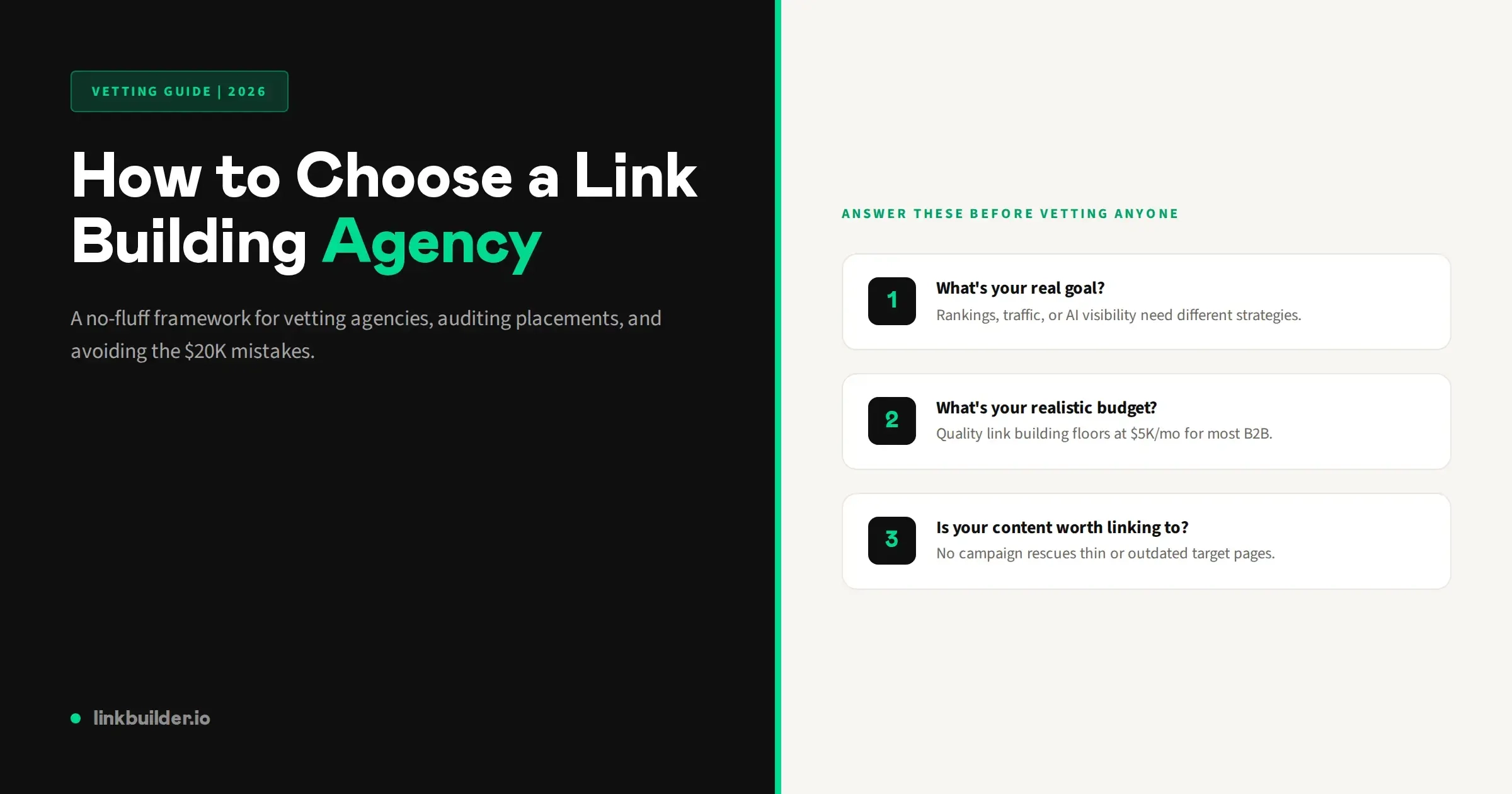
Before You Vet a Single Agency, Answer These Three Questions
Most bad agency hires happen because the buyer never defined what they actually needed. The agency fills the vacuum with whatever they sell.
1. What’s your real goal: rankings, traffic, AI visibility, or all three?
These goals require different link strategies. If you’re going after rankings on commercial keywords, you need editorial placements with topical alignment. If you’re going after AI visibility, you need brand mentions on publications that LLMs actually cite. If you’re going after referral traffic, the placement audience matters more than the DR. We covered the relationship between these goals and link-building reporting in a separate guide, but the short version is that the agency you hire should match the goal you’re actually trying to hit.
2. What’s your realistic budget for the next 6-12 months?
Quality link building isn’t cheap, and trying to negotiate it down past a certain floor just gets you worse links. According to BuzzStream’s 2025 pricing data, the average guest post costs $365 directly from a site, with high-quality placements averaging $930. Digital PR runs $1,250 to $1,500 per link. Most serious link building programs sit at $5,000 to $15,000 per month all-in. If your budget is $1,500/month, you’re not shopping for a premium agency. You’re shopping for a placement marketplace, and that’s a different conversation.
3. Do you have content worth linking to?
This is the question agencies wish more clients asked themselves. If your target pages are thin, outdated, or duplicate something stronger, no link building campaign will move them. The best agencies will tell you this in the discovery call. The worst will take your money and pretend the problem is link volume. Audit your top three target pages before you book any sales calls. If the content needs work, that’s where your budget goes first.
Understand the Four Types of Link Building Agency You’ll Find

“Link building agency” is a broad category that covers very different business models. Knowing which model you’re talking to changes how you evaluate them.
Full-service link building agencies
These run end-to-end campaigns: strategy, prospecting, content creation, outreach, placement, reporting. They typically work on monthly retainers with guaranteed link minimums, and they’re set up as strategic partners, not order-takers. This is what most B2B and SaaS companies need. Pricing usually starts around $5,000 per month.
Digital PR agencies
Digital PR agencies focus on earned media coverage on national and industry publications, often through original research, expert sourcing, and journalist relationships. The links are a byproduct of the coverage. This is the work that drives AI Overview citations and ChatGPT mentions. Our Digital PR service starts at $2,750 per month. If brand authority and AI visibility are the goal, this is the category to look at.
Guest post and link marketplaces
Marketplaces let you browse a database of sites and order placements à la carte. They work for agencies that want white-label inventory or for in-house teams that already have strategy figured out and just need execution capacity. Quality varies wildly. We cover the broader guest posting services landscape elsewhere if you want to compare options here.
Freelancers
Solo link builders can be excellent in niche verticals where they have established relationships. They’re cheaper than agencies and more flexible. The trade-off is scale and reliability. Our guide on hiring freelance link builders walks through the vetting process if you’re going this route.
The Questions That Actually Separate Strong Agencies From Weak Ones

Most “questions to ask” lists are surface-level. They get answers like “yes we do white-hat link building” that mean nothing. Here are the questions that produce useful signal.
“Show me three placements you built for clients in the last 30 days.”
Not aggregated metrics. Not anonymized case studies. Actual live URLs of placements they earned recently. A real agency can show you these in the sales call. They might need to ask permission for some, but they won’t refuse outright. Look at the placements yourself: Is the content actually useful, or is it AI-generated filler? Is the site visited by humans? Does the link sit naturally in the content, or does it look bolted on?
“What’s your process for vetting a publisher before you pitch them?”
The answer should include traffic verification, editorial standards review, topical relevance check, and indexation status. If the answer is just “DR 50+” or “we have a list of approved sites,” they’re working from a database, not doing real prospecting. Database-only agencies tend to recycle the same placements across multiple clients, which dilutes everyone’s results.
“How do you handle AI search visibility?”
This is the 2026 dividing line. AI Overviews now reduce organic CTR for #1 results by 58%, according to Ahrefs’ December 2025 study. Getting cited inside AI answers matters more than ever. A modern agency should be able to talk about which publications LLMs cite in your vertical, how they prioritize placements that influence AI training data, and how they track brand mentions across ChatGPT, Perplexity, and Google AI Overviews. If they look blank when you ask, they’re running a 2020 playbook.
“What’s your typical hit rate on cold outreach?”
A truthful answer is somewhere between 5% and 15%. Anything dramatically higher means they’re not doing real outreach to real publications. They’re using paid placements, content networks, or marketplaces dressed up as earned media. The math just doesn’t work otherwise.
“What won’t you do?”
This question is more revealing than its inverse. A strong agency has clear lines: no PBNs, no link farms, no irrelevant guest posts, no anchor text manipulation, no link schemes. They’ll articulate these without prompting. A weak agency will give you vague reassurances or change the subject.
“Walk me through your reporting.”
Ask to see a real client report, anonymized if needed. The report should show every placement with URL, anchor text, target page, publication date, and quality metrics. If they only report aggregate counts (“built 20 links this month”), you can’t audit the work. Strong reports also track DR growth, referring domain growth, ranking changes on target keywords, and AI citation tracking.
How to Audit Sample Placements Like a Pro
When the agency sends sample placements, don’t just glance at the DR and move on. Domain Rating alone tells you almost nothing in 2026. Run each sample through this audit.
-
Real traffic check. Plug the linking site into Ahrefs or Semrush. Does it have meaningful organic traffic? Is the traffic trending up, flat, or in decline? Sites with declining traffic often signal Google has caught on to link-selling behavior.
-
Topical relevance. Read the article the link sits in. Is it actually related to the client’s industry? A B2B SaaS link in a personal finance roundup isn’t a relevant placement, no matter what the DR says.
-
Editorial signals. Does the article have a named author with a real bio? Does the site have an About page with editorial standards? Are other articles on the site obviously AI-generated, or do they show real expertise?
-
Ad density. Real publications monetize through subscriptions, premium content, or limited display ads. If every paragraph is interrupted by an affiliate box or programmatic ad, you’re looking at a site built primarily to sell links.
-
Other guest posts. Search the site for other guest posts. If the same author byline pops up across dozens of unrelated topics, that’s a content mill, not a real publication.
Contract Terms Worth Negotiating Before You Sign
Most link building contracts are standard, but a few specific clauses can save you significant money and headaches. Push for these.
Replacement policy for lost links
Links die. Sites go offline, articles get deleted, editors clean house. A reasonable contract should specify what happens when a placement disappears within a defined window (usually 90 days). Strong agencies will replace lost links at no cost. Weaker ones either don’t address it or charge full price for replacements.
Approval rights on placements
You should have the right to approve or reject sites before placement, especially for the first few months. This protects you from off-brand placements and gives you visibility into the agency’s prospect list. If they refuse this, ask why.
Anchor text control
The contract should specify who controls anchor text decisions. You want input here. Aggressive exact-match anchors create footprint risk. The agency might prefer brand and URL anchors that are easier to place. There’s a balance to strike, and it should be discussed upfront.
Exit terms and minimum commitments
Standard contracts run 3-6 months, sometimes 12. Be cautious of anything beyond 12 months without performance milestones built in. A confident agency should earn renewal through results, not lock-in. Ask about cancellation terms, how unused link credits are handled, and whether you can pause without losing your account.
Reporting cadence and format
Specify monthly reporting at minimum, with a quarterly strategy review. The format should be agreed in writing. You don’t want to discover three months in that the report is a one-page summary instead of the detailed placement log you assumed.
Red Flags That Should End the Conversation

Some warning signs are worth a follow-up question. Others should send you to the next agency on your list. We’ve covered the broader landscape of link building proposal red flags separately. Here are the ones that matter most when you’re choosing an agency:
-
Guaranteed rankings or specific traffic numbers. Nobody can guarantee Google rankings. Anyone who promises specific positions is either lying or planning to manipulate metrics in ways that will eventually backfire.
-
Vague “proprietary network” language. When agencies talk about “our network of premium publishers” without naming any sites or showing examples, they usually mean a content network they own or rent. That’s not earned media.
-
Pricing that’s dramatically below market. $99 per link for “high-DR placements” means PBN, link farm, or low-traffic site that exists to sell links. There’s no version of legitimate outreach that costs that little.
-
Refusal to share sample placements. NDAs are real, and some clients require confidentiality. But a real agency can always show something. Total refusal usually means there’s nothing they’re proud of.
-
Pressure tactics in the sales process. Limited-time discounts, this-week-only pricing, claims that they’re “about to fill up.” Quality link building agencies have steady pipelines. They don’t need to manufacture urgency.
-
No discovery process. If they pitch a package on the first call without asking about your goals, content, competitors, or current backlink profile, they’re selling you their default offering. That’s the opposite of strategic.
How We Approach New Client Relationships at LinkBuilder.io
We’ve worked with brands like Udemy, SoFi, and TripAdvisor, alongside hundreds of B2B and ecommerce companies trying to figure out what link building should look like for them. The discovery process is the most important part of any new engagement.
Before we send a proposal, we ask about your target keywords and the gap between your backlink profile and what’s actually ranking. We look at your top three target pages and tell you whether they’re ready for link building or whether content work needs to come first. We talk about what tier of placements your budget can realistically support, and we’ll flag when expectations and budget are mismatched.
If you’re vetting agencies right now and want a second opinion on a proposal you’ve received, book a strategy call. We’ll walk through what you’re being offered, how it compares to market rate, and what to push back on before you sign.
The Bottom Line
Choosing a link building agency in 2026 isn’t about finding the cheapest per-link price or the longest list of testimonials. It’s about finding an agency whose process, transparency, and AI search readiness match what you’re trying to accomplish. The strong ones welcome hard questions. The weak ones dodge them.
Do the homework before you book sales calls. Define your goal, set a realistic budget, audit your content. Then ask the questions that produce signal. Audit the placements yourself before you sign. Negotiate the contract terms that protect you when things go sideways.
And if something feels off in the sales process, trust that. The agency you’re talking to in the discovery call is the agency you’ll have for the next twelve months.
Erika
Head of Link Operations