

Guest Posting at the Enterprise Level: Quality, Vetting, and Placement

Erika
Head of Link Operations
Enterprise guest posting isn’t small business guest posting with a bigger budget.
From the outside the tactic looks identical. A writer contributes an article to a publication, the article carries a link, the link points to a page you care about. But once you’re operating inside a company with a legal team, a brand team, a procurement process, and a backlink profile that competitors audit every month, almost every step of that workflow changes.
The failure modes change too. A small brand that buys fifty bad links loses some money. An enterprise brand that buys fifty bad links can put a manual action on a domain responsible for millions in pipeline, then spend two quarters explaining it to a CMO who didn’t know link building was happening.
Add AI search and the stakes shift again. The publications that get pulled into AI Overviews and assistant answers are a narrower set than the ones that clear a DR filter. Choosing where to place is now an AEO decision, not just a link decision.
Here’s how to run an enterprise guest posting program that holds up under all of it.
What changes at enterprise scale
Four constraints break the standard playbook.
Approvals run in sequence, and sequence is slow
Every draft passes through brand, and in regulated categories it passes through legal as well. If your process assumes a two-day turnaround from pitch to publish, it will stall on the first review cycle. Enterprise programs need a pipeline deep enough that ten pieces are moving through approval at once, because the throughput of the program is set by the review queue, not by outreach volume.
Brand safety is binary, not a spectrum
A mid-market brand might accept a placement on a site with uneven content quality. An enterprise brand can’t. One article sitting next to something objectionable becomes a screenshot in a competitor’s sales deck, or a question in a board meeting. The vetting bar has to be set at the level of the most conservative stakeholder in the building.
Your link profile is a public document
Competitors run your backlinks through Ahrefs monthly. So do potential acquirers, and so do reporters working on stories about SEO practices. Everything you build is on the record and attributable to you. That reality should shape what you’re willing to buy.
Volume turns a tactic into a footprint
Ten links with similar anchor text look like coincidence. Three hundred look like a system. Google’s spam policies name links with optimized anchor text in guest posts as an example of link spam, and patterns are easier to detect the more of them there are. This is the single biggest difference between running the tactic at ten links a month and running it at a hundred. The same approach that was invisible at low volume becomes a signature.
It’s also where most enterprise programs go wrong. They take something that worked fine at small scale and multiply it, without changing the underlying method. We’ve written separately about how to scale link building without sacrificing quality, and the core principle applies here: scaling a process is fine, scaling a pattern is not.
What quality means when the buyer is an enterprise
Domain Rating is a starting filter, not a quality standard. Plenty of DR 70 sites will publish anything for a fee, and plenty of DR 45 trade publications have real editors, real subscribers, and real influence over your buyers. At enterprise scale you need criteria that survive scrutiny from someone who doesn’t care about SEO metrics.
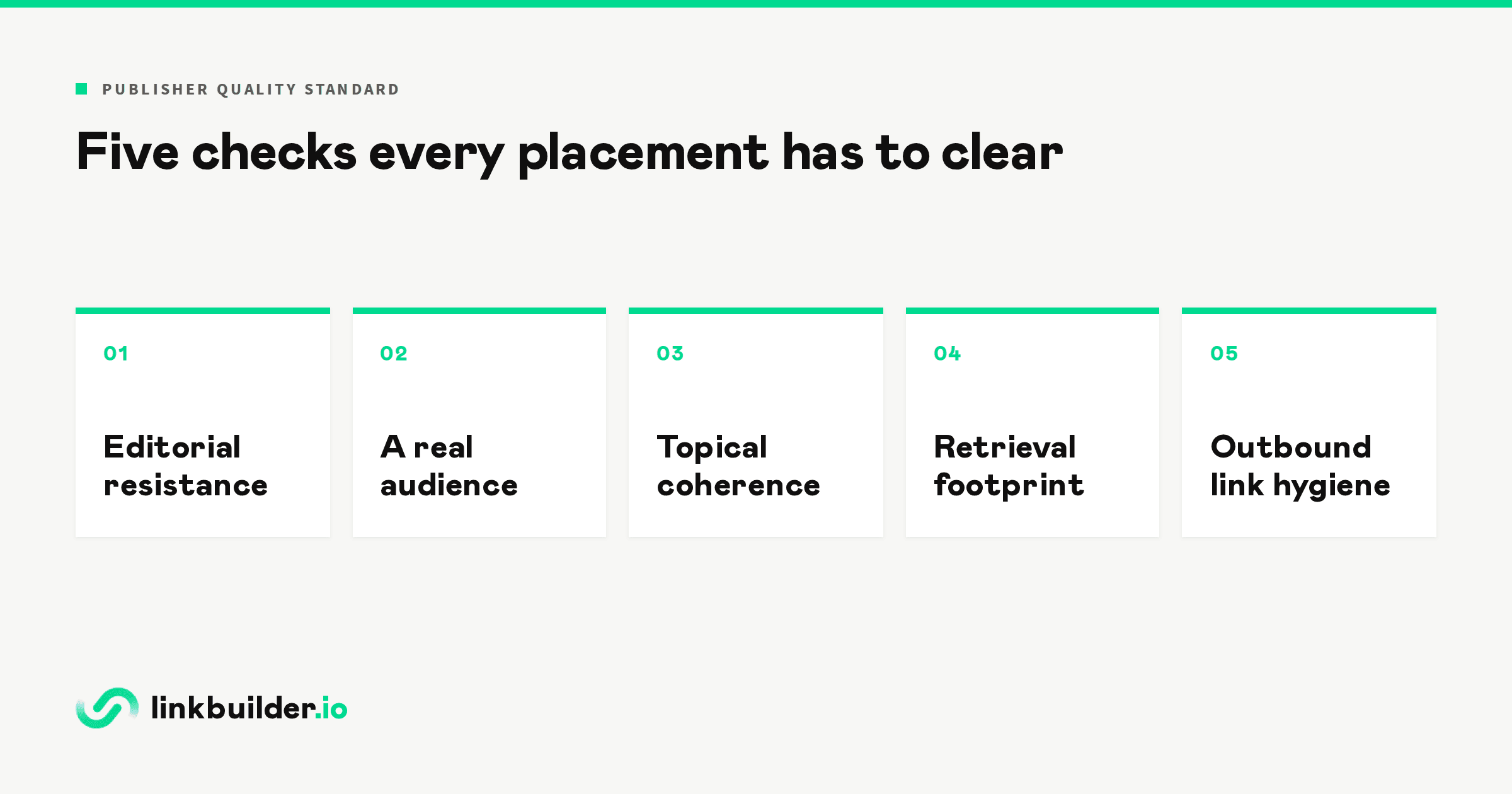
Five checks do most of the work.
-
Editorial resistance. Does the publication reject pitches? A site that accepts every submission has no editorial standard, and the placement carries no implied endorsement. Rejection is a feature.
-
A real audience. Look for signs of readership that exist independently of search: a newsletter with actual subscribers, articles that get discussed on LinkedIn or in industry communities, contributors who are known names in the category.
-
Topical coherence. The publication should cover your category as a matter of course, not as an exception made for you.
-
Retrieval footprint. Query the publication’s core topics in AI Mode, ChatGPT, and Perplexity. If the publication surfaces as a cited source, a placement there sits inside a corpus that assistants already draw from.
-
Outbound link hygiene. Look at who else the site links to. If the last twenty outbound links point to offshore gambling, crypto, and essay writing services, your placement is joining that neighborhood.
Google’s site reputation abuse policy is the sharpest version of this test. Publishing third-party content isn’t a violation on its own. It becomes one when the content is hosted on that site mainly because of the ranking signals the host earned from its own first-party work. Google’s documentation is explicit that columns, opinion pieces, and other editorial work sit outside the policy, while a news site running white-label content to capitalize on its reputation does not. A publisher that will run anything for a fee is building exactly the pattern the policy describes, and your placement inherits the risk. Our link quality framework goes deeper on how to score individual placements against criteria like these.
The AEO layer sits on top of all of it
There’s a temptation to treat AI visibility as a separate workstream with its own tactics. Google’s own guidance on optimizing for generative AI features argues against that framing. Generative AI features are grounded in the core Search index and ranking systems, which means a publisher that gets demoted for site reputation abuse stops being a useful citation source at the same time it stops being a useful link source. One decision, two outcomes.
The same guidance is blunt about something the AEO conversation tends to gloss over: chasing inauthentic mentions across the web is less useful than it sounds, because the ranking systems that feed AI features are the same ones filtering for quality and blocking spam. That isn’t an argument that mentions don’t matter. It’s an argument that manufactured ones don’t. A contributed article on a publication that assistants already retrieve from is a materially different asset than a paid mention on a site nobody reads, even if both show up as one referring domain in your report. We’ve covered why link quality matters more than ever for AEO in more detail.
The practical implication for placement selection: every publication you’re considering should be evaluated twice. Once for whether the link is worth having, and once for whether the publication is a source AI systems pull from when someone asks a question your brand should be the answer to.
A vetting process that survives procurement review
Enterprise programs need vetting documented well enough that someone outside marketing can follow the logic. Here’s a structure that holds up.
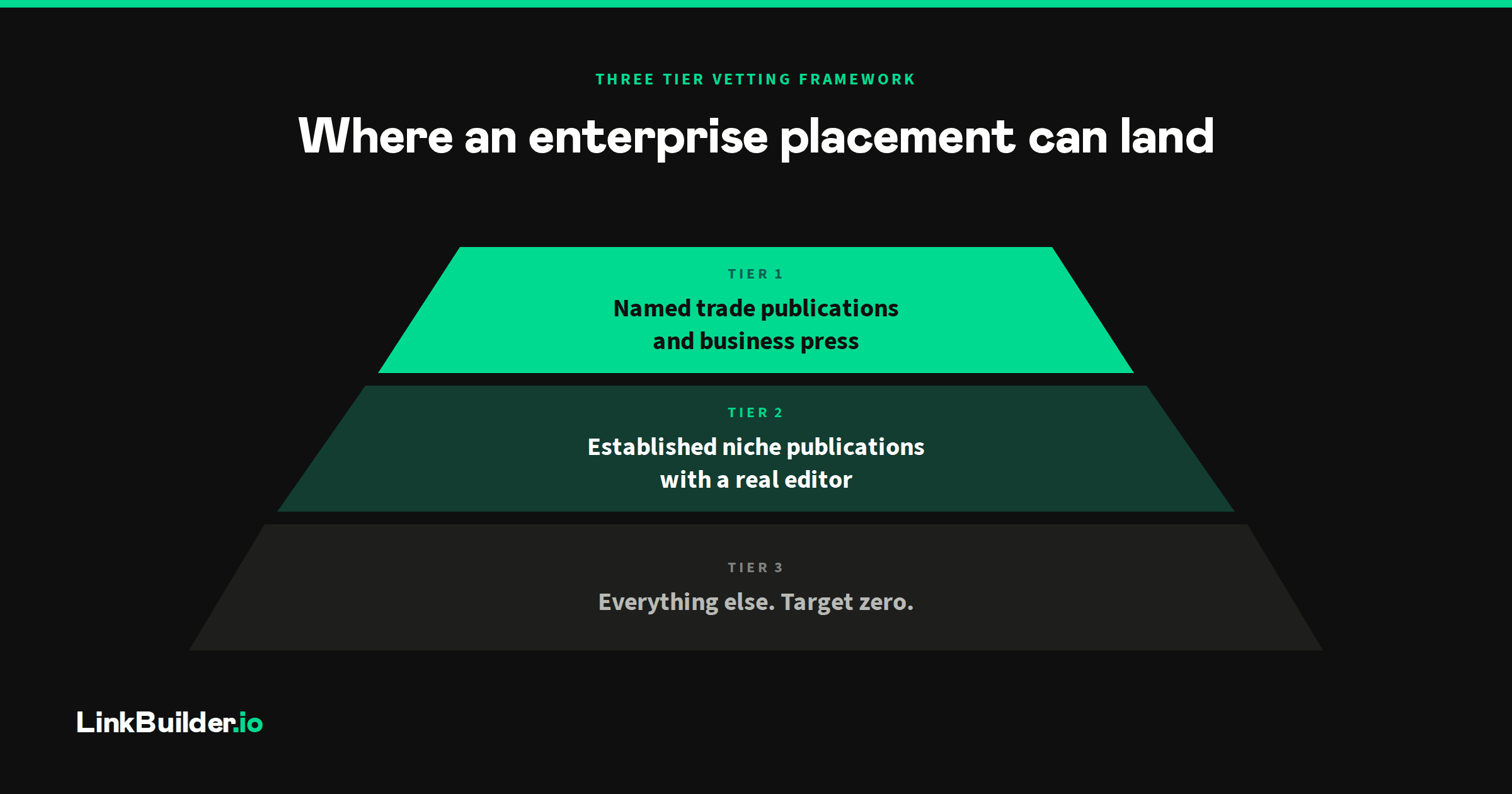
Tier the publication list before you pitch anything
-
Tier 1. Named trade publications and business press in your category. Editorial gatekeeping is real, turnaround is slow, and acceptance rates are low. These are the placements worth the most effort.
-
Tier 2. Established niche publications and respected company blogs with genuine readership and a real editor. This is where most of the volume should sit.
-
Tier 3. Everything else. For most enterprise programs, the right number here is zero.
Run the checks that reveal how a site really operates
-
Contributed content density. What share of the last fifty posts came from outside contributors? Above roughly half, you’re looking at a placement service with a masthead.
-
Traffic against authority. If the DR is high and organic traffic is negligible, the authority was built rather than earned. Check whether traffic came from a sharp jump rather than steady growth.
-
Indexation. Confirm recent articles are indexed. Sites carrying penalties often look fine until you check whether Google is keeping their pages.
-
Disclosure practice. Does the publication label sponsored content when it runs it? A site with a clear labeling policy is one that thinks about compliance.
-
Author verification. Do bylines belong to real people with traceable professional histories, or to stock-photo personas?
If you’re evaluating agencies rather than publications directly, the same skepticism applies to the proposal itself. We’ve cataloged the red flags in link building proposals that tend to predict problems, and the comparison of guest posting services is a reasonable starting point for understanding how different providers operate in practice.
Placement strategy: where the links go
Vetting tells you which publications are acceptable. Placement strategy decides what you do with them.
Target page selection
The instinct is to point everything at commercial pages. Resist it. Enterprise sites usually have strong internal linking, which means authority pointed at a well-connected resource page distributes to the commercial pages beneath it. Pointing every external link at a product page produces an anchor and target profile that looks engineered, because it is.
A workable split: roughly half to editorial and resource content, a third to category or solution pages, the remainder to the homepage and brand assets.
Anchor text distribution
Branded and naked-URL anchors should be the majority of what you build. Partial-match phrasing that reads naturally in a sentence covers most of the rest. Exact-match commercial anchors should be rare enough that you can list every instance from memory. At three hundred placements a year, the distribution is the thing being measured, not any individual link.
Entity coverage, not just link count
This is where AEO changes placement planning in a concrete way. Assistants answer questions by assembling context about entities and their relationships. If your brand appears repeatedly in editorial content alongside the category terms you want to own, discussed by name in substantive articles on sources those systems retrieve from, you’re building the association the model needs.
So plan placements against a topic map rather than a link quota. Ask which five questions you want your brand returned for, then make sure the placement calendar covers each of them across multiple credible publications. Thirty links spread across thirty unrelated subjects build less of that association than fifteen links concentrated on five.
Pacing and distribution
Velocity should track your other marketing activity. A brand publishing steadily, running events, and issuing announcements has a reason to accumulate coverage at a consistent rate. Multinational programs should also spread placements across the markets and languages they operate in, since a US-only link profile for a company selling into eight countries is its own anomaly.
Disclosure, compliance, and who carries the liability
This is the section that gets skipped, and it’s the one that matters most at enterprise scale, because enterprises are the entities regulators pursue.
The FTC’s Endorsement Guides require that a connection between an endorser and a seller be disclosed clearly and conspicuously when it might materially affect how much weight the audience gives the endorsement and when the audience wouldn’t reasonably expect it. Material connections include payment and free or discounted products. The Guides also make clear that advertisers should give guidance to endorsers, monitor compliance, and act on non-compliance, and that intermediaries such as agencies and PR firms can be liable for their role in disseminating endorsements that lack the necessary disclosures.
For an enterprise running contributed content at volume through an agency, that means the compliance exposure is shared and neither party gets to point at the other.
On the search side, Google asks that paid placements be qualified. Its documentation on rel attributes recommends marking advertisements and paid placements with the sponsored value, and notes that nofollow remains acceptable for the same purpose. Links carrying those attributes generally aren’t followed, which is the whole point.
Which surfaces the tension directly. If a placement is paid and the publisher passes ranking credit anyway, that’s the scenario the link spam policy describes. If it’s paid, disclosed, and qualified, you get brand exposure, referral traffic, and audience reach, but not ranking credit. Both are legitimate marketing outcomes. What isn’t legitimate is buying the first and reporting it as though it were earned.
The honest resolution for enterprise programs is to stop treating paid placement as the default mechanism. Genuine contributed articles, accepted on editorial merit by publications that could have said no, sit outside this problem entirely. They’re slower and harder to secure, which is exactly why they’re worth more.
Give your legal team a one-page summary of the program before it launches: which publications, what the commercial relationship is with each, how disclosure is handled, and who reviews drafts. Answering those questions in advance is considerably cheaper than answering them during an investigation.
What to report to leadership
Enterprise link programs die from bad reporting more often than from bad execution. Raw link counts invite the wrong question, which is why the number isn’t higher.
-
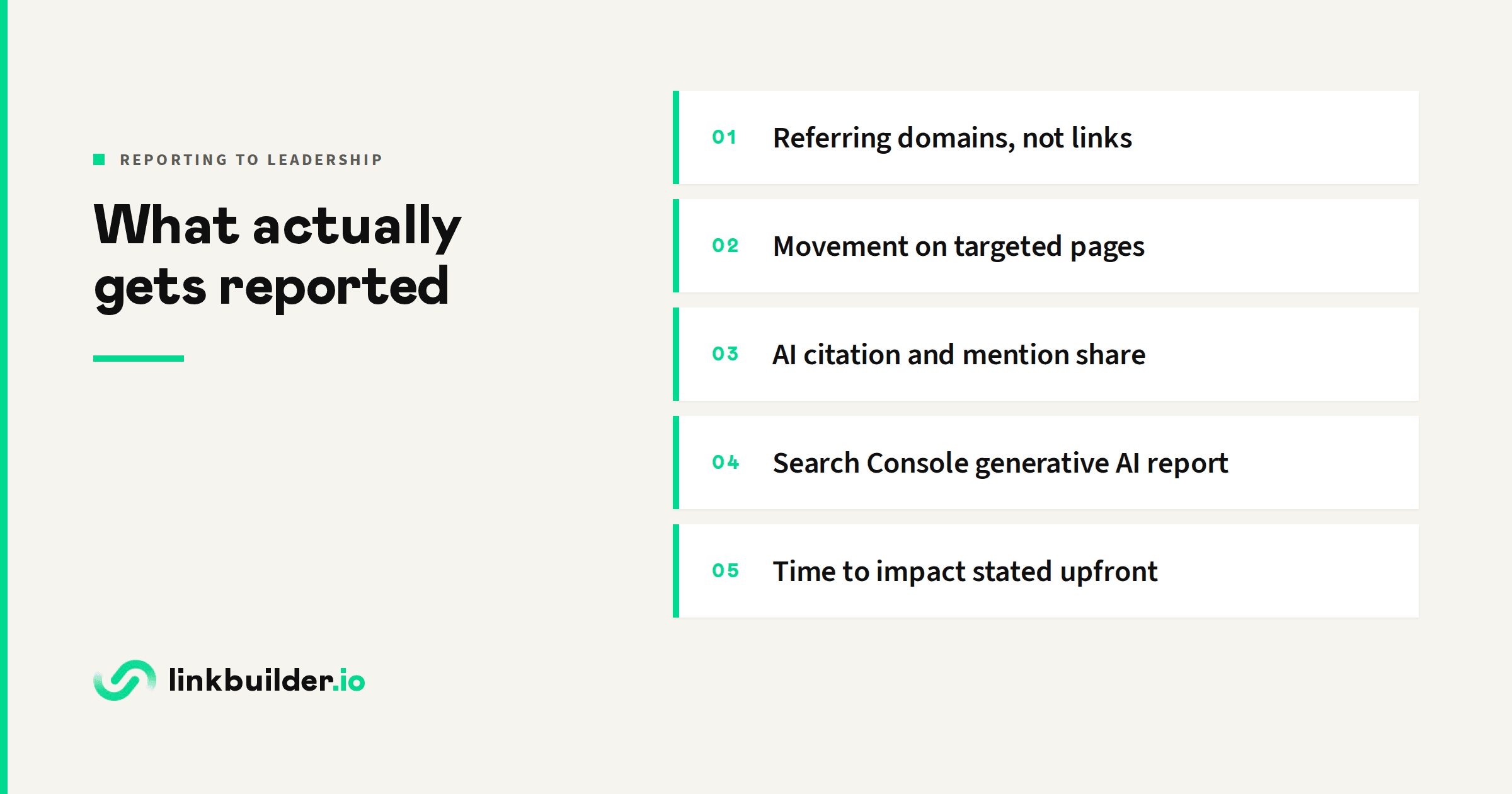
Referring domains, not links. Twenty links from one site is one relationship. Report unique domains and their tier.
-
Movement on the specific pages you targeted. Sitewide traffic is too noisy to attribute. Track rankings and organic traffic for the exact URLs receiving links, against a control set that isn’t.
-
Citation and mention share in AI answers. Maintain a fixed set of prompts your buyers would plausibly ask, run them on a schedule across the major assistants, and log whether you appear and which sources are cited alongside you. Consistency of method matters more than the tool you pick.
-
Search Console’s generative AI performance report. This is first-party data on how your content performs in Google’s AI features, which makes it the least disputable number in the deck.
-
Time to impact, stated upfront. Set the expectation at two to three quarters before you start, in writing. Programs get canceled at month four because nobody said month four would look like this.
How we approach enterprise guest posting
We built LinkBuilder.io around the assumption that placements have to be defensible, because the clients we work with are the ones who get audited. That means editorial pitches rather than placement fees wherever the publication allows it, a vetting process documented well enough to hand to a procurement team, and anchor and target distributions planned across the full program rather than link by link.
It also means we’ll tell you when a publication on your wishlist isn’t worth pursuing. If you want to see the shape of results this produces, the case studies cover campaigns across several categories, and our pricing page lays out how engagements are structured. If you’re still working out what belongs in an enterprise program versus what doesn’t, the guide to guest posts and how they work covers the fundamentals.
The short version
Enterprise guest posting works. It just doesn’t work the way the entry-level version does.
Set your quality bar on editorial resistance and genuine readership rather than authority scores. Vet publications thoroughly enough that the process can be handed to someone outside marketing. Plan placements against a topic map so each one reinforces the association between your brand and the categories you want to be the answer for. Handle disclosure properly, before legal asks. And report on referring domains, targeted page movement, and AI citation share rather than raw volume.
Do those things and the program compounds. Skip them and you build a footprint that someone will eventually find. If you’d like to talk through what this looks like for your brand, let’s talk.
Erika
Head of Link Operations