

Scaling link building is the moment most strategies break. The campaign that landed five solid placements a month suddenly needs to land twenty, and the wheels come off.
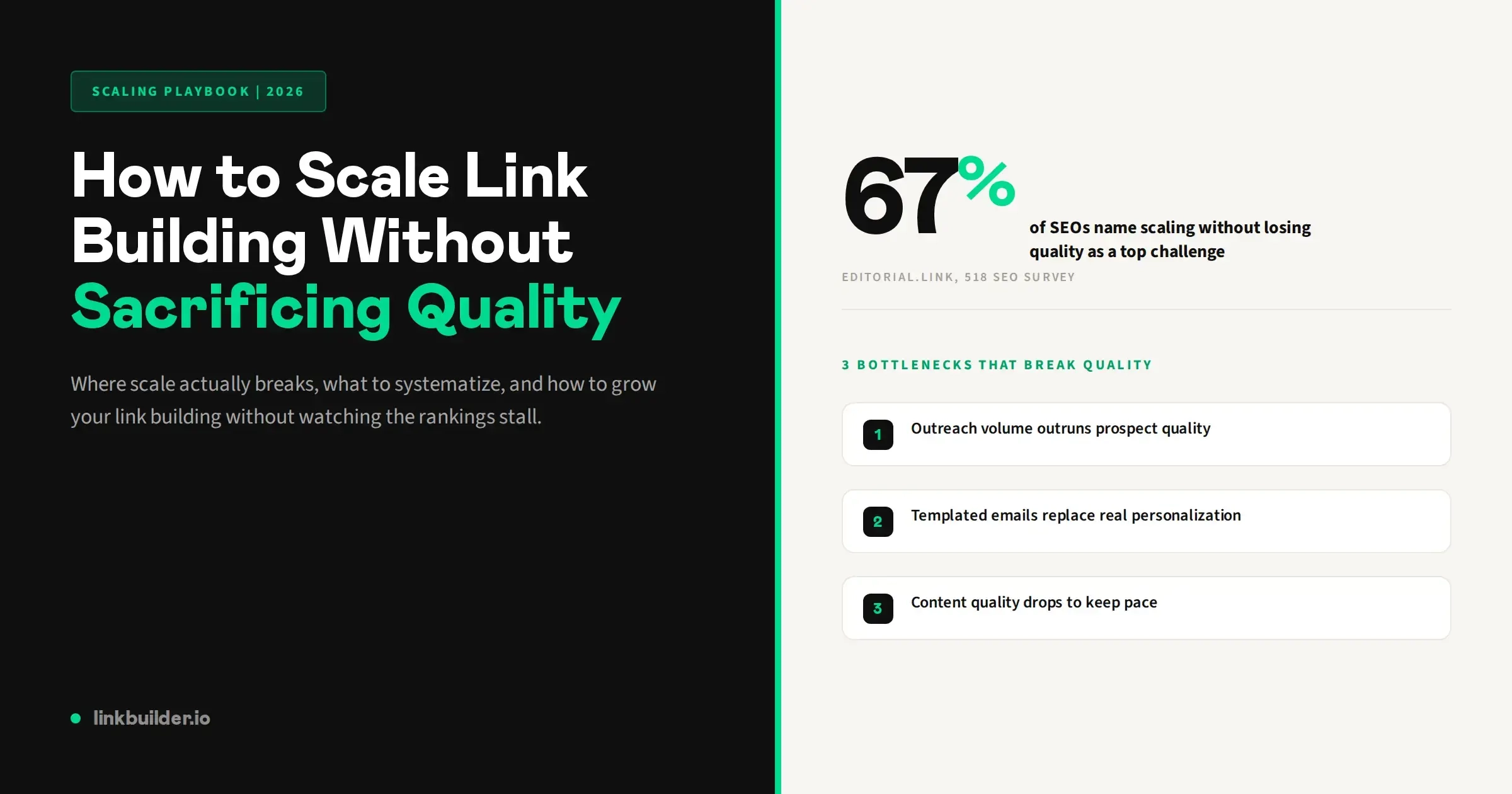
Quality drops, response rates crater, and the team starts cutting corners just to hit the volume target. According to Editorial.link’s survey of 518 SEO experts, 67% named scaling without losing quality as one of the biggest challenges in link building right now. It’s the second-most cited problem in the industry, behind only rising costs.
The problem isn’t that scale and quality are incompatible. It’s that most teams try to scale by doing more of what worked at low volume, when scaling actually requires a different operating model entirely. The link building strategy that produces five placements a month is not the strategy that produces twenty.
This guide walks through how to scale link building without the quality collapse: where the bottlenecks actually are, what to systematize and what to keep manual, when to bring people in versus outsource, and how to measure whether you’re scaling or just spinning wheels.
Why Scale Usually Breaks Quality

Before we get to the fix, it helps to understand the failure mode. Scale tends to break quality at three predictable points.
Bottleneck #1: Outreach volume outruns prospect quality
When you need more placements, the easy lever is to send more pitches. The team adds sites to the prospect list faster than they can vet them. Within a month, the list is padded with sites that look fine on the surface but wouldn’t pass a real quality check. Pitches go out, links get placed, and the report looks good. Six months later the rankings haven’t moved, and an audit shows half the placements are on sites with no traffic, generic AI-written content, or aggressive ad density.
Bottleneck #2: Templated outreach replaces real personalization
Personalized outreach takes time. When the team is under volume pressure, the personalization gets stripped down to a template with the editor’s first name swapped in. Response rates drop immediately. The team responds by sending more emails to compensate, which makes the templating worse, which drops the response rate further. It’s a death spiral that ends with the agency leaning on paid placements to hit the number.
Bottleneck #3: Content quality drops to keep pace with volume
Guest posts and earned media require well-researched content. At low volume, your best writers handle every piece. At higher volume, you start using junior writers, freelancers, or AI assistance to keep up. Editors notice. Acceptance rates drop. The pieces that do get published are weaker, which means they get less engagement, which makes them worse at driving the traffic and citations links are supposed to deliver. AI search algorithms are particularly punishing on low-quality content right now. Over 90% of link builders are now prioritizing link quality over quantity for exactly this reason.
Define What “Scale” Actually Means for Your Site
“Scaling link building” gets thrown around as if it means the same thing for every business. It doesn’t. The right scale for a local dental practice and a global SaaS platform are wildly different, and trying to scale beyond what your site can absorb is its own quality problem.
Reporter Outreach’s 2026 industry survey found that most practitioners need 5 to 15 quality placements per month to move rankings meaningfully. That’s a useful baseline, but the right number depends on your industry’s competitive landscape, your starting backlink profile, and your target keyword competitiveness. Link velocity (the pace at which backlinks accumulate) needs to roughly mirror or slightly exceed your industry norms. Building 50 links a month for a local dentist looks unnatural to Google. Building 50 links a month for a global CRM platform might still leave you behind competitors.
Before scaling anything, set a realistic target. Look at the top three pages ranking for your priority keywords. Pull their referring domain growth rates over the past 12 months. Match or modestly exceed that pace. That’s your real volume ceiling. Trying to push past it is when scale starts breaking quality.
Systematize the Process, Not the Relationships
The teams that scale link building successfully share one habit: they build systems for the parts of the process that benefit from consistency, and they keep the parts that benefit from human judgment as manual as possible.
Systematize: prospecting, vetting, reporting
These steps follow rules. Prospecting filters (DR threshold, traffic minimum, topical relevance, ad density check, indexation status) can be turned into a documented checklist that anyone on the team can apply consistently. Reporting is structured data: per-link details, anchor text, target page, placement date, quality metrics. Build templates for both. The goal is that any team member produces the same quality output for these steps regardless of who’s doing the work.
Systematize: content production workflow
Content quality is non-negotiable, but the workflow around content can be systematized. Brief templates, editorial standards documents, revision checklists, and approval gates all reduce variance without lowering the bar. BuzzStream’s 2025 pricing data shows the average guest post costs $365 directly from a site, with high-quality placements averaging $930. The price difference largely reflects the editorial work behind each piece. Systematizing the workflow lets you produce that quality at higher volume without the cost spiraling.
Don’t systematize: editor outreach and relationship management
This is where teams break quality fastest. Outreach to a quality publication is a relationship, and relationships don’t templatize. The opening line should reference something specific about the publication or the editor’s recent work. The pitch should fit the publication’s actual content style. The follow-up should respect the editor’s signal. None of this scales linearly with templates. What does scale is having more outreach specialists doing personalized work, not one specialist sending more templated emails.
Add Capacity Where the Bottleneck Actually Is
Most teams hire or outsource the wrong role when they try to scale. They add another outreach specialist when the bottleneck was content production, or vice versa. Diagnose the bottleneck before adding capacity.
Bottleneck: not enough qualified prospects
Hire a researcher or junior link builder focused exclusively on prospecting. This role pulls competitor backlinks, runs lookalike searches, vets sites against the quality checklist, and hands a clean prospect list to the outreach team. Most teams underinvest here and overload their outreach specialists with prospect research, which drops outreach quality.
Bottleneck: content can’t keep pace
Bring in specialist freelance writers with topic expertise in your industry, not generalist content writers. The reason guest post acceptance rates drop at scale is usually that the writing quality drops, not the pitch quality. A subject matter expert who writes one piece a week beats a generalist who writes five.
Bottleneck: outreach response rates are dropping
Don’t add more outreach volume. Audit your current outreach. Are pitches still personalized? Are you targeting the right contact at each publication? Are follow-ups respectful or aggressive? In most cases, the response rate drop is a quality problem, not a volume problem. Adding capacity here without fixing the underlying issue makes it worse.
Bottleneck: you can’t track or report on what you’ve built
This is when an in-house team needs to either invest in better tooling (Pitchbox, BuzzStream, Ahrefs) or bring in an agency partner. The reporting bottleneck usually shows up around the 15-20 placement per month mark. Below that, spreadsheets work. Above it, you need real systems.
In-House, Agency, or Hybrid: Choose Based on Volume

The right operating model for scaled link building depends on your target volume.
Under 10 placements per month
In-house with a single dedicated link builder works at this volume. The cost of a full agency engagement is hard to justify, and the work fits one person if your content team supports them. The risk is that the link builder leaves and you lose institutional knowledge.
10 to 25 placements per month
This is the awkward middle. Too much for one in-house person, not enough to justify a full in-house team of three to four. Most companies in this range outsource link building to a specialist agency, sometimes paired with one in-house coordinator who manages the relationship and handles internal alignment. This is also where most agency engagements concentrate.
25+ placements per month
At this volume, the math starts favoring a hybrid model: an in-house team for strategy, internal coordination, and content, plus an agency or white-label partner for execution capacity. Pure in-house at this scale requires a team of four to six, plus tooling, plus management overhead. Pure agency works but limits how tightly link building integrates with your broader content and SEO strategy.
Enterprise (50+ placements per month, multi-property)
At enterprise scale, the conversation changes entirely. Enterprise link building requires synchronized strategy across departments, dedicated tooling, and usually a mix of internal teams plus multiple agency partners assigned to specific verticals or properties.
Measure Whether You’re Actually Scaling

Volume alone isn’t scale. Building twice as many links that are half as effective isn’t scaling, it’s spending more money for the same outcome. These are the metrics that tell you whether you’re scaling or just inflating numbers.
-
Average DR of placements over time. If your average placement DR is dropping as volume goes up, you’re scaling by lowering the bar. Track this monthly and set a floor below which you won’t drop.
-
Topical relevance score. Tag every placement on a relevance scale (high, medium, low). Watch the distribution shift over time. A healthy scaled program keeps high-relevance placements at 70%+ of total volume.
-
Outreach response rate. If response rates are dropping while volume climbs, your outreach quality is degrading. This is the leading indicator that quality collapse is coming.
-
Cost per qualified placement. Not cost per link total. Cost per placement that meets your quality bar. This is the real efficiency metric. If it’s flat or dropping as volume grows, you’re scaling. If it’s rising, you’re paying more for worse work.
-
Ranking and AI citation movement. The ultimate test. If you’re building 3x the links but rankings and AI citations are flat, the additional links aren’t doing work. Time to audit quality, not add more volume.
We covered the broader shift in link building reporting in a separate guide, but at scale these five metrics should be reviewed monthly without exception.
How We Approach Scale at LinkBuilder.io
We’ve worked with brands like Udemy, SoFi, and TripAdvisor at scales ranging from 10 to 50+ placements per month. The common thread across the engagements that work is operational discipline: documented processes for the systematizable parts, named senior people on the relationship parts, and reporting that shows quality metrics alongside volume metrics.
When a client asks us to scale beyond what our current team configuration can absorb at quality, we have an honest conversation about timeline and capacity rather than ramping fast and hoping. Most quality collapses we see in other agencies happen because the agency said yes to scale they couldn’t deliver.
If you’re trying to scale your link building program and the quality is starting to slip, book a strategy call. We’ll walk through where the bottlenecks actually are and what a sustainable scale-up looks like for your specific situation.
The Bottom Line
Scaling link building is a process problem before it’s a volume problem. The teams that do it well separate what should be systematized from what shouldn’t, add capacity at the actual bottleneck, and watch quality metrics with the same discipline they watch volume metrics.
The teams that do it poorly try to scale by doing more of what worked at low volume. Six months later they’re spending twice as much for the same rankings, the same AI citations, and a backlink profile that increasingly looks like everyone else’s.
Pick the right operating model for your volume. Diagnose the real bottleneck before adding capacity. Measure whether your scale is actually working. That’s the difference between a link building strategy that compounds and one that just gets bigger.

Erika
Head of Link Operations