

Every link pointing at your site carries something with it. Some links carry a lot. Some carry almost nothing. And a surprising number of sites are quietly leaking the value they’ve already earned.
That value is link equity. It’s still one of the clearest signals search engines have for deciding which pages deserve to rank, and in 2026 it’s doing double duty: the same signals that get a page onto page one also decide whether it gets pulled into AI Overviews and AI Mode.
This guide covers what link equity is, what determines how much a link passes, how to audit your own site for leaks, and how to build more of it without tripping Google’s spam policies. If you want the tactical playbook for pushing equity toward one specific page, that lives in our link juice guide. This post is about the concept and the site-level strategy.
Key Takeaways
- Link equity is the ranking value a link passes from one page to another. It depends on the linking page’s authority, its relevance to your page, where the link sits, and how the link is tagged.
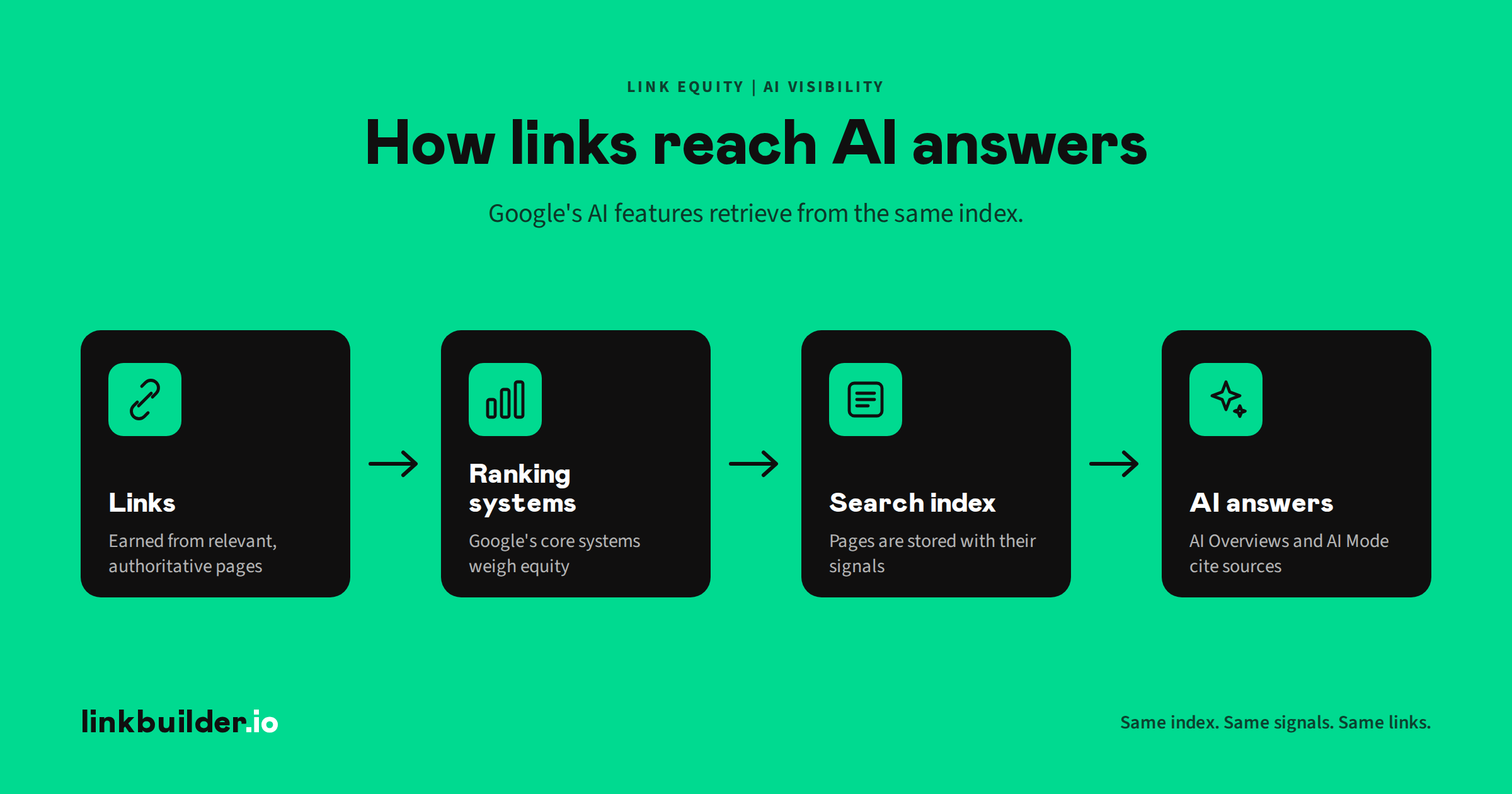
- Google’s generative AI features are grounded in its core Search ranking systems, so link equity affects AI visibility through the same index that powers the ten blue links.
- Nofollow, sponsored, and UGC links are treated as hints. Google says they’ll generally not be followed, but they’re no longer a hard wall.
- Most sites lose equity through redirect chains, broken pages that still have backlinks, and orphaned content. Auditing for leaks is usually the fastest win.
- The best way to strengthen link equity is still the same: earn editorial links from relevant, authoritative sites, then route that value internally to the pages that matter.
What Is Link Equity?
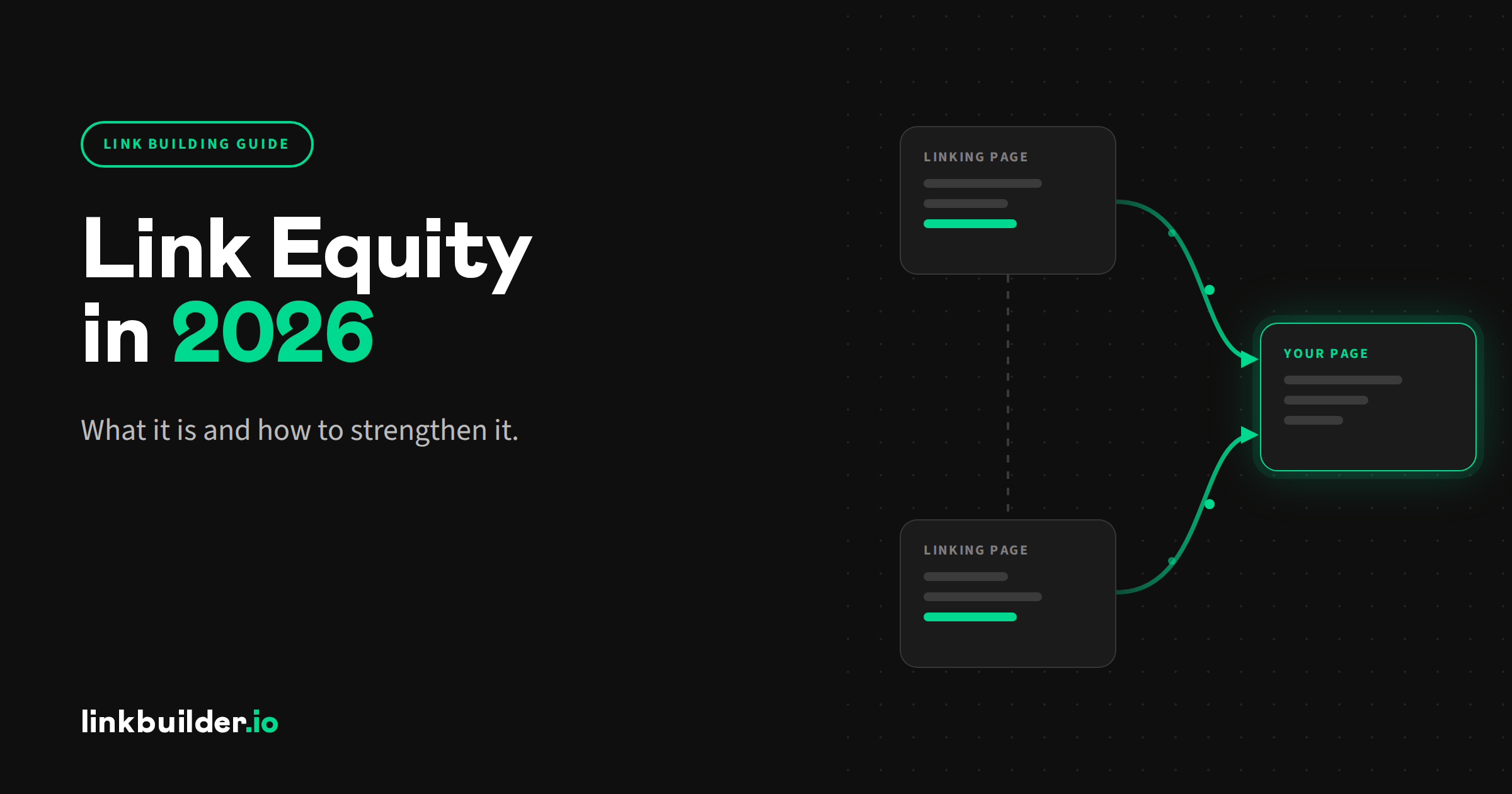
Link equity is the value a hyperlink passes from the page it sits on to the page it points to. When a page with authority links to yours, some of that authority transfers. When your page links onward, it passes a share of what it has accumulated.
You’ll also hear it called link juice. Same idea, less formal name. We’ve written a separate guide to link juice that goes deep on the mechanics of moving equity around your site, so we won’t repeat that here.
The concept traces back to PageRank, the algorithm Google was built on. PageRank treats each link as a vote and weights each vote by the authority of the page casting it. Google’s ranking systems have grown far beyond PageRank, but links remain one of the core Google ranking factors, and the underlying logic hasn’t changed: pages with more high-quality links pointing at them tend to rank better.
Two things to keep straight:
- Page-level versus domain-level. Link equity is fundamentally a page property. A link to your homepage strengthens your homepage. It can strengthen your product pages too, but only if your internal linking passes the value along. That’s why domain authority and page authority are tracked as separate metrics in tools like Ahrefs and Moz.
- Earned versus routed. External links bring new equity into your site. Internal links redistribute what’s already there. You need both.
Why Link Equity Matters More in 2026
Here’s the shift that changes the conversation.
Google’s own guide to optimizing for generative AI features explains that AI Overviews and AI Mode are rooted in its core Search ranking and quality systems. The AI retrieves pages from the Search index using those same ranking systems, then generates a response and cites the sources it pulled from. Google’s generative AI optimization guide describes this grounding process and states plainly that from Google’s perspective, optimizing for AI search is still SEO.
Read that again if you’re being told that links don’t matter for AI.
If the AI layer draws from the ranked index, then anything that helps a page rank helps it get retrieved. Link equity helps pages rank. So link equity feeds AI visibility, not directly through some separate AI scoring system, but through the index that both surfaces share.
There’s a second effect that matters for generative engine optimization. AI systems evaluate whether a source is trustworthy enough to cite. Pages that have accumulated links from recognizable, relevant publications look like sources worth citing. Pages with no external validation look like noise. You can’t cite your way out of a weak link profile.
And there’s a practical benefit: you can now measure this. Google added a generative AI performance report to Search Console so site owners can see how content is surfacing in AI features. If you’re investing in links, that report is where you’ll see part of the return.
One caution. Google’s spam policies now explicitly name attempts to manipulate generative AI responses as spam, right alongside attempts to manipulate rankings. The same rules apply to both surfaces. We’ll come back to that.
What Determines How Much Equity a Link Passes
Not every link is equal. Six factors do most of the work.
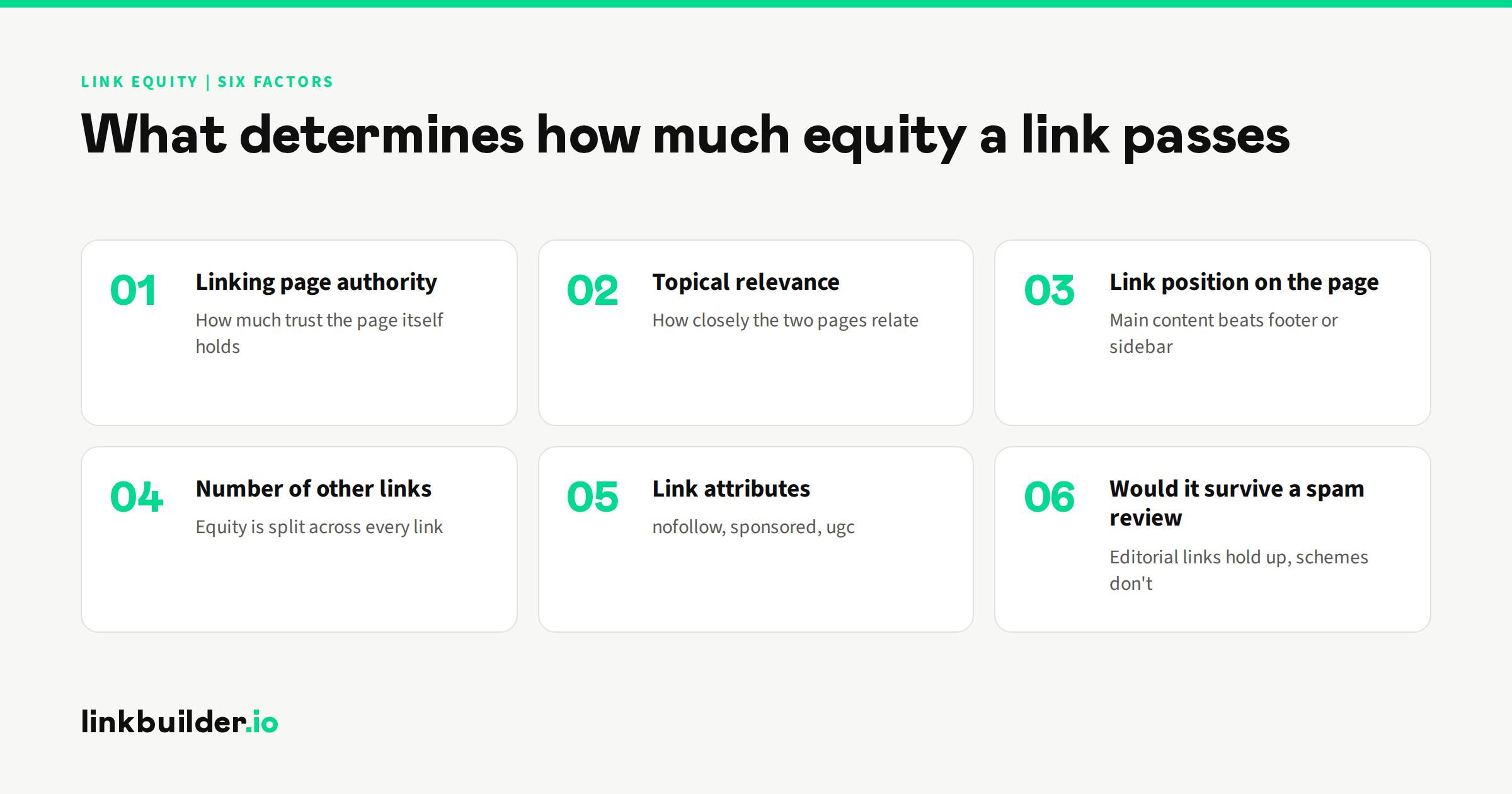
1. The authority of the linking page
This is the biggest lever. A link from a page that has itself earned hundreds of quality links passes far more than a link from a page nobody links to. Tools estimate this as URL Rating (Ahrefs) or Page Authority (Moz). Neither is a Google metric, but they’re useful proxies.
Notice the word “page.” A link from a brand-new post on a major publication passes less than a link from that publication’s most-cited article. Domain strength helps, but page strength is what transfers.
2. Topical relevance
Links from pages about your subject pass more usable value than links from unrelated pages. A link to your SaaS pricing page from a software review site says something to Google. A link from a recipe blog says much less, even if the recipe blog has strong metrics.
Relevance also protects you. A backlink profile stuffed with off-topic links from high-authority domains looks purchased, because it usually is.
3. Where the link sits on the page
Links inside the main body content carry the most weight. Links in sidebars, footers, author bios, and navigation carry less. Google has been discounting boilerplate links for years, and its spam policies specifically call out widely distributed footer and template links as a link spam pattern.
That’s a big part of why editorial links are worth more than placements. An editorial link is one a writer chose to include because it supported the article.
4. How many other links are on the page
Equity is shared among the links on a page. A link from an article with three outbound links gives you a larger share than a link from a resource page with two hundred. This is also why “link roundup” pages with dozens of outbound links tend to move the needle less than people expect.
5. How the link is tagged
This is where the old advice needs an update.
Google supports three qualifying attributes: rel=”sponsored” for paid placements, rel=”ugc” for user-generated content like comments and forum posts, and rel=”nofollow” for everything else you don’t want to endorse. Google’s documentation on qualifying outbound links states that links marked with these attributes will generally not be followed.
The word that matters is “generally.” Back in 2019, Google changed how it treats nofollow, moving all three attributes from directives to hints. In practice, you should still assume a tagged link passes no ranking credit. But you shouldn’t assume it’s worthless. A sponsored link on a major outlet can still send referral traffic, build brand recognition, and put your name in front of the same AI systems that are deciding who to cite.
Plan for followed links to carry your rankings. Treat tagged links as a bonus, not a strategy.
6. Whether the link would survive a spam review
Google’s link spam policy lists the patterns it targets: paid links that pass ranking credit, excessive link exchanges, automated link programs, advertorials with optimized anchor text, low-quality directories, and forum signatures stuffed with keyword links. Links that match those patterns can be ignored or, in a manual action, actively count against you.
The policy also states that buying and selling links for advertising is fine as long as those links are qualified with nofollow or sponsored. That’s the line. Paid placement that’s tagged is advertising. Paid placement that isn’t tagged is link spam.
How to Audit Your Site’s Link Equity
Before you build anything new, find out where you’re losing what you already have. This takes an afternoon with Ahrefs, Semrush, or Search Console, and it’s often the highest-return work in the whole process.
Start with your most linked pages. Pull a report of your pages sorted by referring domains. This shows you where your equity is concentrated. On most sites it’s the homepage, a few older blog posts, and maybe a tool or study that got picked up. Those are your equity reservoirs.
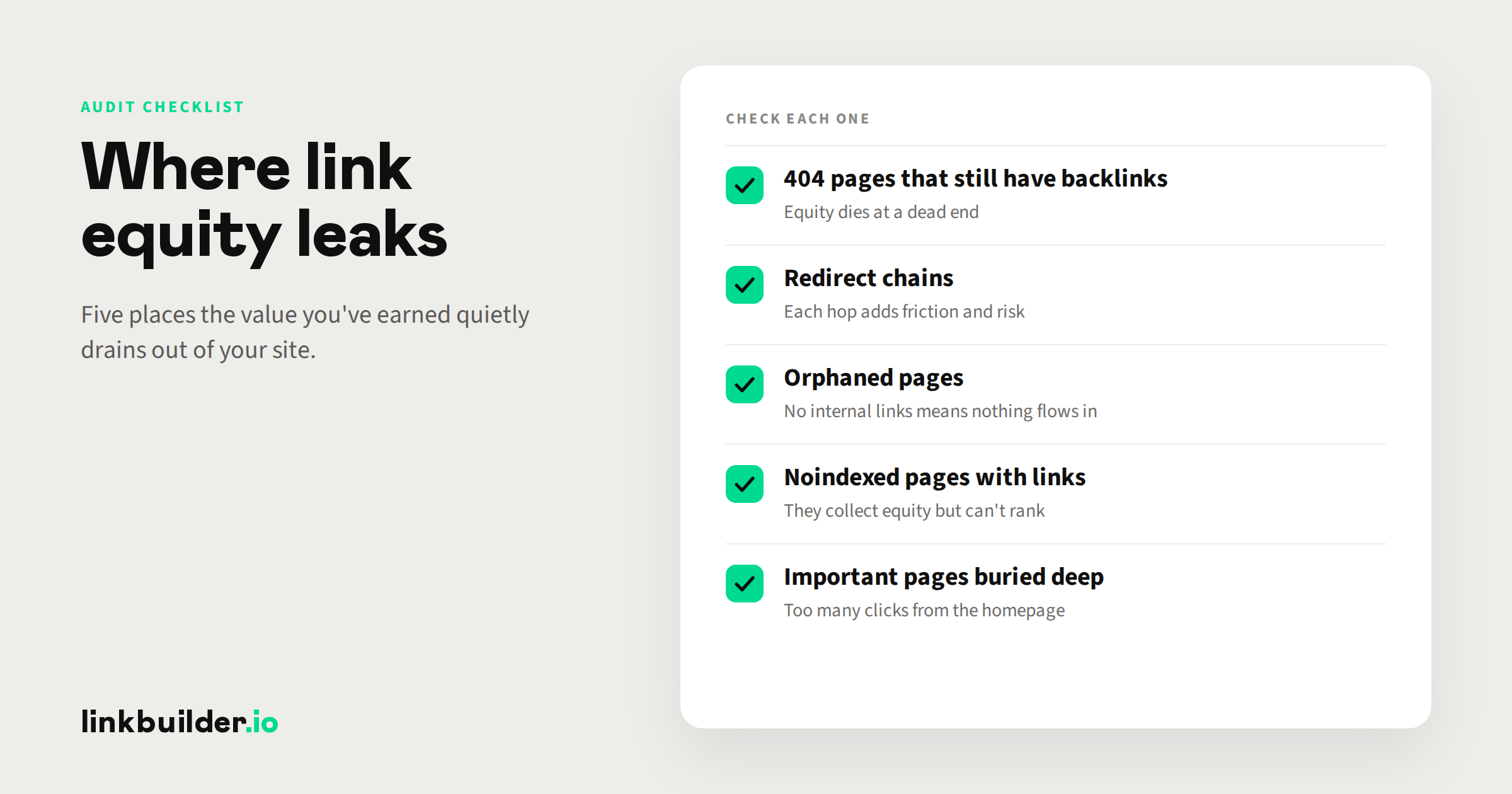
Then find the leaks. Look for:
- Pages that return a 404 but still have backlinks. Every link pointing at a dead page is equity going nowhere. Either restore the page or redirect it to the closest live equivalent.
- Redirect chains. A link that hits a page that redirects to a page that redirects to the final page loses signal along the way and wastes crawl budget. Flatten chains so each old URL points directly to its final destination.
- Orphaned pages. Pages with external links but no internal links pointing to them can’t share their equity with the rest of your site. Link to them from relevant content.
- Linked pages that are noindexed or blocked. If you’ve accidentally noindexed a page that earns links, the equity stops there.
- Important pages buried deep in your architecture. If your best commercial page is five clicks from the homepage, it’s not receiving much of what your homepage has earned.
Finally, check for risk. Review your backlink profile for spikes of links from unrelated domains, sitewide footer links, and exact-match anchor text at unnatural rates. Those are the patterns Google’s spam systems are trained on. Most of the time you can leave low-quality links alone; Google is good at ignoring them. But if you see a pattern that looks like a past campaign gone wrong, that’s worth cleaning up before you invest in new links that will be judged alongside it.
How to Strengthen Link Equity
Once you’ve plugged the leaks, you have three ways to add value.
Earn links on relevant, authoritative pages
This is the part that doesn’t change. The most reliable way to increase link equity is to get links from pages that already have it, on sites that cover your topic, placed within the body of real content.
That means working with publications your customers read, pitching content those publications want to run, and accepting that volume matters less than placement quality. Twenty links from relevant, well-linked pages will outperform two hundred from thin directories every time.
It also means being realistic about what you can earn versus what you’ll need help with. Original research, tools, and data-driven content attract links on their own. Service pages and product pages almost never do. That’s where a managed link building service earns its keep, because it can secure editorial placements pointing at pages that would otherwise never get them.
Route equity to the pages that matter
Internal linking is how you spend what you’ve earned. Your most-linked pages should link to your most valuable commercial pages, in context, with descriptive anchor text. Topic clusters, where a pillar page and its supporting posts all interlink, keep equity circulating instead of pooling in one place.
We cover the specific tactics for this in the link juice guide linked above, including how to identify your strongest pages and what to do about pages that don’t fit anywhere. The short version: every page you want to rank should be reachable within a few clicks from your most authoritative content.
Protect what you’ve built
Link equity compounds slowly and can be lost quickly. A site migration that breaks old URLs, a redesign that drops internal links, or a content purge that deletes linked pages can wipe out years of accumulated value in an afternoon.
Build a check into every major site change: export your top pages by referring domains before the change, then confirm every one of them still resolves afterward. Set up 301 redirects for anything that moves. It’s unglamorous work, and it’s the difference between a site that gets stronger every year and one that keeps starting over.
Two things to steer clear of. First, don’t manufacture links you can’t defend. Google’s August 2026 update to its site reputation policy tightened scrutiny on third-party content hosted primarily to borrow a site’s ranking signals, and its spam policy already covers paid links, link schemes, and inauthentic mentions. Second, don’t chase “AI mentions” as a substitute for real links. Google’s generative AI guidance specifically warns that seeking inauthentic mentions across the web isn’t as helpful as it seems, because its AI features depend on the same quality and spam systems as the rest of Search.
What We See Working at LinkBuilder.io
We build links for brands in competitive spaces, and the pattern we keep seeing is that link equity behaves the same way across industries. Sites that earn relevant editorial links to pages that matter, and that keep their internal structure clean, tend to show up in both traditional results and AI features. Sites that chase volume or let their architecture rot do neither.
You can see how that plays out in our case studies, and our pricing page lays out what a managed campaign looks like at different scales. If you’d rather talk it through, book a call and we’ll look at your current profile together.
Frequently Asked Questions
What is link equity in SEO?
Link equity is the ranking value a link passes from one page to another. It depends on the linking page’s authority, its relevance to the destination, where the link sits on the page, how many other links share that page, and whether the link is tagged with nofollow, sponsored, or ugc.
Is link equity the same as link juice?
Yes. Link juice is the informal name for link equity. Both describe the value that flows through a hyperlink from one page to another.
Do nofollow links pass link equity?
Generally, no. Google treats nofollow, sponsored, and ugc as hints and says links marked with them will generally not be followed. Assume a tagged link passes no ranking credit, but it can still deliver referral traffic and brand visibility.
Does link equity affect AI Overviews and AI Mode?
Indirectly, yes. Google’s generative AI features retrieve pages from the Search index using its core ranking systems, then cite the sources they pulled from. Anything that improves a page’s ranking, including link equity, improves its chances of being retrieved and cited.
How do I check my site’s link equity?
Use a backlink tool such as Ahrefs or Semrush to sort your pages by referring domains, then look for pages that return errors but still have backlinks, redirect chains, and orphaned pages. Search Console’s Links report and the generative AI performance report give you Google’s own view.
What’s the fastest way to increase link equity?
Fix leaks first: redirect dead pages that have backlinks, flatten redirect chains, and link to orphaned content. Then earn editorial links from relevant, authoritative pages and route that value internally to your commercial pages.
The Bottom Line
Link equity is the reason link building works. It’s also the reason link building still matters when AI writes the answer, because the AI is reading from the same index that links help build.
Audit what you have. Fix what’s leaking. Then earn links that would survive a spam review, on pages that cover your topic, pointing at the pages you need to rank. That’s the whole strategy, and it’s held up through every algorithm change so far.
If you want help building it, let’s talk links.

Erika
Head of Link Operations