

Link Building Packages Explained: What's Really Inside a Monthly Package

Erika
Head of Link Operations
Every link building agency sells a “package.” Most of them describe it the same way: a number of links, a DR range, a price. That tells you what you’re paying. It doesn’t tell you what you’re paying for.
That gap matters more than it used to. Google’s own guide to optimizing for generative AI features confirms that AI Overviews and AI Mode sit on top of the same core ranking systems that decide the ten blue links. So the signals that move your rankings are the same signals that decide whether an AI answer pulls your brand in or leaves it out. A package that just drops links on your site won’t build those signals. A package that plans, targets, and measures the work can.
This post opens up a managed monthly link building package and walks through it line by line: what each deliverable is, why it’s there, and what to ask for if it’s missing from the proposal sitting in your inbox. If you’re after cost benchmarks and in-house vs. agency math, our link building pricing guide covers that ground. This one is about the work itself.
What is a link building package?
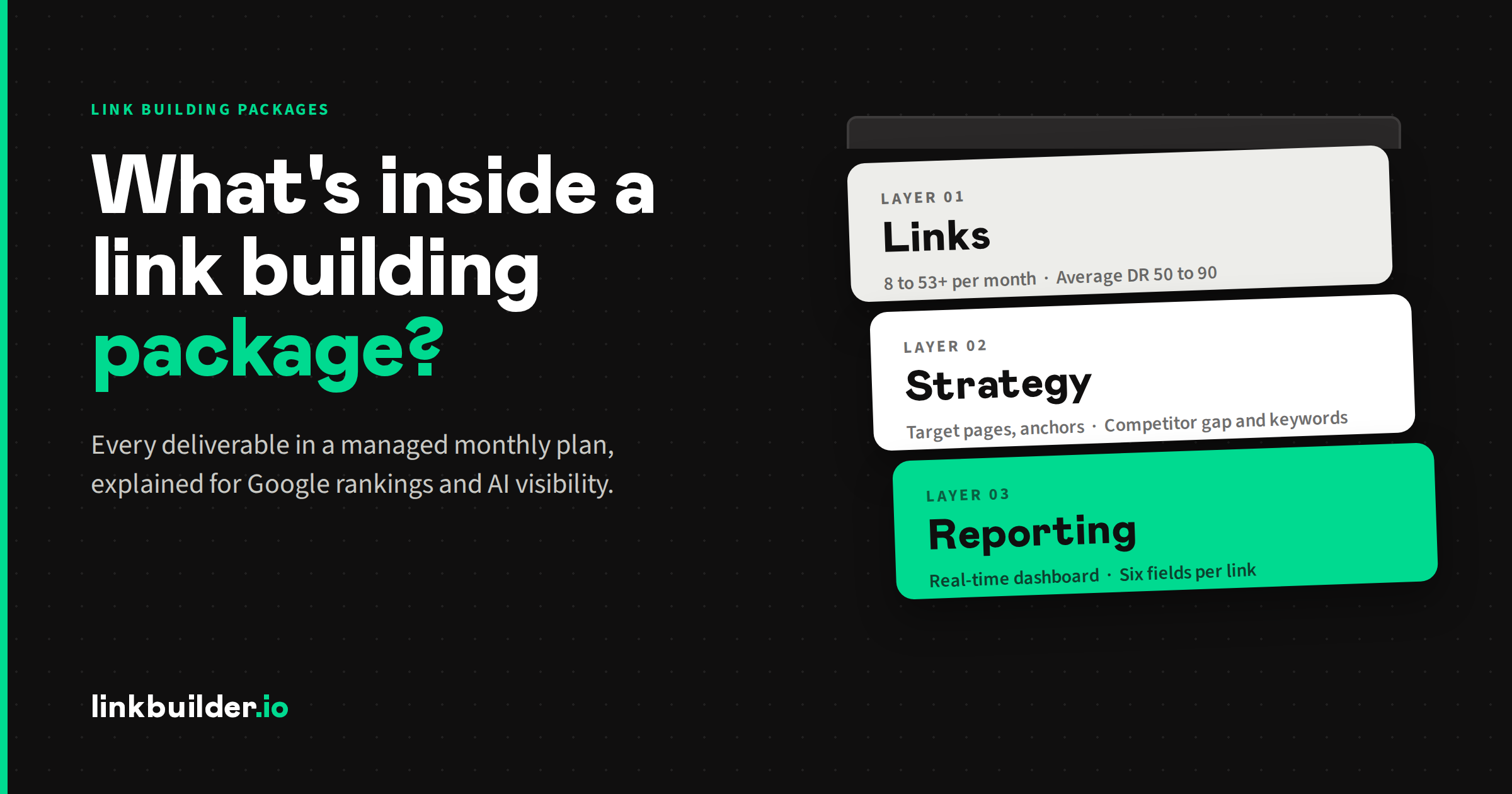
A link building package is a fixed-scope monthly service where an agency plans, earns, and reports on a set number of backlinks to your website. The links are the visible part. The rest of the package is the strategy layer that decides where those links point, what they say, and how you know they’re working.
That’s the difference between a package and a pay-per-link order. Pay-per-link is a transaction: you pick a site, you pay, a link appears. A package is a campaign. Someone is choosing your target pages, mapping anchor text, studying your competitors, and tracking rankings on the pages that matter. You’re buying judgment as much as placements.
At LinkBuilder.io, our packages run from 8 links a month on Startup to 53+ on Enterprise, and every tier includes the analysis layer. Here’s what that layer is made of.
The links: volume, authority, and relevance
Start with the number on the price card. Our tiers deliver 8, 16+, 26+, or 53+ links a month depending on the package, with an average Domain Rating of 50 to 90 across the profile.
Two things to understand about that DR figure. First, it’s an average, not a floor. A healthy profile has a spread of authority, because that’s what an earned profile looks like. Second, DR is a third-party score, and a high score on a site with no real traffic is a warning sign, not a selling point. Repurposed domains with inflated metrics are how link farms get away with charging real money for worthless placements. If a proposal leads with DR and never mentions organic traffic, keep asking questions.
Relevance is the part that price cards leave out entirely. Google’s spam policies define link spam as links created primarily to manipulate rankings, and the same policy now explicitly covers attempts to manipulate generative AI responses in Search. A link from a site in your industry, placed in content a real reader would find useful, is what those policies are designed to reward. Everything in a good package is built around earning that kind of link through outreach rather than buying placements from a catalog.
Volume deserves a sanity check too. More links isn’t always better, and the right monthly number depends on your industry and where your site is now. A local dentist’s website has no business building more than 15 links a month. A global CRM competing against heavily linked rivals would find 15 a slow start. Part of onboarding on any of our packages is agreeing on a safe volume before the first email goes out.
Target page planning: deciding where the links go
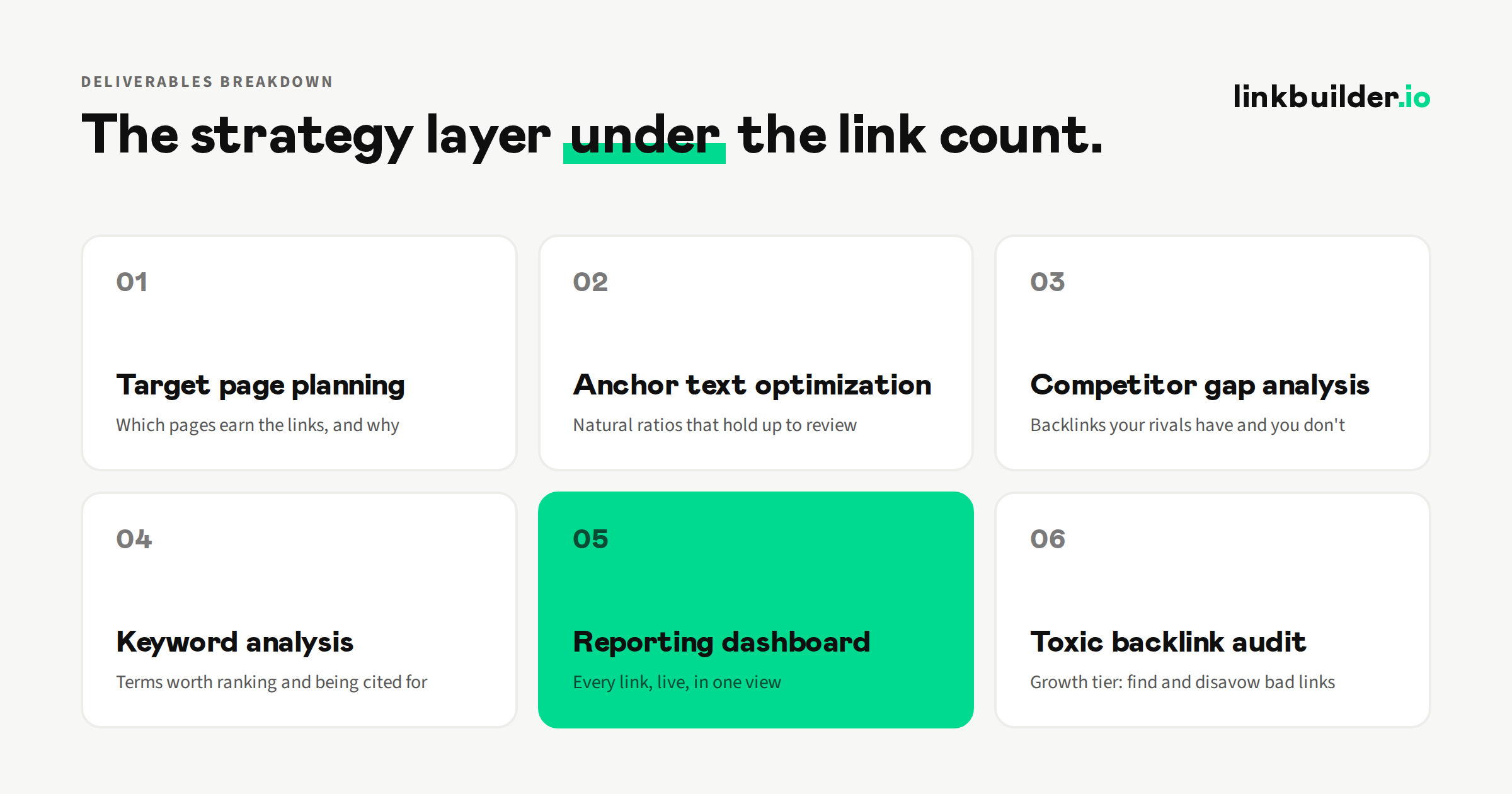
This is the deliverable that separates a campaign from a pile of links. Before any outreach starts, our analysts build a target list of the pages on your site that can realistically move with link support, and estimate the traffic potential for each. Links then get pointed at those pages on purpose.
Why it matters: a link to your homepage helps the whole domain a little. A link to the product page that’s stuck at position eight for a buying keyword helps that page a lot. Without a plan, agencies default to whatever page the publisher is willing to link to, and your commercial pages never move.
It matters for AI visibility for a related reason. Google describes its generative AI features as using query fan-out, where the model breaks a question into several related searches and pulls pages that answer each one. The page that gets cited is the page that answers a specific sub-question well and has the authority to be retrieved for it. Target page planning is how you decide which pages you want to be that answer, and then send authority to them.
Target page planning is included on Pro and above. On Startup, the same thinking shows up as detailed link planning, scaled to eight links.
Anchor text optimization: what the links say
Anchor text is the clickable text of a link, and it’s the most frequently abused part of link building. Google’s link spam policy gives a specific example of what not to do: articles, guest posts, or press releases stuffed with optimized keyword anchors pointing at commercial pages. That pattern is a spam signal, not a ranking tactic.
So “anchor text optimization” in a package means the opposite of stuffing. It means mapping a natural distribution across each target page: branded anchors, naked URLs, partial matches, and a small share of exact matches, in proportions that look like a site people link to on their own. We track the distribution across the whole profile, not just per link, so one month’s placements don’t skew the pattern.
There’s an AI angle here as well. Branded anchors and brand mentions in context reinforce your brand as an entity that AI systems recognize. Google’s guidance is blunt about the wrong way to chase this: seeking inauthentic mentions across the web isn’t as helpful as it might seem, because the same spam systems that filter links also filter mentions. Earned, contextual, branded links are the version that survives that filter.
Competitor backlink gap analysis and keyword analysis
Both of these are included on every tier, and they do the prospecting work that most people imagine an agency skipping.
Competitor gap analysis starts with pulling the backlink profiles of the sites ranking above you. The useful output is a list of domains that link to two or three of your competitors but not to you. Those sites have already demonstrated they’ll link to businesses like yours. They’re the highest-probability outreach targets on the internet for your niche, and they’re also the sites most likely to be feeding the AI answers your competitors currently appear in.
Keyword analysis pairs with that. It’s how we decide which keywords your target pages should rank for, which of them have real traffic behind them, and how far off the current rankings are. The output feeds straight into target page planning: if a page is on page two for a keyword worth chasing, it’s a priority target.
Neither of these is a one-time report. Competitors keep earning links and the gap keeps moving, so the analysis gets refreshed as the campaign runs.
The reporting dashboard: how you know it’s working
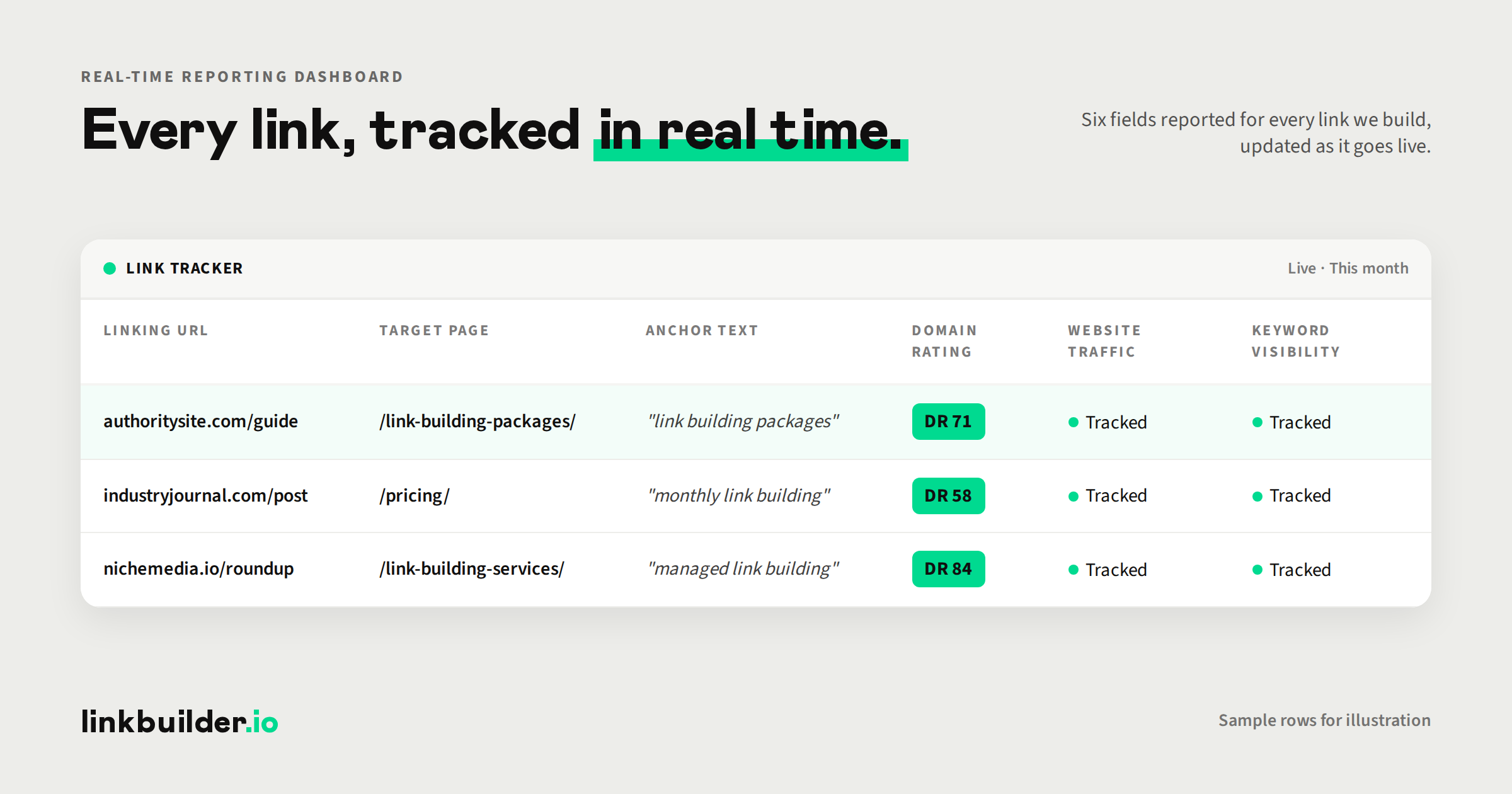
We don’t believe in 40-page monthly PDFs, and we’d argue you shouldn’t pay for them. Our reporting is a shared tracking file that updates in real time as each link goes live, with six fields per link:
- Linking URL (the live page the link is on)
- Target page (the page on your site it points to)
- Anchor text
- Domain Rating of the linking site
- Website traffic of the linking site
- Keyword visibility for the target page
On top of that, you get a monthly report covering the work done, what we’ve observed, and where the campaign goes next. Because we spend so much time in your competitors’ backlink profiles, that report tends to include content and SEO observations you didn’t strictly pay for.
What to look for in any agency’s reporting: the live URL of every link (so you can check it), a traffic figure alongside DR, and rankings for the target pages over time rather than just a count of links built. If you want to measure the AI side yourself, Google Search Console now has a Generative AI performance report that shows how your pages surface in AI features on Google. Pair it with the link tracker and you can see the two move together.
Growth-tier deliverables: internal linking and the toxic backlink audit
The Growth package at 26+ links a month adds two things beyond volume.
Internal linking optimization
Authority that lands on one page only helps the rest of your site if your internal links let it flow. If your best-linked blog post never links to the product page you’re trying to rank, the campaign is leaking. Internal linking optimization maps those paths so the external links you’re paying for do double duty. It also helps AI retrieval, since well-connected pages are easier for crawlers to find and easier to understand in context.
Toxic backlink audit
Most sites that have been around for a while have a layer of junk links in their profile from old campaigns, scrapers, or spam. Ahrefs notes that since the Penguin 4.0 update, Google’s algorithms ignore many spammy and paid links outright, so panic isn’t warranted. But a pattern of manipulative links is still something a manual reviewer can act on, and it muddies your own analysis. The audit identifies what’s there, flags anything worth disavowing, and cleans up the baseline before we build on top of it.
Growth and Enterprise can also spread links across multiple domains, which matters if you’re an agency managing several client sites or a brand with more than one property.
What’s not in a package (and shouldn’t be)
A few things you’ll see promised elsewhere that should make you nervous:
- Guaranteed rankings. Nobody controls Google’s results. An agency can guarantee links and effort, not positions.
- Guaranteed placements on named publications. Editorial links are earned through pitches. A guaranteed slot on a big-name site is usually a paid advertorial, which Google’s spam policy says needs a nofollow or sponsored attribute and passes no ranking credit.
- Dozens of links for a few hundred dollars. Ahrefs reached out to 450 sites across nine niches asking to buy a link outright and found the average asking price was $361.44, with only 12.6% of sites willing to sell at all. Anyone offering 30 links for $300 is placing them somewhere you don’t want to be.
- Bulk “AI mentions.” Google has said directly that inauthentic mentions don’t help. A package selling mention volume with no editorial context is selling the same thing as a link farm with a new label.
- Results in 30 days. Link building compounds. We tell every prospective client to expect at least six months before results are significant, and we’d be suspicious of anyone who says otherwise.
How to read a link building proposal
When a package lands in your inbox, these questions will tell you what’s underneath it in about ten minutes.
- Ask for five links they built last month, with URLs. Then open them. Does the site have real traffic? Would you read the article? Is the link in the body or buried in a footer?
- Ask how they choose target pages. If the answer is “wherever the publisher is comfortable linking,” there’s no plan.
- Ask for a sample anchor text distribution. You want to see brand and URL anchors dominating, not a column of exact-match keywords.
- Ask what the reporting shows. Live URLs, target page, and traffic of the linking site are the minimum. A link count alone is not reporting.
- Ask about contract terms. Long lock-ins with no exit are common. We work on a six-month contract with a 90-day opt-out window, and we’re transparent about it because the results timeline is six months anyway.
- Ask how they define AI visibility. If the answer involves special files, markup, or mention farms, they’re selling tactics Google has said it ignores. If the answer is authority, relevance, and citations from sites AI systems already trust, you’re talking to someone who has read the same documentation we have.
Which LinkBuilder.io package fits
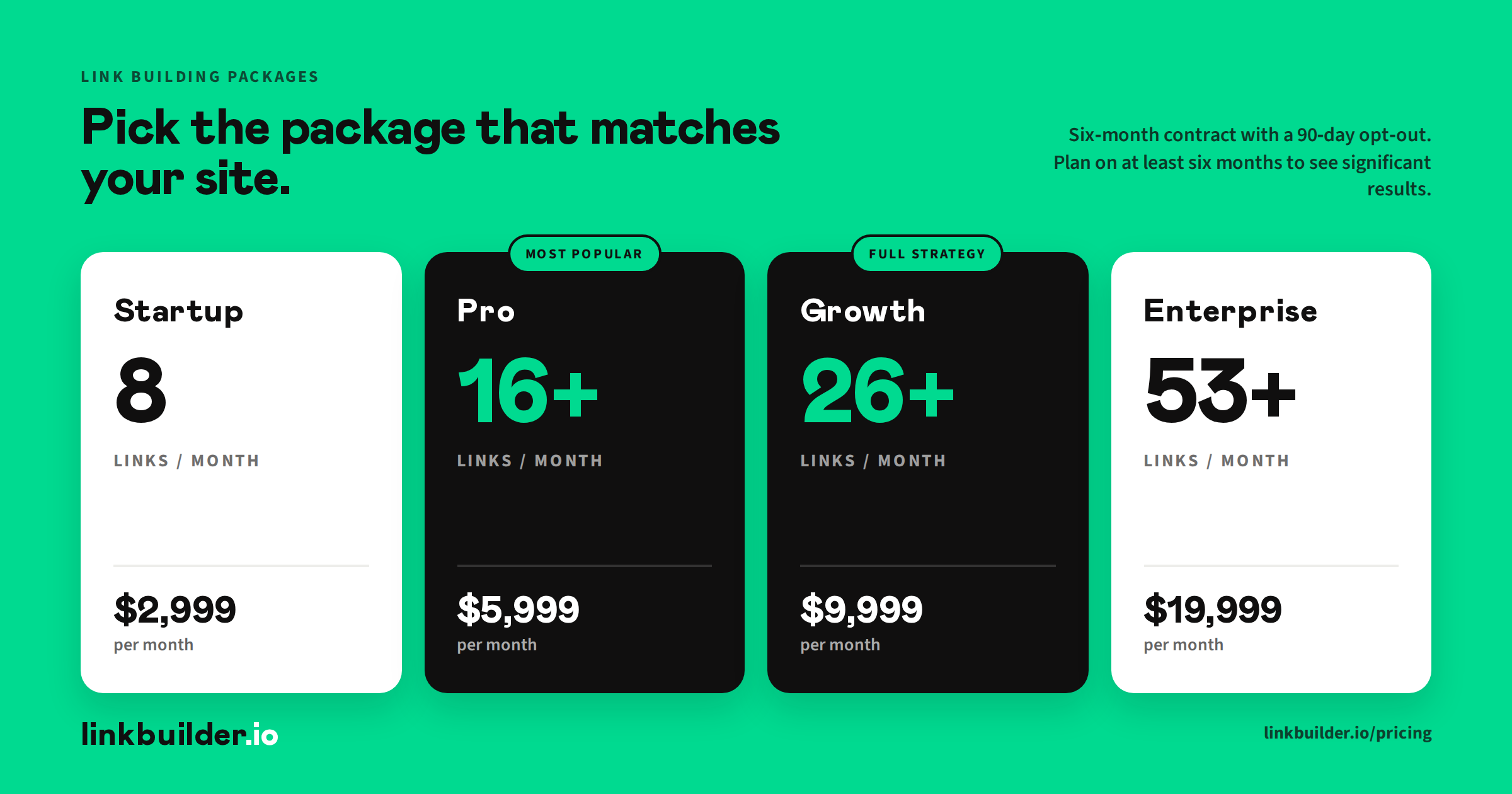
Here’s how our four managed tiers break down, so you can match scope to where your site is.
- Startup ($2,999/mo, 8 links): detailed link planning, competitor gap analysis, keyword analysis, and the reporting dashboard. Built for founders and smaller teams that need a real campaign without an in-house team.
- Pro ($5,999/mo, 16+ links): everything in Startup plus authority links, target page planning, and anchor text optimization. This is the tier where the full strategy layer switches on, and it’s where most growing companies land.
- Growth ($9,999/mo, 26+ links): adds internal linking optimization, the toxic backlink audit, and the ability to spread links across multiple domains. Built for marketing directors and agencies running more than one property.
- Enterprise ($19,999/mo, 53+ links): everything in Growth at scale, plus anytime call scheduling with our founder.
Every tier is built to earn links that influence Google search results and help AI tools recognize your brand. If AI visibility is the primary goal rather than a secondary benefit, our AI Starter and AI Growth packages bundle links with brand mentions, citations, and content refreshes, and you’ll find those on the same pricing page. Agencies that want to resell the work under their own brand can look at white label link building.
Every package starts with a conversation, because the right volume and target list depend on your site. Book a strategy call and we’ll walk through what a campaign for your pages would look like.
Frequently asked questions
What’s included in a link building package?
A managed link building package includes a set number of monthly backlinks plus the strategy work around them: target page planning, anchor text mapping, competitor backlink gap analysis, keyword analysis, and a reporting dashboard that shows each live link with its target page, anchor, and site metrics. Higher tiers add internal linking optimization and a toxic backlink audit.
How much does a monthly link building package cost?
Managed packages at LinkBuilder.io range from $2,999 a month for 8 links to $19,999 a month for 53+ links. Pro is $5,999 for 16+ links and Growth is $9,999 for 26+ links. For industry-wide benchmarks on what links cost, see our link building pricing guide.
How many links per month should a package include?
It depends on your industry and competition. A local service business often shouldn’t build more than 15 links a month, while a competitive SaaS or ecommerce site may need 25 or more to make progress. A good agency will recommend a safe volume during onboarding rather than selling you the biggest tier.
How long does a link building package take to show results?
Expect at least six months before results are significant. Links take time to be crawled, evaluated, and reflected in rankings, and the effect compounds as the profile grows. Any package promising ranking movement in 30 days should be treated with caution.
Do link building packages help with AI search visibility?
Yes, when the links are relevant and earned. Google states that its generative AI features are rooted in its core Search ranking and quality systems, so the authority and relevance signals that earned links build for rankings also influence whether your pages are retrieved and cited in AI Overviews and AI Mode. Packages that sell bulk mentions or special AI markup don’t address those signals.
The short version
A link building package is only as good as the strategy underneath the link count. Target page planning decides where authority goes. Anchor text optimization keeps the profile natural. Competitor gap and keyword analysis find the right sites and the right pages. Reporting proves it. Those are the deliverables that turn a monthly link count into rankings and into the citations that AI answers are built from.
If you’d like to see how those pieces would apply to your site, book a call and we’ll show you the target list before you commit to anything.
Erika
Head of Link Operations