

Link Building for Fintech: Authority in a Compliance-Heavy Niche

Erika
Head of Link Operations
Most articles about fintech link building open the same way. Fintech is YMYL, Google holds finance sites to a higher standard, so go build better links.
All true. None of it is the hard part.
The hard part is that in fintech, the content carrying your backlink isn’t only marketing. Depending on what you sell and who regulates you, it may be a communication your compliance team has to approve before it goes live, retain for years, and defend to an examiner later. A guest post you didn’t write, on a site you don’t control, quoting a rate nobody signed off on, is a compliance event and an SEO asset at the same moment.
That changes what good link building means in this niche. Not just higher DR. Different mechanics, different deliverables, different definition of a win.
Here’s how to build real authority when every placement passes through legal, and why several of the constraints that slow you down are the same ones that make your brand citable in AI search.
YMYL Is the Floor, Not the Strategy
Google’s Search Quality Rater Guidelines put financial security squarely in the Your Money or Your Life category, which means raters apply a stricter standard for expertise and trust. Every fintech SEO lead already knows this. Knowing it doesn’t tell you where to put the budget.
What tells you where to put the budget is what the answer engines reward, because financial queries are exactly where AI systems behave most conservatively. They lean hard on sources they can attribute, and they build their picture of your brand from how the rest of the web describes you.
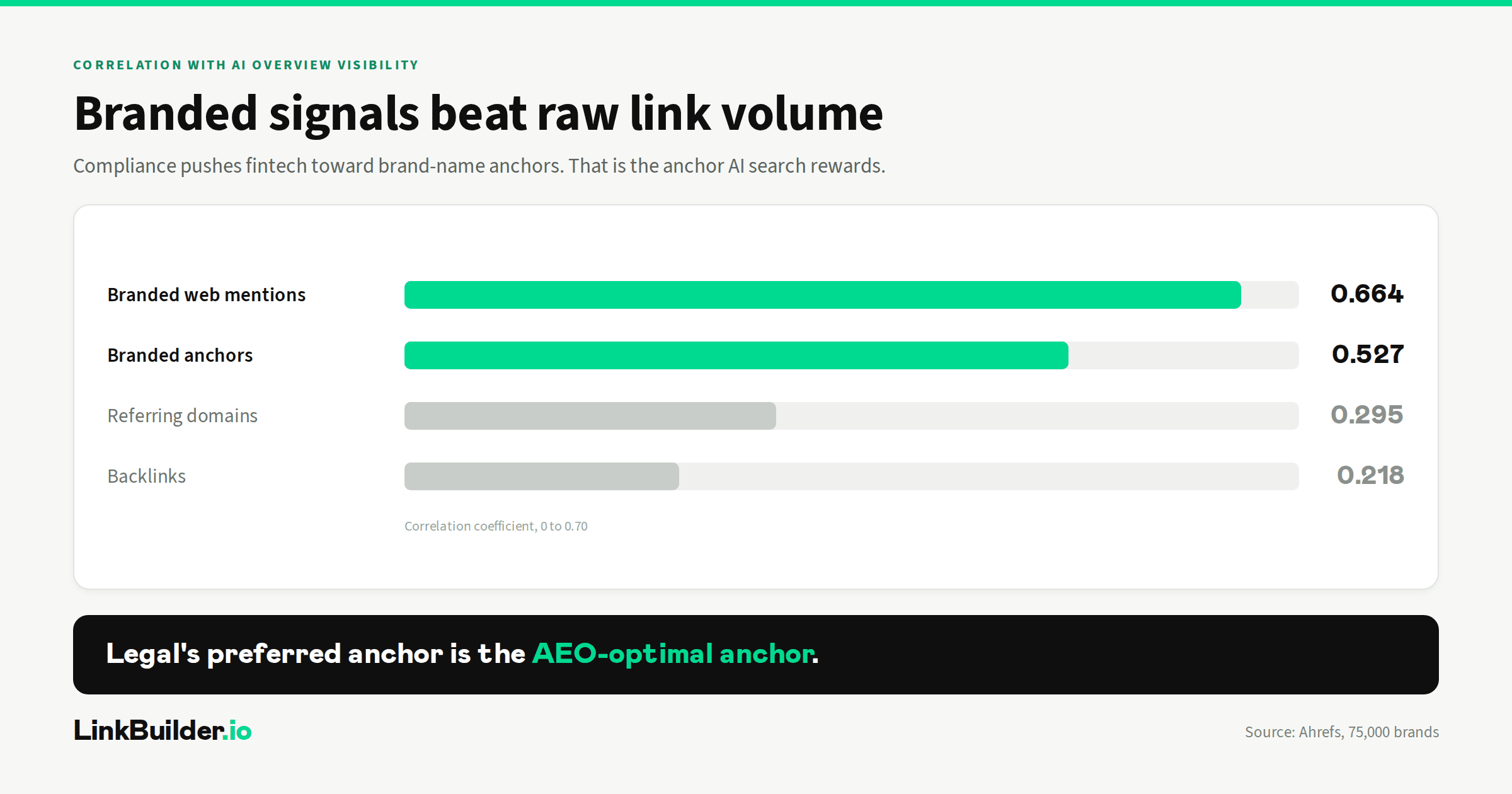
Ahrefs studied 75,000 brands to see which signals track with appearing in Google AI Overviews. Branded web mentions correlated at 0.664. Branded anchors came in at 0.527. Raw backlink counts landed at 0.218, and referring domain counts at 0.295. Brands in the top quartile for web mentions averaged 169 AI Overview mentions, against 14 for the quartile below them. Around a quarter of the brands studied had none at all.
For a fintech marketer, that’s an uncomfortable read. A link package that adds referring domains without putting your brand name into credible editorial text is buying the weakest correlate on the list.
The useful surprise is that the compliance-shaped version of link building produces the strong signals almost by accident. We’ll come back to that in the section on anchors, because it’s the single most counterintuitive thing about link building for AI visibility in regulated categories.
What Changes When Your Marketing Is a Regulated Communication
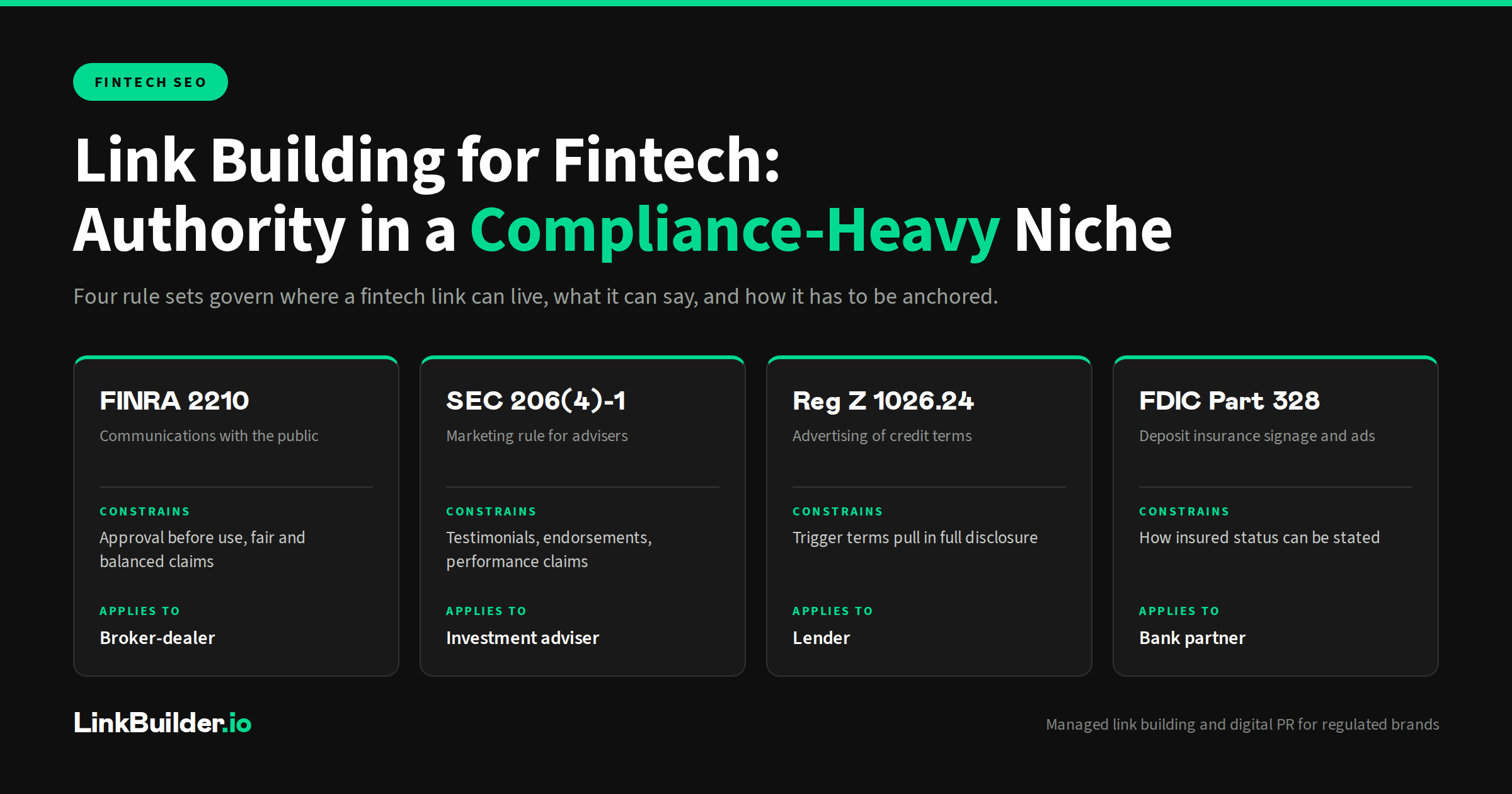
Four rule sets do most of the work in US fintech. Which ones bite depends on your charter, your licenses, and your product. Map yours before you brief an agency, because the answer determines which tactics are even available to you.
Broker-Dealer Side: FINRA Rule 2210
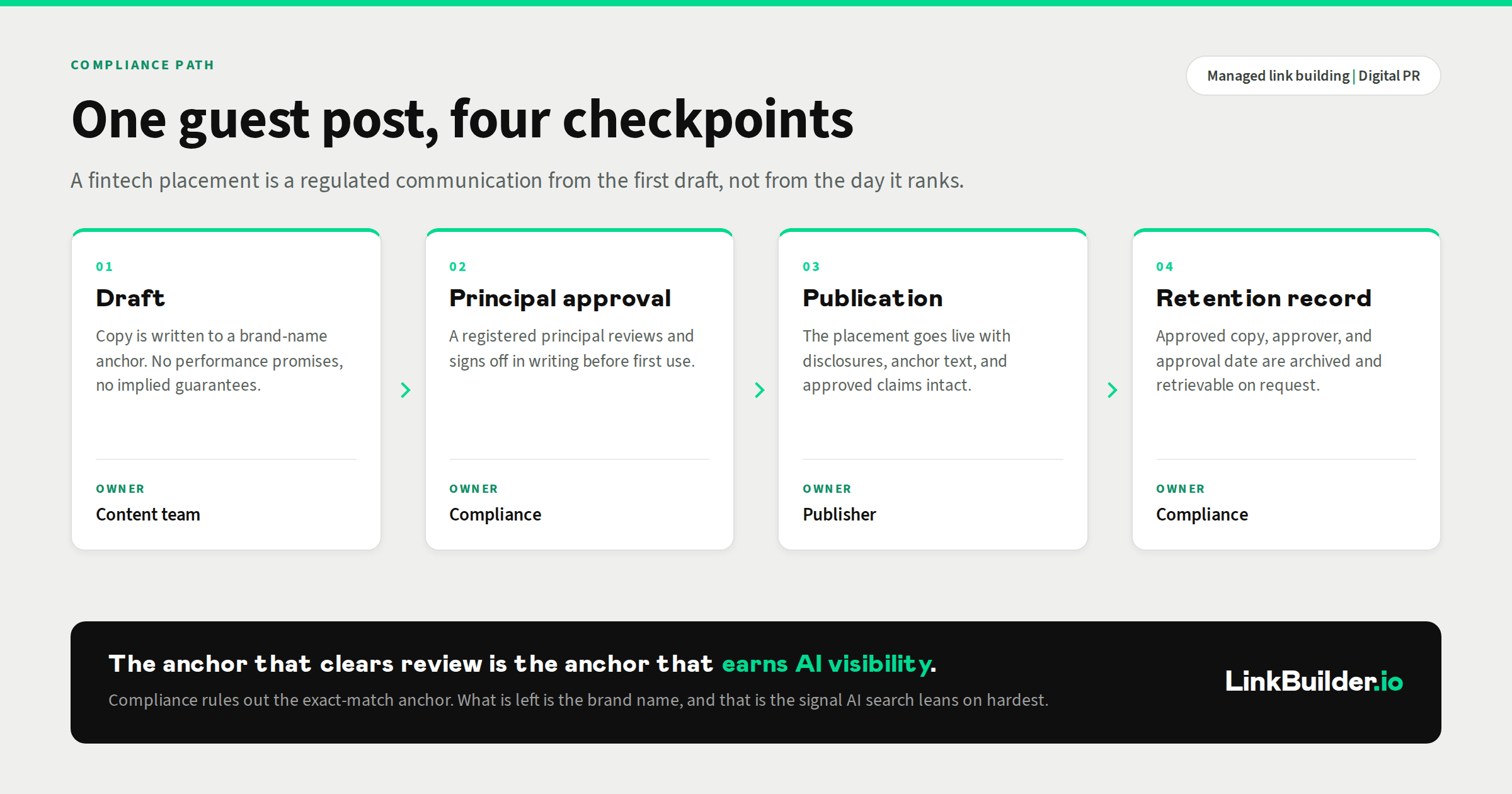
If you’re a FINRA member, Rule 2210 defines a retail communication as anything written that’s distributed or made available to more than 25 retail investors in a 30 day period. A public guest post clears that threshold the moment it publishes. Retail communications need approval from an appropriately qualified registered principal before the earlier of first use or filing.
The recordkeeping piece is the one that catches link building programs off guard. Firms have to retain the communication, the dates of first and last use, the name of the approving principal, and information concerning the source of any statistical table, chart, graph, or other illustration used in it.
Read that last clause again if your digital PR strategy runs on original data studies. The chart that earns you 40 placements is a chart you have to be able to source on demand, years later. Most link building deliverables stop at the URL. Yours can’t.
Content standards apply on top: communications must be fair and balanced, can’t be exaggerated, unwarranted, promissory, or misleading, and can’t project performance. Testimonials carry their own disclosures, including a statement that the testimonial is paid if more than $100 in value changed hands.
One thing to watch rather than plan around: FINRA has proposed replacing blanket principal pre-use approval with a risk-based supervisory framework in Regulatory Notice 26-14. It’s a proposal, not a rule. Build for the rule as written and keep an eye on the file.
Adviser Side: The SEC Marketing Rule
For SEC-registered investment advisers, the marketing rule under Rule 206(4)-1 reaches any adviser that directly or indirectly disseminates an advertisement. Indirectly is the word that matters. A placement you commissioned on a third-party site is your advertisement, even though someone else published it.
Two provisions shape link strategy more than the rest. First, an advertisement can’t include a material statement of fact the adviser doesn’t have a reasonable basis for believing it can substantiate on demand by the Commission. Second, testimonials and endorsements are permitted, but only with clear and prominent disclosure of whether the promoter is a client and whether they were compensated, plus a written agreement with the promoter unless compensation stays at or below $1,000 over twelve months.
So an affiliate arrangement, a creator partnership, or a paid review isn’t a link buy in this world. It’s a promoter relationship with paperwork attached.
Lending and Credit: Regulation Z
If you extend consumer credit, Regulation Z section 1026.24 governs your advertising. Four trigger terms pull in a full set of additional disclosures: the amount or percentage of a down payment, the number of payments or repayment period, the amount of any payment, and the amount of any finance charge.
The official interpretation goes further than most marketers expect. Those provisions apply even when the trigger term isn’t stated explicitly but can be readily determined from the ad. An ad saying 80 percent financing is available has stated a 20 percent down payment. And under 1026.24(a), you may only state terms you’re prepared to offer.
Now picture a “best personal loans” roundup listing your product with a monthly payment figure. That’s an advertisement containing a trigger term, sitting on a page you don’t control, and it stays live long after your pricing moves.
Deposit-Adjacent: FDIC Part 328
Neobanks and banking-as-a-service brands inherit a different problem. The FDIC’s guidance on Part 328 states that display of the FDIC official digital sign by non-bank third parties is generally improper, because it implies the non-bank is itself insured.
If your product runs on a partner bank, every third-party page that describes you as FDIC insured is a misrepresentation risk you didn’t create and still carry. That includes the comparison sites you spent budget getting listed on.
There’s an AEO payoff buried in all four of these. Substantiation discipline is citability. Answer engines pull from claims that are attributable, dated, and sourced, and they skip pages that assert numbers with nothing behind them. The claims register compliance makes you keep is the same artifact that makes a page worth quoting.
Three Tactics That Break Under Compliance Review
1. High-Volume Generic Guest Posting
The economics collapse once every draft needs principal approval and a retention record. Worse, Google’s spam policies name advertorials and native advertising where payment is received for articles containing links that pass ranking credit, along with optimized anchor text in guest posts. You’re paying review cost on placements that carry policy risk anyway.
Do fewer, deeper placements. One piece of expert commentary in a trade publication your regulator’s staff also reads beats twenty posts on general business blogs, and it clears review in a fraction of the time because there’s no product claim in it.
2. Product-for-Coverage Swaps
Google’s link spam examples include exchanging goods or services for links, and sending someone a product in exchange for them writing about it and including a link. A comped premium account is a service. So is a waived fee.
On the regulatory side, the same arrangement can turn a piece of coverage into a compensated testimonial or a promoter relationship, depending on which rule set applies to you. Two separate problems, one tactic.
Trade it for unpaid expert commentary. Your head of risk answering a journalist’s question costs nothing, creates no compensation to disclose, and puts a credentialed name next to your brand.
3. Uncontrolled Comparison and Roundup Placements
This is the money-term play, and it’s the one with the largest regulatory surface. Rates change. Fee structures change. The page doesn’t. A live listing showing terms you no longer offer runs straight into the available-terms requirement in 1026.24(a).
Google’s site reputation abuse policy makes the point with a finance example of its own: an educational site hosting a page of sponsored payday loan reviews written by a third party. Placements in that shape are a poor bet on both fronts. If you’re using contextual link insertions to reach comparison content, the host page and its terms need the same review your own pages get.
Don’t abandon money terms. Pursue them with a monitoring cadence attached, and put most of the program into placements that establish category authority without printing product terms at all.
The pages that survive this filter tend to be the ones answer engines like anyway. Stable, sourced, dated, and free of promotional claims that a model has no way to verify.
The Anchor Text Constraint Is an AEO Advantage
Compliance teams dislike keyword-rich anchors, and they’re right to. “Best high-yield savings account” reads as a claim, because it is one. So fintech link programs drift toward brand-name anchors and neutral descriptive phrasing by default.
Every SEO instinct says that’s a concession. The data says otherwise.
Branded anchors correlated at 0.527 with AI Overview brand visibility in the Ahrefs study, more than double the 0.218 for backlink counts. The anchor your compliance reviewer prefers is closer to the AEO-optimal anchor than the one your SEO tool suggests.
The same logic runs through disclosure. Google expects rel=”sponsored” or rel=”nofollow” wherever a commercial relationship exists. Applying it consistently keeps you out of the manipulation bucket, and the brand mention still lands in the text where language models pick it up. You lose the ranking credit on that specific link and keep the signal that correlates three times more strongly with getting cited.
Building a Program That Survives Review
The teams that ship consistently in this niche have built infrastructure, not just a target list. Six pieces do most of the work.
-
A pre-cleared asset library. Approved statistics, approved product descriptions, approved boilerplate, all versioned with an expiry date. Outreach pulls from the library instead of writing fresh copy that restarts review.
-
A claims register. Every number you use externally, with its source document, methodology, and date. This satisfies the FINRA source-of-statistics requirement and the SEC substantiation standard at the same time, and it doubles as your fact-check layer for AI-facing content.
-
Named authors with pre-approved bios. Credentials matter for E-E-A-T and for the trust signals answer engines lean on. Approve the bio block once and reuse it across placements.
-
A placement register. URL, publish date, a copy of the content as published, the approving reviewer, and a screenshot. This mirrors the retention requirements and gives you a real brand mention tracker rather than a backlink spreadsheet.
-
Disclosure defaults. Decide in advance which arrangements get sponsored attribution and which disclosure language ships with testimonials. Ambiguity is what stalls placements in review.
-
A re-verification sweep. Every quarter, check live placements for terms that have drifted, insurance language that shouldn’t be there, and pages that have changed since publication.
One more thing, and it’s the one that moves the timeline most: embed a single compliance reviewer in the program instead of routing work into a shared queue. A reviewer who understands what you’re building approves in days. A queue takes weeks and kills momentum.
What This Looks Like When It Works
We ran this playbook for a fintech client competing against American Express at DR 91, Wells Fargo at DR 89, and Chase at DR 87. Our fintech link building case study has the full breakdown, but the shape of it is worth pulling out here.
The strategy split into two tracks. One went after money terms through top-tier roundups. The other built authority through personal finance content written by industry experts, with links back to those experts’ professional profiles, which is the E-E-A-T mechanic that makes YMYL placements count for more than their DR suggests.
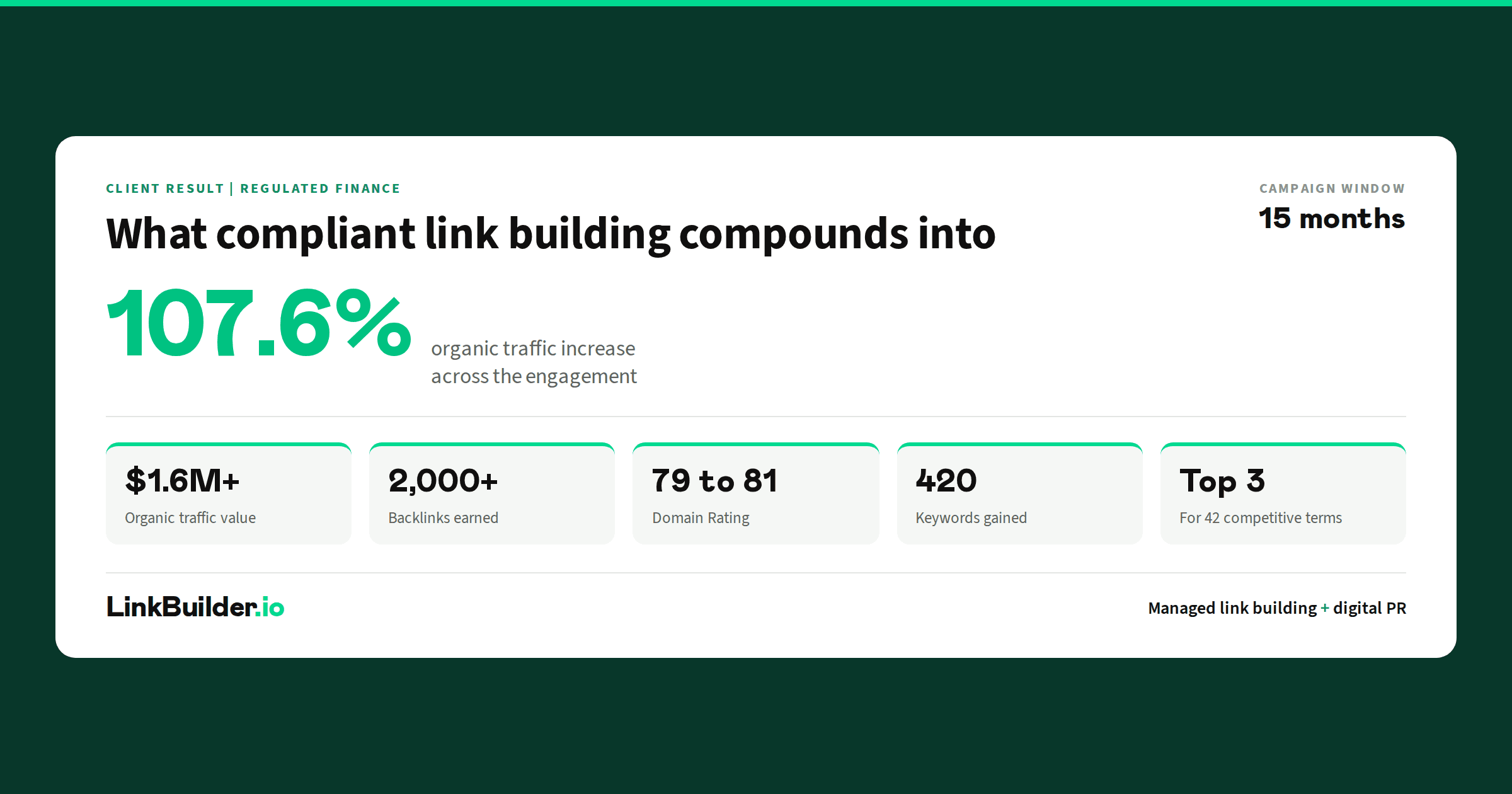
Over 15 months, site-wide traffic rose 107.6%, traffic value grew by more than $1.6 million, and we built over 2,000 high-authority backlinks. Domain Rating moved from 79 to 81. The client ranked for 420 keywords and took top-three positions for 42 highly competitive terms.
Note what carried that result. Expert authorship, profile links, and topical relevance in personal finance. Every one of those is a trust signal first and a link second, which is why the same program holds up as visibility shifts toward answer engines.
Where to Start
If you’re rebuilding a fintech link program around these constraints, sequence it like this.
-
Map your product to its regulators before anything else. Broker-dealer, adviser, lender, and bank-partner products face different rules, and a program built for the wrong one wastes review cycles.
-
Build the claims register first. It’s the dependency for everything else, and it’s the artifact that makes your content substantiable and quotable.
-
Move budget from placement volume toward named-author editorial. Fewer pieces, better bylines, publications your buyers and your examiners both recognize.
-
Shift the anchor profile toward brand. It clears review faster and it’s the stronger AI visibility signal.
-
Set the monitoring cadence before you chase comparison placements, not after one goes stale.
-
Change the reporting metric. Referring domains alone won’t tell you whether you’re gaining ground in AI answers. Track branded mentions and citation presence alongside the link count.
The Constraint Is the Moat
Compliance overhead is why fintech link building is slow. It’s also why it defends so well. Your competitors face the same review cycles, the same retention requirements, and the same narrow set of tactics that clear both Google’s policies and their own general counsel. Nobody is buying their way past this.
Which means the fintech brands that build the infrastructure to move faster inside the constraints compound an advantage that a bigger budget can’t copy quickly.
We build links in regulated categories for a living, and we’d rather work inside your review process than around it. Take a look at how our managed link building service works, or check pricing if you’re scoping a program.
Erika
Head of Link Operations